
Fort Greene Brownstones Are Some of the Best in Brooklyn – the Roofs Should Be Too
Stop waiting for it to seal itself. Many of the most beautiful brownstones on blocks like South Oxford Street or Adelphi Street present flawlessly from the sidewalk – restored cornices, fresh pointed brick, well-kept stoops – while their roofs quietly fail at drains, seams, and flashing transitions that nobody checks until a ceiling stain appears. This article is for the owner who wants to know what’s actually happening up there before the next storm makes the decision for them.
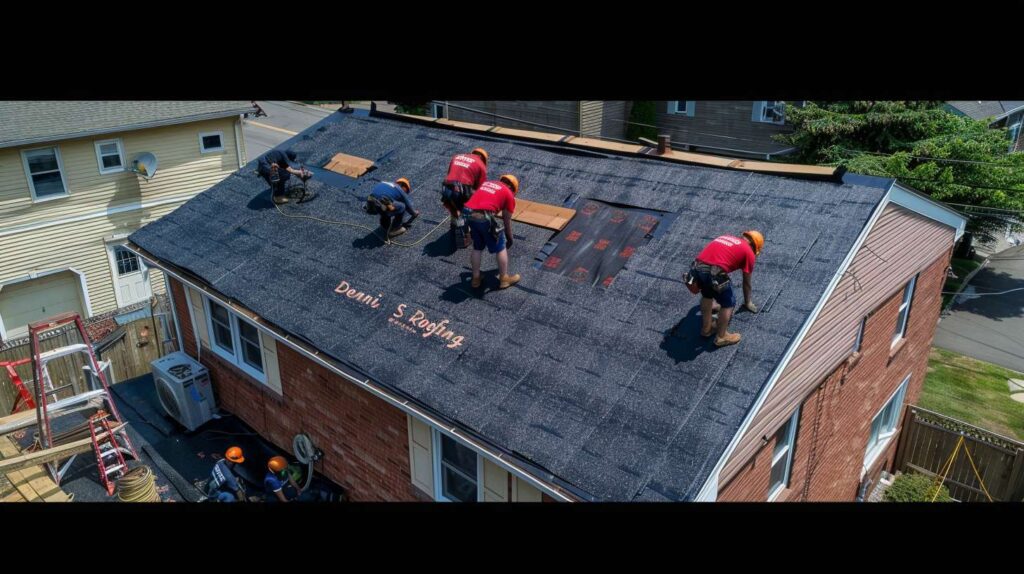
What Fort Greene Brownstone Roofs Hide in Plain Sight
Many beautiful Fort Greene brownstones hold up their end of the bargain at street level. The façade is convincing. The ironwork is crisp. But a convincing façade and a structure that actually survives the next storm are two different things entirely – and on a brownstone, the roof is where that difference gets settled. From the sidewalk, the building looks like it’s handling itself just fine. From the roof, you sometimes find a different story written in patched membrane, clogged drains, and flashing details that haven’t been touched since the Clinton administration.
Here’s the blunt version: brownstone charm does not waterproof a building. Most Fort Greene rowhouses carry flat or low-slope roof assemblies, and those come with parapets, bulkheads, skylights, rear additions, and old flashing transitions – each one a potential leak path that has nothing to do with how good the cornice looks. The membrane may be aged, the parapet cap may be cracked, the scupper may be blocked, and none of it will announce itself until water is already inside.
| Myth (Street-View Assumption) | Fact (Roof-Level Reality) |
|---|---|
| A neat cornice means the roof is fine. | Hidden membrane failures can exist well above a pristine façade. The cornice and the roof assembly are independent systems. |
| A leak near a skylight always means the skylight is bad. | Surrounding flashing, open seams, or ponding water nearby are more often responsible. Skylight repair alone may not stop the leak. |
| Flat roofing always needs full replacement. | Targeted roof repair can resolve many issues if the field membrane still has flexibility and the damage is localized. |
| New masonry work fixes the roof waterproofing. | Roof sealing and flashing transitions still need proper detailing. Repointed brick and a failed cap flashing can coexist without contradiction. |
| Small ceiling stains can wait until it gets worse. | Repeated moisture spreads into roof decking, insulation, and plaster faster than most owners expect. Small stains compound. |
Start With Water Behavior, Not Guesswork
How a Roof Inspection Separates Repairs From Panic
On a Fort Greene roof, the first thing I look at is the drain – not the skyline. Water has to go somewhere, and how it gets there (or doesn’t) explains most of what I’m going to find. I’m tracking flow paths, low spots, anywhere water slows or pools before it exits. Old parapets trap debris; patched scuppers restrict drainage; bulkheads create shadow zones where water sits. I’m Brett Callahan, and after 17 years diagnosing old flat roofing systems on Brooklyn brownstones, I can tell a lot about a roof’s problems before I’ve even touched the membrane – just by watching where the water hesitates.
I was on a Fort Greene block just after 7 a.m. on a gray Tuesday when an owner told me, “It only leaks when the rain blows sideways.” We went up to the flat roof together, and the problem wasn’t the field membrane at all. It was chimney flashing repair somebody had smeared over with mastic three winters in a row – layer on layer, none of it properly seated. The roof looked fine from the hatch, like a movie façade, but two steps closer and you could see every shortcut. That’s why roof leak detection has to happen before anyone recommends anything. The leak point and the stain location are often not in the same zip code.
A proper roof inspection on a Fort Greene brownstone covers more ground than most owners expect. Membrane seams, drain flow and low-spot mapping, chimney flashing integrity, skylight installation and skylight repair details, gutter installation and gutter repair where applicable, and any signs of trapped moisture in the assembly below. These buildings have been modified over decades – rear additions, replaced skylights, patchwork drainage fixes – and the roof reflects that history in ways that take local knowledge to read correctly. Three feet from the parapet is where the story usually changes.
-
1
Interior Leak Mapping – Identify and photograph every stain, bubble, or efflorescence inside the top floor to establish where water has traveled.
-
2
Rooftop Moisture-Path Review – Walk the entire roof surface to trace how water moves, pools, and exits (or doesn’t).
-
3
Drain and Low-Spot Assessment – Check drain openings, scuppers, and any low areas where ponding occurs, including around bulkheads and rear parapet corners.
-
4
Membrane and Seam Inspection – Probe seams, laps, and field areas for brittleness, open joints, blistering, or moisture intrusion below the surface.
-
5
Flashing and Penetration Review – Inspect all chimney flashing, skylight curbs and surrounds, vent pipe boots, and parapet cap flashings for separation or failure.
-
6
Repair-vs-Replacement Recommendation – Deliver a clear written finding with photo evidence, scope options, and an honest assessment of what’s worth fixing versus what needs replacing.
| Inspection Finding | What It Usually Means | Likely Service |
|---|---|---|
| Isolated flashing failure at chimney or parapet | Membrane field is likely intact; failure is at a transition point | Chimney flashing repair or localized roof repair |
| Ponding water around drain or low spot | Drainage restriction or settled substrate creating a low point | Drain correction plus flat roof repair |
| Multiple open seams across aging membrane | Membrane nearing end of life but may not be saturated | Broader roof repair or roof coating depending on condition |
| Saturated insulation across large roof areas | System-wide water infiltration; assembly is compromised | Roof replacement / new roof estimate |
| Recurring leaks at skylight after prior repairs | Flashing detail around curb was never addressed correctly | Skylight repair or replacement plus surrounding membrane work |
| Storm-related puncture or lifted edge flashing | Mechanical damage from wind or debris requiring immediate action | Emergency roof repair and storm damage repair documentation |
Choose the Scope That Matches the Damage
When Repair Is Smarter
One August afternoon, heat bouncing off the parapets hard enough to make the air shimmer, I met a couple who had just purchased a Fort Greene brownstone and were bracing for full roof replacement. What they actually had was a drain issue, some failed seams, and one ugly section around a skylight repair that had been handled by someone who clearly hated measuring tape. I told them, “You don’t tear down the whole set because one wall wobbles,” and they laughed before we got into the real plan. And here’s my honest take: pushing a new roof when a targeted repair will do is bad advice – but pretending a genuinely failing system can be patched forever is just as bad. Both directions cost the owner money they didn’t need to spend.
When Replacement Is Justified
For residential and light commercial roofing on Fort Greene brownstones, the system choice matters as much as the scope. Flat roof installation using EPDM roofing or TPO roofing handles ponding well and seams reliably when installed correctly. Modified bitumen roofing is a common existing system on older buildings and repairs cleanly if the base layer isn’t degraded. Tar and gravel roofs have real limits on restoration – they can be coated or partially repaired, but once the gravel is gone and the felt is exposed, the math usually favors replacement. Asphalt shingle roofing shows up on pitched rear sections and additions and behaves differently than the flat field. Metal roofing is appearing more on select details and modern additions. And here’s the insider truth most owners don’t hear enough: the field membrane is rarely where the storm gets in. It’s the transitions – at skylights, chimneys, parapets, and edges – that decide whether the next rain event stays outside or becomes a ceiling problem.
| System | Pros | Cons |
|---|---|---|
| EPDM Roofing | Long lifespan, flexible in cold temps, seams repair cleanly, widely available | Dark color absorbs heat; seam adhesive can fail if not properly primed; tears at edges under foot traffic |
| TPO Roofing | Reflective white surface reduces heat load; heat-welded seams are strong; good energy performance | Seam quality depends on installer skill; older formulations had durability issues; less flexibility than EPDM in cold |
| Modified Bitumen Roofing | Common on existing brownstones; repairs integrate well; strong tear resistance; layered systems add redundancy | Torch-applied installation carries fire risk; aging base sheets can lose adhesion; not ideal over saturated insulation |
| Tar and Gravel Roof | Durable when intact; gravel provides UV protection and ballast; familiar system for older buildings | Heavy; restoration options are limited once gravel erodes; repairs are messy; adds load to old decking |
| Asphalt Shingle Roofing | Cost-effective for pitched rear sections; easy to match repairs; good range of lifespans by grade | Not appropriate for flat or low-slope sections; wind uplift at edges on exposed Brooklyn rooftops; granule loss accelerates with age |
Respond Fast When the Leak Turns Active
“If I’m standing with a homeowner at the hatch, I usually ask, ‘Where does the water hesitate?'” During a November emergency roof repair call, right around dinner time, I climbed up in a light sleet while the owner kept apologizing because guests were arriving in an hour. The house was gorgeous inside – candlelit, immaculate – and meanwhile the roof was acting like the backstage area nobody wanted to inspect. The leak that had stained the top-floor ceiling wasn’t dramatic at all. It came from ponding water sitting on a tired low spot in an old flat roofing section, then slipping past a seam near the bulkhead. That job is a good reminder of how emergency roof repair works in practice: you stop the active water first, protect the interior, document the source, and then plan the real fix. Temporary roof waterproofing buys time; it doesn’t replace roof leak detection and a proper repair sequence. And honestly, calling it in sooner almost always means a smaller bill.
- Repeated mastic smears seal the surface but don’t address the water path below – they just postpone the next leak.
- Covering a wet area without drying or diagnosing it traps moisture in the assembly and accelerates deck deterioration.
- The stain on your ceiling is rarely directly below the actual leak source. Water travels on decking, insulation, and framing before it finds a way in. Assuming otherwise makes proper roof leak detection harder later.
Use This Fort Greene Roofing Decision Map Before You Book
Ask yourself one ugly, useful question: does your roof have one failure, or a whole cast of them?
A patched flat roof can lie to you better than a cracked windshield. It looks sealed, it holds for a few weeks, and then a different section opens up. The right next step isn’t panic – it’s pattern recognition. One identifiable leak source with an otherwise sound membrane probably means a targeted repair. Repeated issues showing up in multiple details – flashing, seams, drains, bulkhead transitions – that’s a different conversation, and it usually points toward a larger scope or full system work. Don’t let the first patch dictate the whole plan.
Start with a roof inspection, not a quote. If the damage is isolated, the membrane is still flexible, and the insulation below isn’t saturated, repair usually wins. If you’ve got recurring leaks in multiple locations and layers of prior patches, replacement is probably the more honest path.
Depends on the building. EPDM roofing and TPO roofing are strong options for new flat roof installation; TPO’s reflective surface helps with heat. Modified bitumen roofing is a common existing system that repairs well. The right choice also depends on drain configuration, foot traffic, and parapet geometry – that’s a conversation, not a one-size answer.
Yes – and that’s most of the work on these blocks. Matching into an existing modified bitumen or EPDM field, correcting a drain detail, or re-flashing a chimney transition doesn’t require touching the whole roof. The key is diagnosing correctly so the repair is in the right place, not just the obvious one.
We do. On a brownstone, these details interact – a failed gutter overflows onto a parapet, a loose skylight curb affects the membrane below it, and chimney flashing repair done without addressing the surrounding membrane doesn’t hold. Coordinating the whole scope in one visit avoids the situation where separate contractors undo each other’s work.
Date-stamped photos of the damage, interior staining, and any lifted or displaced materials. A written scope from a licensed roofing contractor that separates pre-existing wear from storm-related damage. Don’t make emergency repairs before documenting – adjusters need to see the original condition. We can walk through this with you on the first visit.
- Licensed and insured – not negotiable in New York City; always ask for documentation
- Documented inspection findings with photos – every finding should be visible and explained in writing before any work is scoped
- Experience with both residential roofing and commercial roofing – Fort Greene has mixed-use buildings and multi-family brownstones that need both
- Ability to perform emergency roof repair – same-day or next-day response when water is actively entering the building
- Knowledge of flat roof installation and brownstone-specific detailing – parapets, bulkheads, and multi-decade patchwork require local experience, not just general roofing knowledge
- Clear written scope – repair versus replacement should be spelled out, with reasoning, before you sign anything
Your brownstone deserves a roof that performs as well as it looks from the street. Call Dennis Roofing for a Fort Greene roof inspection, a repair plan, or an emergency response – before a good-looking roof becomes a very expensive stage set with a backstage nobody wanted to see.