
Farragut Houses Is a Major Residential Complex – Roofing Here Needs Real Expertise
Why Farragut Houses Roofing Problems Spread Faster Than Residents Expect
I’ll save you three hours of searching. Roofing at a major residential complex like Farragut Houses isn’t mainly about which membrane you pick or whether you’ve got shingles or a flat roof – it’s about understanding how one small failure in a shared building system sends water, stress, and damage farther than anyone living three floors down would ever expect.
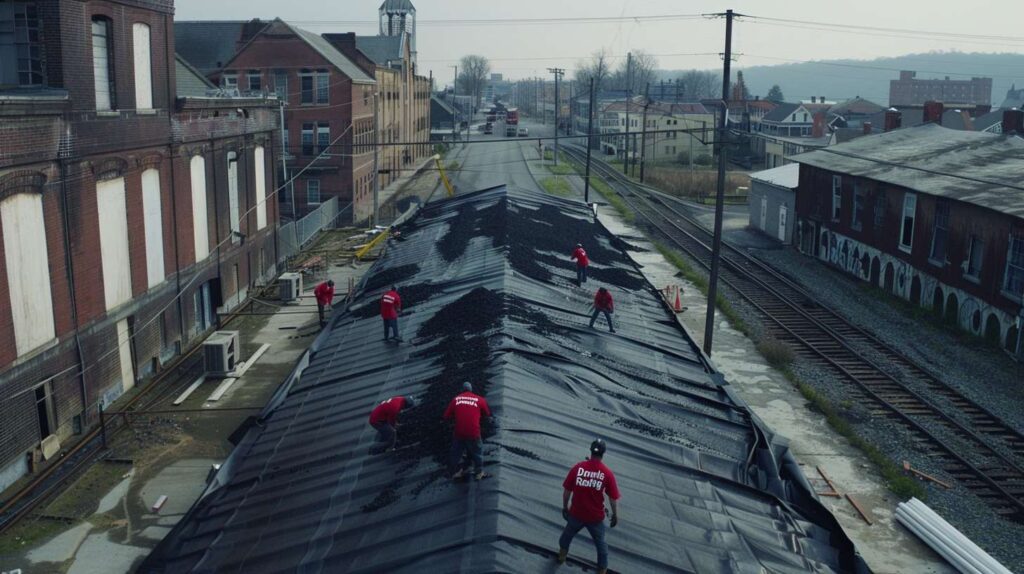
At 7:00 a.m., a flat roof tells the truth better than it does at noon. Standing water catches the flat light, seam stress shows up in shadows, and you can trace where moisture traveled overnight before the sun starts drying the evidence. That’s when the failure chain becomes readable – one leak stain in a top-floor unit can trace back through deteriorated flashing, blocked drains, failing seams, or compromised edge details in a section of roof nobody pointed at. Here’s the part people usually don’t want to hear: residential roofing logic and commercial roofing logic overlap heavily in a building this size, because large residential complexes behave like complex flat-roof systems even when some sections carry a shingle roof or metal roof component. Derek Faulkner, Dennis Roofing’s Safety & Compliance Officer with 17 years of roofing experience, built his diagnostic approach specifically around tracing those system failures rather than chasing cosmetic symptoms – because at a place like Farragut Houses, patching the symptom without reading the chain just buys the next contractor a harder problem.
Farragut Houses spans multiple large residential towers across a substantial footprint. That scale means roofing details repeat across sections – and one flawed detail copied across a building creates compounding exposure, not isolated risk.
Drainage systems on large residential complexes are shared infrastructure. A blocked or slow drain doesn’t just affect one section – it backs up water across the entire plane, stressing seams and perimeter details far from the original blockage point.
Water doesn’t fall straight down through a multi-story building. It follows structure, insulation paths, and pipe chases – often appearing two or three units away from the actual roof breach. Assuming a stain is directly below the source is one of the most expensive mistakes made in complex buildings.
By midday, sun dries surface moisture and evaporates the visual evidence of overnight water movement. Early morning inspections – especially after rain – catch ponding patterns, active seep points, and drainage failures that disappear once the roof dries out.
| Myth | Real Answer |
|---|---|
| “A ceiling stain starts directly above the stain.” | Water travels along roof decks, insulation layers, and structural members before dropping. In multi-story residential buildings, the entry point can be six to twenty feet – or multiple floors – away from where the stain appears. |
| “Emergency sealant solves most leaks.” | Sealant applied over an active breach can trap moisture inside the roof assembly, accelerating insulation saturation and substrate rot. It also masks the water path, making the next inspection significantly harder to read accurately. |
| “Flat roofs only fail at ponding spots.” | Ponding is a symptom, not the only failure mode. Flat and low-slope roofs also fail at perimeter edge details, penetration flashings, seam terminations, and areas with mechanical foot traffic – all of which can be dry-looking during ponding inspections. |
| “If one corner has wind damage, the rest is fine.” | Wind events stress the entire membrane system, not just the obvious breach. Uplift pressure travels across seams and edge metal. Checking only the visible damage point after a storm routinely misses the secondary failures that become the next leak. |
| “Residential roofing rules are enough for every building here.” | Buildings at this scale operate with commercial-style roof systems, shared drainage infrastructure, and multiple roof zones. Standard residential roofing approaches don’t account for the system-level dependencies that define how water moves, where membranes fail, and how maintenance decisions affect multiple units at once. |
Follow the Failure Chain Before You Choose Roof Repair or Roof Replacement
What a real roof inspection should trace
I’ve stood in that exact kind of hallway before, looking at a stain nobody could explain. Just after 6:15 in the morning on a Farragut-adjacent building, gray winter light, a resident walking me to a top-floor unit where the ceiling stain had come back even after another contractor patched it. What I found wasn’t dramatic – bad flashing logic around a rooftop penetration, and water that had traveled far enough that the apartment below the actual entry point looked dry. That job reinforced something I tell every property manager: roof leak detection isn’t about finding where the water drips. It’s about tracing the pathway – through the chimney flashing repair zone, past a failed skylight repair, through edge metal, across the deck – until you find where the chain starts. Treating the symptom without reading the route means you’re already setting up the next call.
If I were asking the first question on this building, it’d be this: is the moisture tied to one isolated breach, or is it moving through seams, penetrations, drains, and perimeter details across multiple sections? That distinction matters enormously at Farragut Houses. The complex’s large footprint means roof details repeat – the same flashing profile, the same drain configuration, the same parapet cap detail – across multiple sections. One failed detail that gets copied across a building doesn’t produce one leak; it produces a pattern. And in a dense residential setting like this, where a single roof section sits above multiple occupied units, a bad detail allowed to run affects families, not just square footage. Roof leak repair on a building this size has to account for building behavior, not just roof behavior.
Bluntly, a big residential complex makes small roofing mistakes expensive. Repeated emergency roof repair without documentation is, in my experience, a budget trap – not a maintenance strategy. You pay the emergency rate, the patch holds for a season, then the same zone fails again because nobody traced what was actually driving the water. At some point, a new roof, full roof replacement, or at minimum targeted roof installation over a problem section becomes the rational financial decision. That’s especially true for aging flat roofing systems – whether you’re dealing with modified bitumen roofing, EPDM roofing, TPO roofing, or tar and gravel roof assemblies – where repeated patching on a substrate that has already accepted moisture is compounding the damage every winter.
If you only inspect the stain, you’re already one step behind the leak.
When a new roof is smarter than repeated patching
- Yes: Proceed with targeted storm damage repair or wind damage repair. Document and inspect adjacent seams before closing.
- No – damage spreads across sections: Request a full-perimeter inspection. You’re likely looking at commercial roof repair scope, not a single patch.
- Yes: The repair didn’t address the cause chain. Inspect penetrations, flashing, and drains upstream of the stain.
- Multiple units reporting moisture: System-level failure is likely. Full roof inspection across all zones required immediately.
- Yes + aging system: Assess whether flat roof installation replacement is overdue. Repeated seam failures on an aged membrane don’t respond well to ongoing patching.
| What We Find | Likely Cause Chain | Urgency Level | Typical Service Response |
|---|---|---|---|
| Open seam | Membrane movement from thermal cycling or adhesion failure. Water enters the seam and travels under the field membrane before surfacing inside. | High | Seam heat-weld or adhesive repair; full seam walk to identify additional stress points. |
| Loose edge metal | Fastener pull-out or improper lap, allowing wind-driven rain to enter at the perimeter. Often found adjacent to wind damage zones. | High | Perimeter metal re-fastening and re-sealing; check for membrane uplift in adjacent field. |
| Flashing split | Age brittleness or differential movement at a penetration or parapet wall. Water enters the split and tracks along the deck – often surfacing far from the split location. | Urgent | Chimney flashing repair or full penetration flashing replacement; map water travel path before closing. |
| Recurring ponding | Drain blockage, roof deflection, or inadequate slope. Persistent ponding accelerates membrane degradation and stresses seams below the water line. | Medium | Drain clearing, slope correction, or tapered insulation install; assess membrane condition under the pond zone. |
| Blistered membrane | Trapped moisture or air between membrane layers, often from improper installation or moisture in the substrate at time of install. Not always an active leak, but a sign the system is compromised. | Medium | Cut, dry, and patch blisters; core test insulation below for saturation. May indicate section replacement need. |
| Interior stain, no obvious rooftop opening | Water traveling laterally from a distant breach – common in large residential buildings with shared decks. Also check HVAC curbs, scuppers, and through-wall flashings. | Urgent | Full roof leak detection sweep; do not patch interior until the entry point and path are confirmed. |
Which Roofing Systems Show Up Here and What Usually Fails First
A roof is a lot like overhead rigging – the visible part isn’t the whole risk. Farragut-area buildings can involve flat roof sections covering the main building mass, asphalt shingle roofing on smaller adjoining or setback structures, metal roofing on mechanical enclosures or select architectural components, and low-slope membranes where roof waterproofing details – seams, terminations, and edge conditions – matter far more than surface appearance. Roof sealing, roof coating, and ongoing roof maintenance can extend the life of these systems meaningfully, but only when the substrate beneath is sound and the detailing is actually correct. Coating over a failing seam or a saturated insulation board is like taping a cracked rigging connection: it looks resolved until it isn’t.
First failure points: Ridge cap lifting, step flashing separation at dormer or parapet junctions, valley flashing corrosion, and cracked boot seals around pipe penetrations.
Typical repair path: Spot shingle replacement for isolated tabs; reflashing at penetrations; full section or roof replacement for widespread aging.
Coating or sealing appropriate? Rarely. Shingle systems aren’t designed for surface coatings. Address the shingle and flashing conditions directly.
First failure points: Panel seam separations, fastener backing out or corroding through the panel, flashing at wall transitions, and expansion/contraction stress cracking at penetrations.
Typical repair path: Fastener replacement and sealing; panel overlap repair; full section replacement if rust or panel deformation is advanced.
Coating or sealing appropriate? Yes – elastomeric roof coating is commonly used on metal roofing to extend service life and address minor fastener corrosion, provided the substrate is structurally sound.
First failure points: Lap seam adhesion failure, shrinkage at perimeter flashings, punctures from foot traffic, and flashing separation at penetration curbs.
Typical repair path: Lap seam reactivation or cover tape; penetration flashing replacement; full re-cover or tear-off on systems with widespread seam or shrinkage issues.
Coating or sealing appropriate? EPDM-compatible liquid coatings can be used for UV protection on sound membranes, but they won’t seal open laps or bridging failures.
First failure points: Heat-welded seam delamination (particularly on older or improperly installed systems), flashing weld separation, and membrane cracking from excessive UV exposure on thin membranes.
Typical repair path: Seam re-weld with proper heat gun; flashing replacement; assess membrane thickness before deciding between repair and flat roof installation replacement.
Coating or sealing appropriate? Compatible coatings exist but require proper surface prep and adhesion testing. Not a substitute for structural seam repair.
First failure points: Blister formation, gravel displacement exposing felt, flashing at walls and curbs, and lap separations – particularly at drains and scuppers.
Typical repair path: Torch-down modified bitumen patches on compatible surfaces; reflashing at perimeter; full tear-off on systems with widespread saturation or multi-ply failure.
Coating or sealing appropriate? Reflective coatings can be applied over sound modified bitumen, but gravel removal and surface prep are required. Don’t coat over active blisters or wet sections.
Storm Calls, Emergency Work, and the Mistakes That Make the Next Leak Harder to Find
What counts as urgent right now
At 3:40 on a storm call, the roof usually tells a different story than the super does. One August afternoon I walked a building near the Farragut Houses footprint where the superintendent was confident the wind damage was isolated to one corner of the flat roof. By the time I’d completed the field walk, I’d documented membrane stress at multiple seams across two sections, loose edge metal that had already allowed water ingress, and drainage issues that had turned what looked like a manageable storm damage repair into a building-wide maintenance warning. That job is what I think about when someone calls in a post-storm situation and says “it’s just one corner.” Wind damage repair and commercial roofing work done right means walking the full field – not just the obvious tear. The pattern matters more than the puncture, because the pattern tells you what happens next time a storm comes through. And for an insurance claim roofing situation, documentation of the full scope is the difference between a covered claim and a dispute.
Temporary fixes can distort the evidence. I remember a rainy Tuesday when I had to explain to a frustrated property manager why a cheap emergency roof repair from the prior month had made the current leak harder to trace. Someone had sealed over the symptom – applied product over the visible wet zone – without documenting what was beneath it or where they suspected the water was entering. Now the roof was telling us a false story, because the sealant had redirected moisture movement without stopping it, and we were chasing a trail that had been partially buried under somebody’s quick fix. Here’s the insider detail that matters: always photograph temporary repairs before closing them up – log the exact date, the materials used, and your best guess at the suspected water path. If you seal over a symptom without that record, the next contractor is starting blind, and the building’s maintenance history becomes unreliable. In a place like Farragut Houses, where roof decisions can affect dozens of occupied units, that documentation isn’t paperwork – it’s how you protect residents and the building budget at the same time.
What Dennis Roofing Should Be Able to Show You Before Work Starts
What would you need to see before you trusted someone on this roof? That’s actually the right question to start with. I’m Derek Faulkner – I’ve spent 17 years doing exactly this kind of system-level roofing work in Brooklyn, and the standard I hold for any contractor on a building like Farragut Houses starts with scope clarity before anyone picks up a tool. That means a documented inspection with photos showing the actual findings – not just the stain, but the failure chain upstream of it. It means a written explanation of why repair or replacement makes sense for this roof and this budget, not a one-size recommendation. And it means coordination across all the related details: gutter installation and gutter repair, skylight installation and skylight repair, roof cleaning, and maintenance items that feed into the same leak pathway. Dennis Roofing approaches large residential roofing this way because, and not gonna lie, it’s the only approach that actually holds up over time in a building where one unaddressed detail keeps multiplying.
It depends on whether you’re dealing with isolated damage or a pattern. A single breach from a documented event – missing flashing, a puncture, a storm hit – often warrants targeted roof repair. Repeated leaks in the same zone, widespread membrane deterioration, or a system past its service life points toward roof replacement. The key is a real inspection that traces cause, not just symptoms. Don’t let anyone recommend replacement without documentation, and don’t let anyone recommend repair on a system that’s been patched three times in two years.
Yes – and on a complex like Farragut Houses, that’s not unusual. Many large residential buildings carry both flat roofing sections over the main mass and sloped shingle or metal components on adjoining structures. Managing both in one inspection and one scope avoids the gaps that happen when different contractors handle each system separately and nobody looks at how they connect. That connection zone – where a flat roof meets a sloped section or a wall – is often where the failure chain starts.
Date-stamped photos of all visible damage – rooftop and interior – taken before any temporary work begins. A written scope identifying the storm event, the affected zones, and what condition the roof was in prior to the event (existing maintenance records help here). Material documentation for any temporary repairs made. And a contractor’s assessment tying the damage to the specific event rather than pre-existing wear. Missing any of these gives the insurance adjuster room to reduce or dispute the claim.
Absolutely – and this gets missed more than people realize. A blocked or damaged gutter can drive water back up under edge metal or siding, creating interior stains that look like a roof membrane failure. A skylight with failing curb flashing routes water directly into the building at a predictable path. Gutter installation, gutter repair, skylight installation, and skylight repair all connect into the same drainage and waterproofing system. Inspecting the roof alone without checking how water moves off and around it leaves part of the failure chain unread.
Roofing at a place like Farragut Houses rewards contractors who read the full building system – not just the spot that’s visibly wet. Call Dennis Roofing for a roof inspection that follows the failure chain from the first finding to the actual source, and gets you a clear answer on whether roof repair, roof replacement, or emergency work is the right next step.