
Roofing Experts in Columbia Street Waterfront
Last February, a nor’easter rolled in off the East River with 45-mile-per-hour gusts pushing rain sideways across Columbia Street. I spent the next three days responding to emergency roof repair calls-most from buildings within four blocks of the piers. What I saw told two very different stories. On a converted warehouse off Van Brunt, water poured through the ceiling because fifteen years of patch jobs had finally given up. The owner showed me receipts for six “repairs” since 2018, each one chasing the leak to a new spot, never addressing the real problem: the entire EPDM membrane had been compromised by wind uplift, and the seams were opening every time we got cross-harbor winds. Three blocks away, another flat roof I’d installed in 2019-fully adhered TPO with reinforced perimeter-stayed bone dry. Same storm, same salt air, completely different outcome. That difference comes down to understanding how waterfront roofs actually fail and building systems that account for the specific stresses this neighborhood puts on every roof.
Why Columbia Street Waterfront Roofs Fail Faster
If you own property within sight of the piers, your roof is working harder than roofs ten blocks inland. The salt-laden air accelerates deterioration on every roofing material-metal roofs show rust at fasteners and seams, asphalt shingle roofing loses granules faster, and rubber roof membranes become brittle and crack years earlier than the manufacturer’s warranty suggests. But the real killer is wind. Cross-harbor gusts hit the buildings along Columbia Street and Ferris, lift the edges of poorly secured membranes, work under flashing, and turn small defects into major roof leak situations during every significant storm.
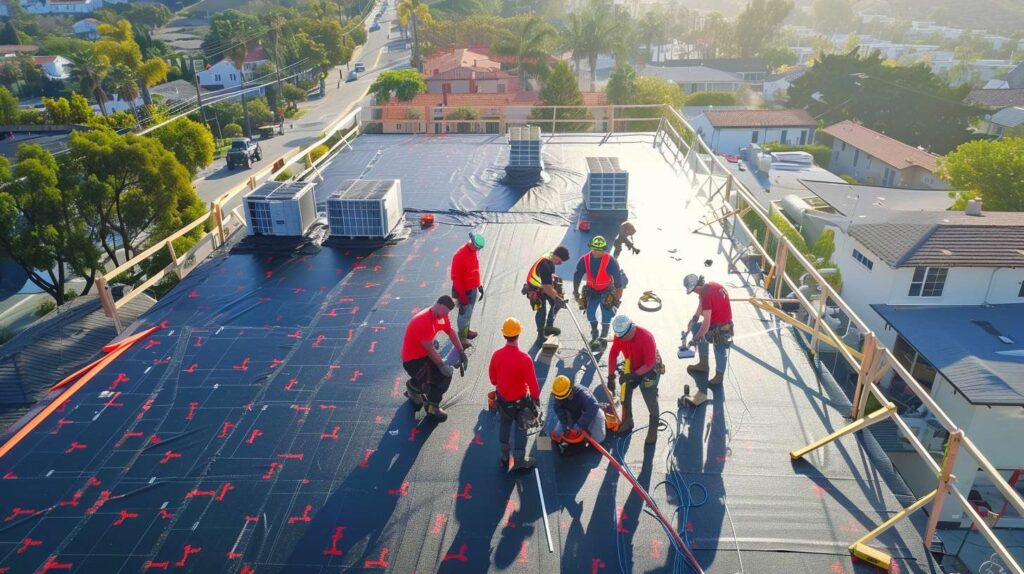
I pulled a modified bitumen roof off a three-story rowhouse near Degraw last spring-the membrane looked fine from the ground, but when we stripped it back, half the adhered sections had delaminated. Wind had been pushing under the edges for years, creating pockets where water pooled, froze, and slowly destroyed the deck underneath. The owner thought he needed simple roof leak repair. What he actually needed was full roof replacement with attention to edge details and proper attachment-mechanically fastened base sheet, fully torched cap, and custom fabricated metal edge that extends four inches past the wall line to shed water away from the parapet.
The buildings that survive longest here share common characteristics: proper roof waterproofing at every transition, robust flashing at all penetrations, and attachment methods designed for high-wind zones. A standard torch-down job adequate for Flatbush won’t hold up facing the harbor. You need either fully adhered systems with reinforced perimeters or mechanically fastened membranes with plates spaced close enough to resist uplift-typically 12 inches on center within four feet of edges and corners, versus the 18-24 inches you might use inland.
Roof Repair vs. Roof Replacement: Making the Right Call
Most calls I get start with “Marco, I’ve got a leak-can you patch it?” and the honest answer is: maybe, but probably not for long. Roof repair makes sense in specific scenarios. If your roof is under eight years old, the leak is localized to a single penetration or flashing detail, and the surrounding membrane shows no signs of general deterioration, a targeted repair-done right-can buy you another 5-8 years. I did exactly that on a townhouse off President Street last fall: the skylight flashing had separated at one corner, water was tracking down the interior wall, but the TPO field membrane was in excellent condition. We cut back the old flashing, installed new custom-fabricated aluminum with an EPDM boot, sealed it with compatible membrane adhesive, and that roof is solid.
But if you’re chasing leaks, if “the roofer was just here six months ago,” if you’re seeing multiple wet spots after every rain, or if your flat roof is over fifteen years old, roof replacement is almost always the more cost-effective choice. Here’s the math: a proper repair on a compromised membrane runs $1,200-$2,800 depending on access and scope. If that repair fails in two years and you do it again, you’ve spent $2,400-$5,600 plus the cost of interior damage from ongoing leaks. A complete flat roof installation on a typical Columbia Street Waterfront rowhouse-1,200-1,800 square feet-runs $14,000-$24,000 depending on system, access, and deck condition. Spread over 20-25 years, that’s $560-$1,200 per year. The patching approach often costs more when you factor in repeated emergency calls, tenant disruption, and damage to ceilings, walls, and belongings.
What a Real Roof Inspection Should Cover
Every roof inspection I do in this district follows the same pattern: I’m looking at three things simultaneously-current condition, failure mechanisms specific to waterfront exposure, and realistic service life given the building’s use and owner’s budget. I start at the lowest corner and work systematically across the roof, photographing every transition, penetration, and area of concern. On flat roofs, I’m checking membrane attachment by lifting edges where possible, looking for bubbles or delamination in the field, examining every seam for separation, and testing drainage by watching where water flows during the next rain.
For roof leak detection, I use a combination of visual inspection, moisture meter readings on the deck (accessed from below when possible), and infrared scanning on larger commercial buildings. Salt air and wind create predictable failure points: chimney flashing on rowhouses almost always fails at the back corner where water sheets down from upslope; skylight perimeters leak where the curb meets the membrane because thermal expansion constantly works the seal; and parapet walls leak where the cap stone overhangs the flashing because wind-driven rain pushes up and under.
A proper inspection report gives you specific recommendations in priority order. “Your EPDM membrane is twelve years old with significant weathering but no active leaks-budget for roof replacement in 3-5 years and plan annual roof maintenance to extend its life” is a useful answer. “You need a new roof” without explanation or timeline is not. I write reports that help owners plan capital improvements, coordinate with co-op boards, and present clear documentation to insurance companies when storm damage occurs.
Flat Roofing Systems That Work in Waterfront Conditions
Most Columbia Street Waterfront buildings have flat roofs or very low slopes-that’s the nature of the neighborhood’s industrial past and modern rowhouse construction. You have five main system choices, each with specific advantages in this environment:
| System | Best Use | Life Expectancy | Cost per Sq Ft | Waterfront Performance |
|---|---|---|---|---|
| TPO roofing | Residential flat roofs, roof decks | 20-25 years | $11-$16 | Excellent; white surface reflects heat, heat-welded seams resist wind |
| EPDM roofing | Low-traffic roofs, standard residential | 18-22 years | $9-$13 | Good; requires fully adhered installation near harbor |
| Modified bitumen | High-traffic roofs, commercial buildings | 15-20 years | $10-$15 | Very good; multi-layer systems handle wind and salt well |
| Tar and gravel | Existing older buildings, ballasted systems | 20-30 years | $12-$18 | Excellent; ballast resists wind, but heavy and messy |
| Metal roofing | Sloped sections, architectural details | 30-50 years | $14-$22 | Outstanding with marine-grade coatings and proper detailing |
TPO roofing has become my go-to recommendation for most residential and small commercial roof replacement projects here. The heat-welded seams create a monolithic membrane that wind can’t penetrate, the white surface keeps buildings cooler in summer (important for top-floor units without insulation), and properly installed TPO stands up to salt air better than EPDM. On a mixed-use building on Van Dyke, we installed 60-mil mechanically fastened TPO in 2017-it’s been through six nor’easters, countless summer thunderstorms, and still looks nearly new. The key is proper attachment: we use plates and fasteners every twelve inches at the perimeter and eighteen inches in the field, which exceeds code but accounts for the wind exposure these buildings face.
EPDM roofing-rubber roof membrane-costs less upfront and works well when fully adhered. The problem is that many contractors install it with perimeter attachment only (to save labor costs), which leads to billowing and eventual failure in high winds. If you’re choosing EPDM, insist on fully adhered installation with lap sealant at all seams and properly detailed terminations. The black surface absorbs heat, which can be an advantage in winter but makes top floors uncomfortably hot in summer unless you have good insulation underneath.
Modified bitumen roofing is my choice for commercial buildings and any roof that gets regular traffic. The multi-layer system-base sheet, interply, and cap sheet-creates redundancy that protects against isolated punctures and wind damage. I torch-apply all layers on waterfront projects; adhesive systems don’t bond reliably in the temperature swings and humidity we get here. A properly detailed modified bitumen roof with granulated cap sheet will outlast most single-ply membranes in high-traffic applications. We installed a two-ply modified system on a warehouse conversion off Verona in 2014, and it’s held up to constant rooftop HVAC servicing, holiday parties, and everything else the owners throw at it.
When Metal Roofing Makes Sense
Not every Columbia Street Waterfront roof is flat. The rowhouses have sloped sections over bay windows, many conversions have pitched roofs over additions, and some newer construction uses standing-seam metal roofing for the entire envelope. Metal is expensive-figure $14-$22 per square foot installed-but in the right application, especially facing the harbor, it’s the most durable choice available. Marine-grade Kynar-coated steel or aluminum sheds water instantly, resists salt corrosion, handles thermal expansion without damage, and looks sharp for decades.
I installed a standing-seam metal roof on a townhouse near Summit Street two years ago-the owner wanted something that would outlast him and provide a modern aesthetic. We used 24-gauge Galvalume with a dark bronze Kynar finish, concealed fasteners, and soldered seams at all transitions. That roof will still be performing in 2070. The investment makes sense when you consider that an asphalt shingle roof in this location might last twelve years before wind and salt destroy it, meaning you’d replace it four times over the same period at a total cost approaching the metal installation.
For sloped residential sections, asphalt shingle roofing remains the most common choice because of lower upfront cost-$6-$9 per square foot for architectural shingles, installed. But on waterfront buildings, you need to upgrade from standard three-tab or basic architectural shingles to high-wind products rated for 130+ mph winds. We install them with six nails per shingle instead of four, use starter strips at all edges, and add ice-and-water shield under the entire roof deck on buildings within two blocks of the piers. Even with these upgrades, expect 12-15 years of service versus the 20-25 years the same shingles would give you in less exposed locations.
Addressing Leaks, Flashing, and Waterproofing Details
Most roof leak repair calls in Columbia Street Waterfront trace back to flashing failures, not membrane problems. Chimney flashing repair is a constant need on the neighborhood’s older rowhouses-the stepped flashing separates from the brick, the counter-flashing rusts through, or the mortar joint where the flashing is embedded deteriorates and lets water behind the system. A proper chimney flashing detail requires cutting a reglet into the mortar joint, inserting custom-fabricated copper or coated steel flashing, sealing it with polyurethane, and applying compatible mastic at all transitions to the roof membrane. The $1,200-$1,800 cost seems steep until you price the interior damage from years of water running down inside your walls.
Skylight installation and skylight repair require equal attention to waterproofing. Every skylight is a hole in your roof-you’re intentionally creating a vulnerability and asking flashing to keep water out. On flat roofs, we build curbs that extend at least twelve inches above the membrane, flash them with the same material as the roof (TPO skylight flashing welded to TPO membrane, for example), and create positive drainage around all four sides so water never ponds at the base. I’ve responded to dozens of leaking skylights where the original installer simply set the unit on a curb and caulked around it. Caulk is not waterproofing. Caulk is a temporary seal that fails within two years in waterfront conditions. Proper roof waterproofing at skylights requires lapped and sealed membrane flashing, cant strips, and metal counter-flashing-work that takes a full day for each unit but eliminates leaks permanently.
Parapets create similar challenges. Water running down the parapet wall needs to be directed away from the roof edge with properly detailed cap flashing and drip edges. On a warehouse conversion near Pioneer, we found that water was tracking down the interior face of the parapet, following the brickwork, and entering the building eight feet below the roof level. The “roof leak” wasn’t related to the roof membrane at all-it was inadequate parapet flashing. We installed new copper cap flashing with a 3/4-inch drip edge, sealed all lap joints, and haven’t had a callback in four years.
Gutters, Drainage, and Storm Damage
Flat roofs in this neighborhood face a specific drainage challenge: many buildings share walls with neighbors, so water can only drain toward the front or rear. Gutter installation becomes critical on buildings where roof runoff sheets down the facade-without gutters, water deteriorates masonry, stains siding, and causes foundation problems over time. We install oversized gutters (six-inch minimum) with commercial-grade hangers spaced every eighteen inches, because a standard five-inch residential gutter will overflow during heavy rain when it’s also handling wind-driven water from the roof surface.
Gutter repair in salt air means addressing rust and separation at seams before they become emergency situations. Aluminum gutters last longer than steel near the harbor, but joints still separate and end caps work loose. I recommend annual inspection and maintenance-budget $300-$600 per year to clean gutters, reseal joints, and address small issues before they cascade into larger problems.
Storm damage repair and wind damage repair often go hand-in-hand after major weather events. If you experience roof damage during a storm, document everything with photos before making temporary repairs, contact your insurance company immediately, and hire a contractor experienced with insurance claim roofing to prepare a detailed scope and estimate. Insurance adjusters often underestimate the extent of damage on flat roofs because it’s not visible from the ground. I’ve worked with building owners to document delaminated membranes, damaged flashing, and compromised deck structures that weren’t initially included in the adjuster’s assessment, adding $8,000-$15,000 to the approved claim amount.
Emergency roof repair after storm damage means making the building weather-tight while you work through the insurance process and plan proper restoration. We keep rolls of ice-and-water shield, reinforced tarps, and temporary patching materials on the truck specifically for these situations. A proper temporary repair-not just a tarp thrown over the problem-can protect your building for months while you coordinate permanent work.
Maintenance, Coatings, and Long-Term Roof Performance
The most cost-effective money you’ll spend on your Columbia Street Waterfront roof is annual roof maintenance. For $400-$800, depending on building size, we inspect the entire roof system twice per year (spring and fall), clear drains and gutters, reseal minor separations, tighten loose flashing, and document the roof’s condition with photos and notes. This service catches small problems-a separated seam, a loose vent boot, a beginning crack-before they become leak sources. Buildings enrolled in maintenance programs average 22-25 years from their roof systems; buildings with no maintenance average 14-16 years before major problems develop.
Roof coating extends life and improves performance on aging membranes that are still structurally sound. We apply elastomeric coatings to EPDM, modified bitumen, and even properly prepared tar and gravel roofs, creating a renewed waterproof surface that adds 5-8 years of service life at a fraction of replacement cost. On a small commercial building off Dwight, we applied white elastomeric coating to a fifteen-year-old EPDM roof showing surface weathering-the $4,200 investment gave them another six years before replacement became necessary, and the white surface reduced their cooling costs by about 12% based on their utility bill comparison.
Roof sealing is part of every maintenance visit. We use high-quality polyurethane or silicone sealants compatible with the roof membrane to address the constant movement and thermal cycling that waterfront roofs experience. Cheap caulk fails within a year; marine-grade sealants last 3-5 years and maintain flexibility through temperature extremes.
Roof cleaning matters less for performance than appearance, but accumulated debris holds moisture against the membrane and accelerates deterioration. On buildings with significant tree coverage or bird activity, annual cleaning-$300-$600-removes organic matter before it creates problems.
Commercial Roofing Considerations
If you own or manage commercial property in Columbia Street Waterfront, your roofing needs differ from residential in scale and performance requirements. Commercial roofing systems need to handle rooftop equipment, accommodate regular service access, meet specific code requirements for fire ratings and wind uplift, and minimize business disruption during installation. We schedule commercial roof repair and flat roof installation projects in phases when possible, keeping portions of the building operational while work progresses.
Larger buildings benefit from fully adhered or mechanically fastened systems with reinforced attachment at the perimeter and around roof-mounted equipment. We coordinate with HVAC contractors, electricians, and other trades to ensure that equipment curbs, electrical penetrations, and service access paths are properly integrated into the roofing system. A warehouse conversion we re-roofed on Ferris required coordination with three different HVAC contractors, a solar installer, and the building’s elevator maintenance company-the roof needed to serve as a working platform for all of these systems while remaining water-tight for the next twenty years.
Working with Dennis Roofing
Every project starts with a thorough roof inspection and written assessment. I’ll spend 45-60 minutes on your roof, document everything, and provide a detailed report with photos, specific findings, and clear recommendations. If you need immediate roof leak repair, we’ll handle that first and then discuss long-term solutions. If you’re planning roof replacement, we’ll walk through system options, provide pricing for different approaches, and explain exactly what you’re getting for your investment.
Our installations account for Columbia Street Waterfront’s specific challenges-wind exposure, salt air, drainage complications, and the need for systems that perform in real conditions, not just lab tests. We carry full insurance, provide written warranties on labor and materials, and return for scheduled maintenance visits to ensure your roof delivers its expected service life. After sixteen years working in this neighborhood, I know which details matter, which shortcuts cause problems, and how to build roof systems that still look and perform well when the next nor’easter rolls in off the East River.
Whether you need emergency repair after last night’s storm, annual maintenance on an existing roof, or complete new roof installation on a building you’re renovating, the approach is the same: understand how your specific roof responds to waterfront conditions, address the actual causes of problems rather than symptoms, and build or maintain systems designed for long-term performance in one of Brooklyn’s most demanding environments. That’s how roofs survive here.