
Ocean Hill Doesn’t Always Get the Attention It Deserves – Your Roof Shouldn’t Suffer for That
I know this neighborhood well enough to say it plainly: the leak you’re pointing at inside your Ocean Hill home is probably not where your roof actually failed. The stain on the ceiling, the drip in the hallway – that’s where water arrived, not where it started its trip.
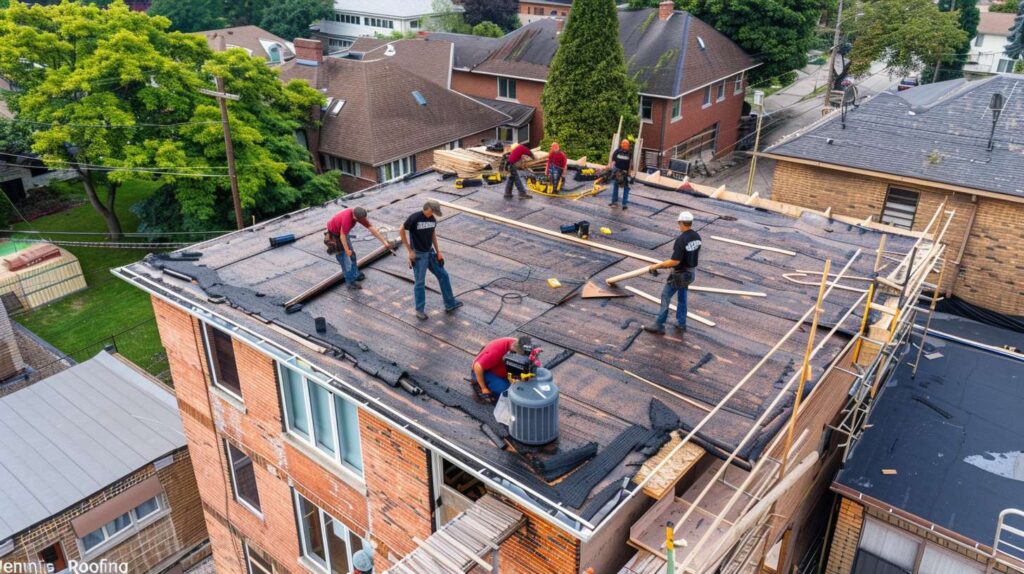
Where the leak shows is rarely where the roof failed
On an Ocean Hill rowhouse, the back edge tells me more than the front ever will. I remember being on a Pacific Street roof at 6:40 in the morning after a night storm, coffee still too hot to drink, while a homeowner kept pointing at a bedroom stain. The real problem was chimney flashing repair on the party-wall side – water had been sneaking three houses over before finally showing up inside that bedroom ceiling. That’s not a dramatic story. That’s a Tuesday.
Water in an attached building doesn’t fall straight down the way people expect. It takes wrong turns. It makes hidden stops. It gets delayed for weeks behind a parapet cap or inside a flat roof seam before it drips anywhere a person notices. On these blocks, rear slopes, parapet edges, clogged drains, skylight curbs, and old patched flat roof membranes all funnel water sideways through the building before it arrives at its final destination – your ceiling. The interior stain is the last stop on a long route, not the source.
Signals that tell you repair is enough and signs that point to a larger reset
Here’s my blunt opinion: a roof doesn’t care whether a neighborhood gets attention. A patched flat roof on a quiet block of Ocean Hill will fail the same way as one on a block that gets more foot traffic from contractors and real estate agents. The question isn’t what the roof looks like from the street – it’s what the failing zones are actually doing underneath. That’s the way Chris Tobin, 17 years in roofing with a specialty in Brooklyn flat roof leak tracing, looks at it: you’re not diagnosing a neighborhood, you’re diagnosing a system. Cosmetic panic – a dark stain, a bubbled ceiling – is different from structural failure, and confusing the two is where repair bills get padded.
Repairable trouble spots
A lot of what shows up on Ocean Hill roofs is genuinely fixable without tearing anything off. Isolated roof leak repair around a single chimney flashing repair or a skylight repair is often a half-day job. Gutter repair that’s letting water back up behind a fascia, a small section of damaged shingle roof, or a localized membrane seam issue on an EPDM roofing, TPO roofing, or modified bitumen roofing surface – those are contained problems. Metal roofing penetrations around pipe boots or vents fail the same way and respond to the same targeted fix. If the failure zone is specific and the surrounding membrane is sound, repair is the honest answer.
Conditions that make a new roof more realistic
Repeated leak paths, saturated insulation that squishes underfoot, widespread blistering across a flat roof field, or a deck that’s seen four rounds of patching over the years – those are different conversations. If your asphalt shingle roofing is curling across most of the slope and losing granules in handfuls, a third patch isn’t a plan. Failing flat roof drainage that’s let water pond for years will eventually compromise everything below it. You’ll hear some contractors say a coat of roof coating buys five more years on that kind of system. But that’s not the part I’d bet on.
| Roof Condition | Usually Points To | Why | Urgency |
|---|---|---|---|
| Isolated flashing failure | Chimney flashing repair | Rest of roof is sound; one seam or cap has separated | High – book soon |
| One skylight curb leak | Skylight repair or curb resealing | Leak is localized; surrounding membrane intact | Moderate |
| Punctured membrane near drain | Targeted flat roof repair | Damage confined to one zone; drain area repairable | High |
| Widespread ponding on flat roof | Drainage correction + possible flat roof installation | Standing water accelerates membrane degradation across full surface | High |
| Repeated leaks after multiple patches | Roof inspection for full replacement assessment | Stacked patchwork means system integrity is compromised | High |
| Curled/lost shingles across large area | Roof replacement – new asphalt shingle roofing | End-of-life condition; spot repair won’t hold long | Moderate-High |
| Saturated insulation under roof coating | Tear-off and roof installation | Trapped moisture can’t be coated over; deck may need inspection | High |
| Storm damage to one roof section | Storm damage repair / wind damage repair | Isolated event; rest of roof undamaged | High – call same day |
| Storm damage across many sections | Inspection + insurance claim roofing process | Widespread damage may justify full claim before repair decisions | High – document fast |
Routes water takes on the homes and buildings around here
I was standing on a ladder off Dean Street when this clicked again. The building I was looking at had three rear additions, two different roof heights, a patched parapet that had been repointed at least twice, and a drain that was tucked into a corner where nobody had cleaned it in years. In Ocean Hill, that’s not unusual – it’s practically standard on blocks of older attached rowhouses where every decade of ownership adds another layer of fix. Water doesn’t find the shortest path here. It finds the path of least resistance, and on these buildings that route winds through shared wall cavities, behind addition flashing, under gravel, and along decking before it goes anywhere visible. The building tells the story if you know which edges to follow first.
| ❌ Myth | ✅ Fact |
|---|---|
| The stain is directly under the leak. | Water travels horizontally along joists, decking, and wall cavities before dripping. The stain is an arrival point, not a return address. |
| A fresh roof coating always solves flat roof trouble. | Coating over a saturated or failing membrane traps moisture and delays failure – it doesn’t fix it. Roof inspection comes before any coating decision. |
| If the skylight drips, the skylight is definitely bad. | Skylight leaks often originate upslope at a flat roof seam or curb flashing failure, not at the skylight unit itself. The skylight is where water exits, not always where it enters. |
| Only old roofs leak in storms. | Wind-driven rain exploits any vulnerable seam, flashing, or penetration – on roofs of any age. Wind damage repair calls come in from properties with roofs that were installed just a few years prior. |
| If one contractor said replacement, inspection is pointless. | A second roof inspection with a different entry point – starting from the actual water path instead of the symptom – regularly changes the scope. Diagnosis matters more than the first opinion. |
What to do before you call and what deserves same-day action
If I asked you where the water showed up, would you also tell me where the roof first broke? Most people can describe the stain precisely and have almost no information about what the roof looks like, when it was last worked on, or whether the gutters overflowed during the same storm. That’s not a criticism – it’s just where the useful details get lost. Before a roofing visit, try to recall when the leak first appeared, whether it happens in steady rain or only during wind-driven rain, whether any roof sealing or roof coating has been done in the last few years, and whether gutters were overflowing. Wind direction during the storm matters more than people expect. All of that narrows down the route.
A ceiling stain is an arrival point, not a return address.
Here’s the insider tip that’s worth knowing before you call anyone: one August afternoon, on a roof surface hot enough to soften my kneepads, I met a landlord who was convinced he needed a full roof replacement. Expensive decision. But once I pulled back a bad patch near a drain, it became clear that years of sloppy roof coating had trapped water in the insulation and made a smaller roof repair look much bigger than it actually was. The stacked patchwork and the swollen deck made the problem look terminal from the outside. It wasn’t. The lesson isn’t that replacement is always wrong – sometimes it’s the honest answer. But don’t self-diagnose from a ceiling stain and a previous contractor’s quote. Start with a real inspection that opens up the system before you commit to the scope.
Ocean Hill rowhouses and flat roofs can be deceptively slick, especially near ponding water, coated membranes, and rear parapet edges. Don’t climb up during a storm, after dark, or on a wet EPDM or TPO surface – the footing is nothing like it looks from the ladder. Let a contractor trace the route.
Service map: the roofing work Ocean Hill properties actually end up needing
The hard truth is that small neglect turns into expensive geometry. A missed drain cleaning leads to ponding. Ponding leads to membrane failure. Membrane failure leads to saturated insulation. And by the time that water shows up in the apartment below, you’re not talking about a one-afternoon fix anymore. The services that come up most often on these blocks are: roof inspection and roof leak detection first, followed by roof leak repair, emergency roof repair after storms, flat roof installation on older membranes past their life, roof waterproofing on parapet bases and additions, roof maintenance scheduling, gutter installation and gutter repair on attached homes with undersized systems, skylight installation and skylight repair, commercial roof repair on mixed-use buildings, and insurance claim roofing documentation after wind events. That’s not a long list to memorize – it’s a map of how deferred maintenance moves through a building.
The one I still talk about was a Sunday call right after church let out, when a family on Herkimer had a bucket under a skylight and everybody assumed it needed skylight repair. I found the leak had started upslope where an old seam on the flat roof had opened just enough during wind-driven rain to send water on a long detour – across the roof deck, behind the curb, and into the hallway ceiling. The skylight was dry. But that’s not the part I’d bet on without climbing up and following the route. Everybody wanted to swap the skylight. Nobody had checked the seam. That single inspection changed the whole job and saved the family a few thousand dollars in the wrong fix. If your roof is sending you signals you can’t read from inside the building, Dennis Roofing is the call worth making – reach out for a roof inspection and let’s trace the problem before you pay for the wrong answer.
Ocean Hill doesn’t lack good buildings – it lacks contractors who actually follow the water instead of quoting from the stain. If your roof is giving you trouble and you’re not sure whether you need a patch or a full reset, call Dennis Roofing and ask for a roof inspection first. Know what you’re dealing with before you decide what to pay for.