
Mapleton Is a Small Neighborhood With Big Roofing Needs – Here’s How We Address Them
Mapleton’s roofing trouble usually starts below the obvious damage
Think about the last time a stain showed up on a ceiling and someone immediately blamed the nearest visible problem – a cracked shingle, a missing cap, a dark streak on the fascia. That’s the surface story versus structural story problem, and in Mapleton, it plays out on almost every block. The biggest roofing headaches here rarely come from one dramatic storm. They come from old repairs stacking on top of older repairs until nobody can read what the roof is actually doing underneath.
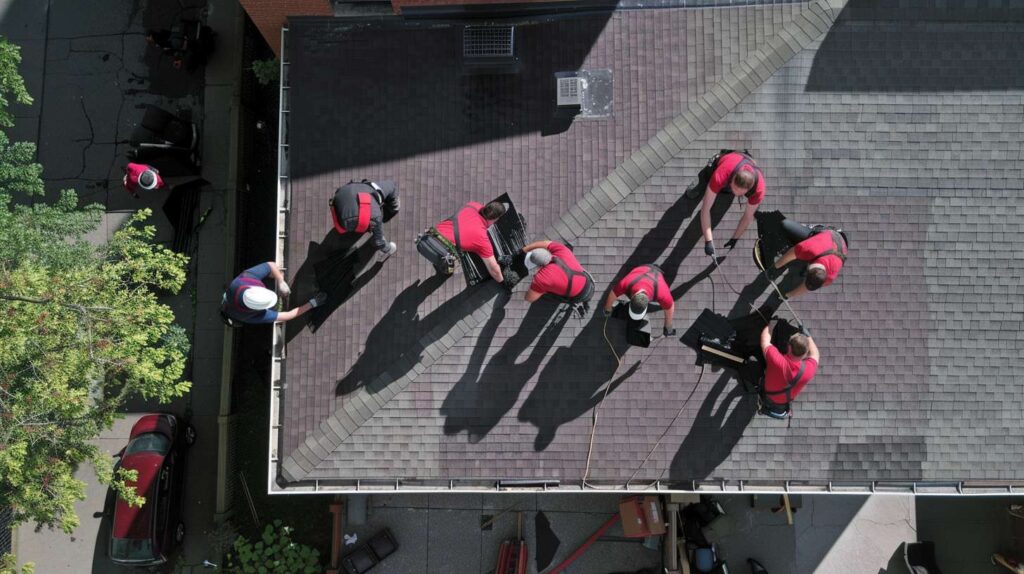
Homes and mixed-use buildings in this part of Brooklyn carry history in their layers. A flat roof might have a coat of sealant over a membrane patch over original tar and gravel – applied by three different people across two decades. When water gets in, it doesn’t drop straight down. It travels. It finds the gap between incompatible materials, runs along a seam nobody’s touched in years, and surfaces somewhere that makes no geometric sense. The visible damage is rarely the origin. That’s what makes guessing so expensive.
| Myth | What’s Actually Going On |
|---|---|
| The stain location equals the leak source. | Water travels horizontally under membranes, especially on flat roofs. Roof leak detection – not cosmetic repair – is the only way to trace the real entry point. |
| Every flat roof leak means the whole thing needs replacing. | Most isolated membrane failures respond to targeted flat roof repair. A full roof inspection determines whether the system is still sound enough to patch. |
| My neighbor just got a new roof, so I need one too. | Roof age and condition don’t move in lockstep across a block. Drainage habits, flashing condition, and repair history vary house to house. Your roof needs its own evaluation. |
| Roof coating fixes ponding water on its own. | Roof coating seals surfaces – it doesn’t correct slope or drainage issues. Ponding water needs structural correction, or any coating will fail within a season or two. |
| Gutters are a separate problem from roofing. | Failed gutter repair or missing gutter installation directly causes water to back up under the roof edge. Decking damage, fascia rot, and interior leaks often trace back here first. |
Instead of guessing, match the service to what the roof is doing
Three layers deep, that’s usually where Mapleton starts talking. I was on a block here just after 6:30 in the morning, fog still sitting low over the row houses, and a homeowner was absolutely certain the leak was over the back bedroom – that’s where the stain was, that’s where it had to be coming from. I climbed up, traced the water path, and the real culprit was failed chimney flashing repair near the party wall. Water was traveling sideways under the membrane before it ever dropped inside. Brett Callahan – with 17 years working roofing on the kinds of older row houses and mixed-use buildings that define Mapleton – will tell you that roof leak detection matters more than brute-force repair in situations like this. If we’d patched the stain, they would’ve paid twice.
For residential roofing calls where the structure is still sound, the answer is almost never a full replacement. A proper roof inspection opens up options: targeted roof leak repair, chimney flashing repair, gutter repair, a section of asphalt shingle roofing where the decking took damage, skylight repair, and a roof maintenance plan to catch the next problem before it becomes expensive. The goal is to match the scope of the repair to the actual scope of the failure – not to sell a solution before you’ve identified the problem.
Commercial roofing is a different conversation, and one August on a Mapleton corner storefront made that clear fast. Ninety-two degrees, no breeze, and the owner had already paid for emergency roof repair twice that summer. When I got up there, I found three incompatible materials layered over each other: modified bitumen roofing over old tar and gravel roof sections, then a patch coating thrown over areas where water kept ponding. The roof was behaving exactly like a bad stage set – fine from the street, completely unstable behind the surface. That conversation turned into a real commercial roof repair plan instead of another bandage. On older Brooklyn buildings running EPDM roofing, TPO roofing, or layered flat systems, repeated emergency calls are usually a sign that the underlying system has already failed. Patching on top of that just delays the honest conversation.
| What You’re Seeing | Likely Structural Story | Best-Fit Service | Usually Best Next Step |
|---|---|---|---|
| Isolated roof leak near chimney | Flashing has separated at base or party wall junction; water entering at penetration | Chimney flashing repair + roof leak detection | Trace full water path before sealing |
| Backed-up edge from broken gutters | Overflow soaking fascia and decking; ice dam risk in winter | Gutter repair + roof waterproofing at edge | Inspect decking for saturation before closing up |
| Recurring ponding on flat roof | Drainage blocked or slope insufficient; membrane stress accelerating | Flat roof repair + drainage correction | Address slope before applying any roof coating |
| Blistering modified bitumen | Trapped moisture under membrane; adhesion failure from heat cycling | Modified bitumen roofing repair or replacement evaluation | Moisture test before deciding scope |
| Aging asphalt shingles with localized decking damage | Long-term moisture entry in one zone; rest of system may still be viable | Asphalt shingle roofing section replacement + decking repair | Full roof inspection to confirm surrounding area is dry |
| Membrane seam failure on commercial roof | Thermal movement or installation error separating seam over time | Commercial roof repair – EPDM or TPO seam repair | Check all adjacent seams before calling it done |
| Storm-opened flashing | Wind lifted edge or counter flashing; immediate entry point for water | Emergency roof repair + wind damage repair + flashing reset | Document for insurance claim roofing before permanent fix |
| Widespread saturation across old roof layers | Multiple failed materials holding trapped moisture; system no longer functional | Roof replacement / new roof installation | Strip all layers before new flat roof installation to start clean |
So what problem are you actually paying to solve?
Call Dennis Roofing immediately. Contain interior damage, document the entry point, and don’t wait for a scheduled estimate. Active water entry causes compounding damage every hour.
Roof inspection first to confirm the rest of the system. Then: roof leak repair, chimney flashing repair, skylight repair, gutter repair, or localized shingle replacement depending on what the inspection reveals.
Strip all existing layers to assess decking condition. Choose the right system – EPDM, TPO, modified bitumen, asphalt shingle, metal roofing – based on structure, slope, and building use.
When the current flat roofing system is beyond patching, a proper flat roof installation – with correct drainage, edge detail, and material selection – is the only option that stops the cycle of emergency calls.
When drainage is the hidden problem, leaks keep getting blamed on the wrong thing
I’m going to say this plainly: a leak stain is often the least honest part of the whole roof. I met an older couple right before a Sunday rainstorm who were convinced they needed a full roof replacement because their neighbor had just gotten a new roof and told them “that’s what these houses need now.” After a real roof inspection, it was clear their asphalt shingle roofing still had life left. The gutter repair had been ignored so long that runoff was backing up along the edge and soaking the decking – quietly, season after season. We handled the drainage, replaced the damaged section, and bought them years before they’d need a full roof installation. Here’s the thing – water doesn’t care where you expect it to land. Once it’s on the roof, the gutter installation and drainage path determine where it actually goes. That means gutter repair, roof waterproofing, roof sealing, and roof maintenance aren’t side issues. They’re part of the same system, and skipping them while fixing the membrane is like patching one hole in a funnel.
Not every roof in Mapleton needs replacement-but some need honesty more than another patch
What replacement is really solving
Here’s the blunt truth – small neighborhoods age roof systems in very particular ways. In Mapleton, you’ve got row houses sharing party walls, rear additions with their own roof transitions, and storefronts below residential floors where flat and sloped systems meet at awkward angles. The worst roofing money I’ve seen spent wasn’t on bad materials – it was on owners who bought a solution before anyone identified the actual system failure. Roof replacement or a genuinely new roof is the right call when there’s widespread trapped moisture, incompatible materials stacked over decades, a chronic leak history that keeps migrating despite repeated repairs, a failed flat roof installation that never drained correctly, or a commercial roof repair situation where the substrate itself is compromised. In those cases, patching isn’t repair – it’s postponing.
What a proper installation should account for on this block
Here’s an insider point that doesn’t get said often enough: a proper roof installation isn’t just about the field – the flat open section everyone can see. On Mapleton buildings, ask whether the proposed work addresses edges, penetrations, the drainage path, and material compatibility across every transition. A shingle roof installation needs correct flashing at every valley and chimney base. A metal roofing job needs expansion detail at the edges. EPDM roofing, TPO roofing, and modified bitumen roofing all behave differently at seams and terminations – especially around HVAC units and parapet walls. Skylight installation and chimney flashing details need to be built into the spec, not added as an afterthought. Storm damage repair, wind damage repair, and insurance claim roofing situations can legitimately trigger full replacement – but they’re event-based reasons, not blanket ones. The system still needs to be evaluated on its own terms before that decision is made.
| Comparison Point | Targeted Repair | Full Roof Replacement |
|---|---|---|
| Upfront Cost | Lower immediate cost; right choice when damage is truly isolated | Higher upfront investment; justified when layers are compromised throughout |
| Lifespan Impact | Extends life of a still-sound system by years; may not help a failing one | Resets the clock entirely; new warranty coverage from day one |
| Disruption | Minimal; usually completed in a day or less depending on scope | More involved; especially on occupied residential or commercial buildings |
| Compatibility Risk With Old Layers | High risk if patch material doesn’t match existing system; needs evaluation first | Risk eliminated when all old layers are stripped and substrate is inspected |
| Suitability After Storm Damage | Appropriate for isolated wind damage repair or flashing loss | Warranted when storm damage exposes pre-existing saturation across multiple zones |
| Value for Mixed-Use / Commercial | Best when commercial roof repair can address one membrane section without disturbing the rest | Best when repeat emergency repairs signal a system that can no longer hold; flat roof installation from scratch |
One practical way to avoid surprise failures is to treat the roof like a system, not a symptom
A roof in Mapleton is a lot like an old theater set – I say this from experience building sets before I ever climbed onto a roof – and what’s holding it together matters more than what’s painted on the face. The neighborhoods that avoid expensive emergency calls are the ones where property owners treat roof inspection, roof cleaning, flashing review, seal checks, and drainage maintenance as a single recurring system, not a list of individual problems to react to. For residential roofing, that means catching failing roof waterproofing at penetrations before a seam opens up. For commercial roofing, it means checking membrane condition on your flat roof before summer heat cycles push a small blister into a full delamination. Roof coating and roof sealing have a place in that cycle – but only after drainage and substrate conditions are confirmed solid. If you want someone to come out, read the layers honestly, and tell you what your Mapleton roof is actually doing before recommending roof repair or roof replacement, call Dennis Roofing and we’ll give you a straight answer.
| Timing | Task | Why It Matters in Mapleton |
|---|---|---|
| Spring | Roof inspection – full system review | Catch any damage from freeze-thaw cycles before spring rains arrive; confirm flashing and seals held through winter |
| Summer | Seal and flashing review; roof coating where specified | Heat cycling accelerates membrane blistering and sealant breakdown; best time to address before humidity drives moisture into open gaps |
| After Any Storm | Wind damage check; inspect flashing and parapet edges | Mapleton’s row house density means wind funnels between buildings; lifted flashing and shifted cap materials happen even in moderate storms |
| Fall | Gutter cleaning and drainage test | Blocked gutters going into winter cause ice backup and fascia damage; clearing them now prevents the most common edge-leak scenario we see in January |
| Winter | Leak monitoring from inside; note any new stains | Interior stains that appear during cold snaps, not rain, often indicate ice dam behavior at the edge – a drainage problem, not a membrane failure |
| Every 3-5 Years | System-specific review – flat roofing membranes, asphalt shingle wear, metal fastener check | Material lifespans vary; a scheduled deeper review catches layer degradation before it becomes a full roof replacement conversation |
If you want Dennis Roofing to inspect your Mapleton roof and explain the real problem before recommending roof repair or roof replacement, call us now – we’ll read the layers with you and give you a straight answer, not a sales pitch.