
Gravesend Has Deep Residential Roots – and the Older Homes Here Need Roofers Who Know It
Tell me where the leak is, and I’ll show you why you’re probably pointing at the wrong spot. In older Gravesend homes, the ceiling stain, the drip on the hallway floor, the dark ring forming near the light fixture – those are where water stopped, not where it got in. Knowing that difference is the whole job.
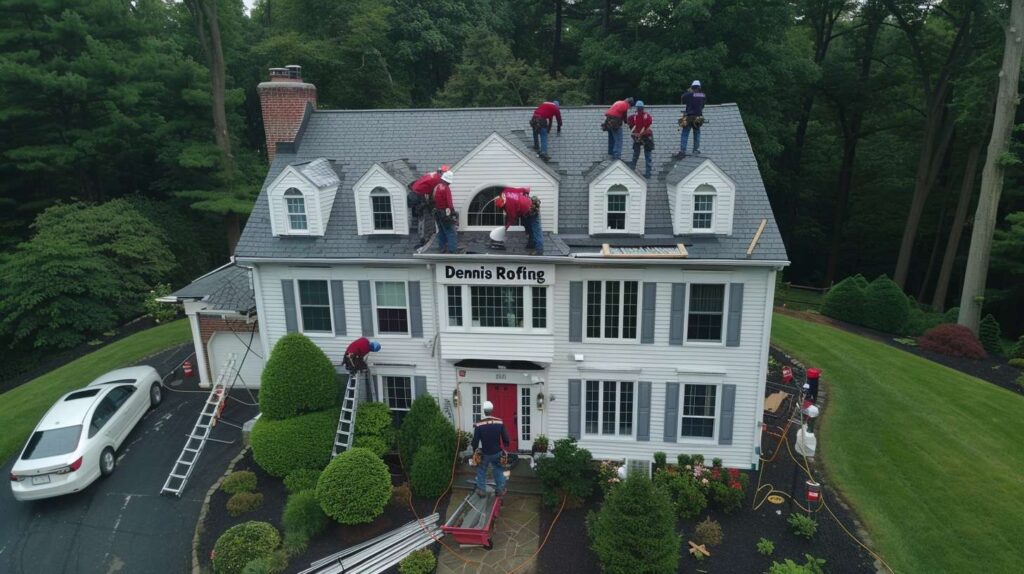
Water Doesn’t Land Where It Introduced Itself
On a Gravesend roof, the first thing I look at is never the stain. I’m Joe Santangelo, and I’ve been reading older residential roof systems in Brooklyn for 17 years – the kind of roofs where patched layers, deteriorating chimney flashing, and flat-to-pitched transitions all come together in one problem. What I’ve learned is that water doesn’t drop straight down. It chooses a path – the path of least resistance through old wood, cracked flashing, loose seams, or tired mortar – and that path can carry it several feet before it ever shows up on your ceiling. So when I walk a job, I follow the path water is choosing, not the stain it left behind.
If I asked you where the water came in, what would you point at? Most people in Brooklyn NY Gravesend point at the ceiling. Some point at the wall. And honestly, they’re not wrong to look there – those marks are real clues. But in houses with mixed roof types, added flat sections, multiple chimney stacks, and 60-plus years of repairs stacked on repairs, the actual entry point can be two rooms and a rafter bay away from where you’re standing. Wall stains can mean a flashing failure four feet higher. A hallway drip can trace back to a shingle-to-flat transition on the other side of the house. That’s just how these homes are built.
Visible drip rarely equals source
Where water exits inside the home can be several feet – sometimes a full room – from the actual roof failure.
Older homes often have layered repairs
Decades of patch-over work create hidden failure points that won’t show up until you pull the surface back.
Flashing and transitions fail first
The large field areas of a roof rarely fail before the flashing at chimneys, walls, skylights, and slope changes.
Interior staining can show feet away from entry point
Water travels along rafters, joists, and plywood before it drips – which is why mapping the interior is step one, not an afterthought.
The stain is where water stopped, not where it started.
Before Repairs, Trace the Route the House Is Hiding
Inside Clues That Point Back to the Real Failure
A roof leak in these homes moves like a bad subway transfer – it starts in one place, changes direction completely, and drops you somewhere you weren’t expecting. I go inside first and map the staining pattern. After that, I go to the flashing, because that’s almost always where the real failure is waiting. I remember being on a block off Avenue U at 6:40 in the morning after an overnight rain, and the homeowner kept insisting the leak had to be from the middle of the flat roof. I went upstairs, saw the brown ring forming three feet from the actual drip, and found the real issue at the chimney flashing where old mortar had completely let go. That was a classic Gravesend house – the roof told one story outside and the ceiling told another inside. The path water was choosing was entirely invisible until we stopped looking at the stain.
Exterior Spots That Usually Finish the Story
Here’s the blunt part. Older Gravesend houses – and you know exactly which ones I mean if you’ve walked these blocks – often combine a flat roof section, a shingle roof section, a chimney or two, maybe a skylight, and gutters that haven’t been right in years, all in one leak path. The two-families on the side streets near McDonald Avenue are a good example: patched transitions where flat meets pitched, original flashing from decades ago, and gutter downspouts that overflow straight toward the fascia. From there, the gutters tell the rest. If they’re blocked, loose, or pulling away from the fascia, water is getting under the edge before it ever has a chance to run off the roof correctly.
| What the homeowner sees | What gets checked next | Why the leak travels | Likely service |
|---|---|---|---|
| Brown ring on bedroom ceiling | Chimney flashing and mortar joints | Water enters at chimney base, runs along rafter to ceiling | Chimney flashing repair |
| Hallway drip after rain | Flat-to-pitched transition and seam condition | Seam opens, water tracks along top plate before dropping | Roof leak detection + flat roof repair |
| Water stain near window header | Gutter attachment and fascia condition | Overflowing gutter drives water behind fascia and down the wall | Gutter repair + roof waterproofing |
| Ceiling bubble or soft spot in living room | Flat roof membrane and ponding areas | Standing water on flat roof slowly saturates through failing membrane | Flat roof inspection + emergency roof repair if active |
| Stain appearing below skylight but offset | Skylight curb flashing and surrounding roof coating | Cracked coating at curb allows water in, which travels along framing before dripping | Skylight repair + roof sealing |
🔺 Chimney flashing failure → bedroom ceiling stain
🔺 Skylight curb failure → hallway stain
🔺 Low-slope seam failure → wall bubbling
🔺 Gutter overflow → fascia rot and window header staining
Layered Roofs Change the Conversation Fast
Three layers deep is where old Brooklyn houses start arguing with you. I had a Saturday job on a shingle roof near Gravesend Neck Road where the customer said, “Just replace what blew off,” after a windy storm. Simple enough request. Then I pulled up the first damaged section, and found two older repairs buried underneath – and plywood so soft my flat bar sank into it easier than it had any business doing. That job turned from a targeted roof repair into a full-on conversation about the structure holding the whole thing up. Then I checked the low seam where the shingle field met an older flat section, and that told me the rest of the story. And honestly, that’s my personal opinion after 17 years doing this: older homes punish the homeowner who insists on the cheap version twice. The math never works out the way they hope.
The insider tip that most people don’t hear is this: before anyone commits to repair or replacement, a roofer worth listening to will check decking firmness by walking it carefully and probing edge zones, look at old fastener patterns to see if previous layers were nailed through properly or just surface-tacked, and assess moisture in the transitions. That information tells you whether a repair is honest or just temporary. It also tells you whether a new roof – whether that’s asphalt shingle roofing, metal roofing, a flat roof installation in modified bitumen roofing, EPDM roofing, or TPO roofing – can even be installed responsibly over what’s already there. Sometimes the answer is yes. Sometimes you’re doing the homeowner a disservice by not saying no.
Wind damage that removes shingles or membrane sections often reveals what was hidden underneath. Requesting a patch-only repair before a proper inspection can mean sealing over weak decking, saturated insulation, or previous repairs that have already failed structurally. A photo of what’s underneath the lifted section is worth more than any estimate written without one. Don’t let anyone price a wind damage repair without pulling the affected section first.
Not Every Gravesend Roof Wants the Same Material or Fix
What tends to suit flat sections
What tends to suit pitched residential sections
Where specialty details matter most
I learned this the hard way on a two-family near West 6th. The front section pitched toward the street, the rear was flat with a parapet wall, and they met in the middle with a transition that had been patched at least four different times with four different materials. Nobody was wrong, exactly – each roofer probably did what made sense at the time. But the result was a seam that nothing could bond to cleanly anymore. From there, I look at how the surfaces meet, because that junction is usually where everything breaks down. A rubber roof – whether that’s EPDM roofing or TPO roofing – can handle a flat section well if the drainage is designed right. Modified bitumen roofing is often the right call on low-slope sections with complex penetrations. A tar and gravel roof can still be in sound shape on a Brooklyn house; don’t let anyone talk you out of a good one just because it’s older. The flat section and the pitched section need to be evaluated separately, then considered together.
One August afternoon, with the heat bouncing off a tar and gravel roof behind me, I was working with an elderly couple in Gravesend whose son had already called three companies before reaching us at Dennis Roofing. They had a visible stain near a skylight, but the stain was in the hallway – not under the skylight itself. The real failure was the transition where a newer skylight repair met an older roof coating that had cracked around the curb from years of expansion and contraction. I ended up drawing the water path on the back of a grocery receipt at their kitchen table because they wanted to understand it, not just trust it. That’s exactly the kind of job where roof coating, roof sealing, and roof waterproofing around the curb were the right answer – not a full skylight installation. Skylight repair, chimney flashing repair, gutter installation, gutter repair, roof leak detection – these are all detail-driven services that depend entirely on reading what the path water is choosing, not just quoting what’s visible from the street.
| Roofing Option | ✅ Pros | ⚠ Cons |
|---|---|---|
| Asphalt Shingle Roofing | Cost-effective, widely available, easy to repair in sections, good variety of profiles for Brooklyn residential | Shorter lifespan than metal, vulnerable at transitions, can hide old decking problems |
| Metal Roofing | Long lifespan, handles freeze-thaw well, low maintenance once installed, strong in wind | Higher upfront cost, expansion noise, not ideal for complex older roof transitions without experienced installers |
| EPDM Roofing | Excellent for flat sections, durable in Brooklyn weather, repairable without full replacement, good flexibility | Seams can separate over time, black surface absorbs heat, not ideal where foot traffic is high |
| TPO Roofing | Reflective surface reduces heat load, heat-welded seams are strong, good for commercial and flat residential | Thinner membranes can be puncture-prone, quality varies by brand, fewer experienced installers than EPDM |
| Modified Bitumen Roofing | Strong for complex flat sections, handles penetrations well, proven track record on older Brooklyn homes | Requires experienced installation, torch-applied method needs proper safety protocols, heavier than membrane options |
When to Call Now and What to Have Ready
If water is actively dripping, a ceiling is bulging, wind has torn materials off your roof, or a flat section is visibly ponding with no sign of draining – stop trying to figure out the stain and make the call. Those situations don’t get better sitting overnight, and in an older Gravesend home with layered repairs and aging decking underneath, a slow problem can become a structural one faster than it should.
If you’re seeing a leak, a recurring stain, storm damage, or signs that an older roof system in Gravesend is starting to give out, call Dennis Roofing and get an inspection that actually follows the path water is choosing – not one that starts and ends at the stain. That’s where real answers come from.