
Fulton Ferry Has a Rich History and a Very Small Footprint – Every Roof Here Matters
Fix it once. Small historic blocks like Fulton Ferry can actually be harder to keep dry than larger properties – because when there’s almost no margin for drainage errors, a bad patch or mismatched material doesn’t sit quietly. It compounds. What looks like a minor roof repair on a compact rowhouse or mixed-use building can turn into a structural problem faster than most owners expect, and by the time the stain shows up on the ceiling, the water has already been traveling for a while.
Tight Footprints Create Outsized Roofing Problems
Fix it once. That’s not a slogan – it’s the only real strategy on a Fulton Ferry block. Small historic neighborhoods like this one can be harder on roofs than larger properties because there’s almost no forgiveness built in. Less square footage means less margin for drainage mistakes, repair shortcuts, or material mismatch. Every edge, transition, and drain point has to work, because there’s no spare roof surface to absorb the consequence when one doesn’t.
On a Fulton Ferry roof, ten square feet can cause ten thousand dollars’ worth of trouble. Both residential roofing and commercial roofing face the same neighborhood constraint: the buildings sit close together, setbacks are tight, and water doesn’t have far to travel before it finds a wall, a seam, or someone’s ceiling. But that’s not the part that gets people. The part that gets people is that the water rarely announces itself at the source. It moves sideways. It finds gaps in chimney flashing. It pools behind parapets. It shows up in a hallway three rooms away from where the roof actually failed.
| Myth | Fact |
|---|---|
| Small roof means simple repair. | Compact Fulton Ferry roofs have proportionally more edge, flashing, and transition detail per square foot – which means more failure points, not fewer. |
| The leak shows up directly below the problem. | Water moves sideways under membranes and along framing before it drops. The stain and the source are rarely in the same zip code on a tight-footprint building. |
| Flat roofing can be patched with anything adhesive. | Generic mastic over EPDM or TPO roofing fails fast, especially in summer heat. Material compatibility isn’t optional – it’s the whole repair. |
| If shingles blew off, roof replacement is automatic. | Wind damage repair often turns out to be an edge detail problem or clogged gutters. A proper roof inspection determines the real scope before any replacement decision. |
| Historic block buildings all need the same roofing system. | Mixed-use, rowhouse, and freestanding Fulton Ferry structures have different drainage layouts, masonry conditions, and load histories. System choice has to follow the building, not a catalog. |
Where Water Actually Travels on These Buildings
Leaks Rarely Introduce Themselves Honestly
If I were standing in your top-floor hallway, I’d ask one question first: where does the water start, and where does it want to go? Water doesn’t wander – it has a plan. It looks for permission at every seam, every penetration, every place where one material ends and another begins. Good roofing blocks those routes before water finds them. Bad roofing – or a repair done without tracing the full path – just relocates the leak. I’m Lamar Boudreau, and after 17 years doing this work with a specialty in tight-footprint drainage and flashing details, I can tell you that the hardest part of diagnosing a Fulton Ferry roof isn’t finding the drip. It’s resisting the urge to stop looking once you find the first candidate.
I was on a Fulton Ferry rowhouse roof at 6:40 in the morning after a night of cold spring rain. The owner was certain the skylight was the problem – the stain was right below it, and she’d had skylight trouble before. It wasn’t the skylight. The real source was a small split in old chimney flashing uphill, and the water had taken a sideways route under the membrane before it finally dropped inside. That job stuck with me because in a neighborhood this compact, roofs lie to you if you only look where the drip lands. The confession and the crime scene are usually two different locations.
Fulton Ferry buildings add a few more wrinkles to that equation. Parapets that separate rooftops from neighboring setbacks can collect water and push it laterally into masonry. Old brick transitions where additions meet original structures create invisible gaps that move moisture downward and sideways at the same time. Mixed-use buildings along Water Street or near the Empire Stores have roofline levels that step – and every step is a potential entry point if flashing wasn’t installed correctly or has aged out. Roof leak detection here means looking uphill and outward, not just at the stain. You’re mapping where water wanted to go, then working backward to where it got permission to start.
The drip you see is often just the confession, not the crime scene.
Don’t wait. Active water intrusion over occupied space needs same-day attention.
Known visible damage needs a full professional assessment before any work begins.
Multiple past repairs plus age usually mean the system has run its course.
▸ Chimney and Counterflashing Failures
▸ Skylight Corners and Curb Transitions
▸ Flat Roof Seams Around Drains and Parapets
▸ Gutter Backup and Edge Infiltration on Shingle Sections
Matching the Service to the Roof System
Repair, Restore, or Replace
I’ll say this upfront: small roofs are not simple roofs. A compact Fulton Ferry building might carry a flat roof over the main structure, an asphalt shingle roofing section over a rear addition, a metal roof detail over a bay window below, and leftover tar and gravel roof assembly in a corner that nobody touched in twenty years. That’s four different systems on one building, and each one has its own failure mode, its own compatible repair material, and its own lifespan. One humid August afternoon, I got called to a small mixed-use building where a restaurant tenant downstairs was furious – water was dripping near the prep line. Somebody had done a fast patch on the flat roof with the wrong material, and it had softened up in the heat like it had given up by lunch. I stood there with the owner while delivery trucks ground by outside, explaining that in Fulton Ferry a bad repair doesn’t stay small. These buildings don’t have much room to hide failure. Material mismatch causes more avoidable callbacks than most owners ever expect – and honestly, it’s the part that costs the most to fix correctly the second time.
The real issue sits one layer below that. Deciding between roof repair, roof coating, and full roof replacement on a small-footprint building requires knowing whether the failure is isolated or systemic. A localized membrane split on an otherwise sound EPDM roofing field is a repair. A rubber roof that’s been patched in five different spots over eight years with three different materials is not a repair candidate – it’s a replacement. The same logic applies across modified bitumen roofing, TPO roofing, and tar and gravel roof assemblies: age and patch history matter as much as what’s visible today. Metal roofing and asphalt shingles follow slightly different rules, but the principle holds. One incompatible material layered over another doesn’t add protection – it traps moisture and accelerates the failure it was meant to stop.
Material Mismatch Is a Quiet Expensive Mistake
| Roof System | Common Fulton Ferry Use | Best First Service | Warning Sign That Changes the Plan |
|---|---|---|---|
| Asphalt Shingle Roofing | Rear additions, pitched sections on rowhouses | Roof inspection + targeted shingle repair | Multiple missing shingles plus granule loss in gutters – replacement moves to the table |
| Metal Roofing | Bay window caps, small addition roofs, decorative cornices | Seam sealing, roof coating, or flashing repair | Active rust through panel or failed seam allowing water behind façade |
| EPDM Roofing | Flat roofs on residential and small commercial buildings | Roof inspection + targeted seam or flashing repair | Widespread shrinkage, multiple open seams, or incompatible prior patches covering field |
| TPO Roofing | Newer flat roof installations, light commercial conversions | Roof inspection + weld seam review | Delamination, significant punctures near drains, or ponding over 48 hours |
| Modified Bitumen Roofing | Common on older flat roofs and low-slope sections | Roof coating or targeted membrane repair | Surface cracking through cap sheet plus visible blisters – coating won’t hold, replacement warranted |
| Tar and Gravel Roof | Aging flat roofs on pre-1980 commercial and residential stock | Full roof inspection before any work – material age matters | Alligatoring, exposed felt layers, or substrate softness under foot – replacement is usually the honest answer |
Storm Response and Maintenance on Roofs With No Spare Room
Here’s the blunt truth – old Brooklyn buildings do not forgive lazy flashing. A few winters ago, right after a windy December storm, I inspected a compact rooftop near the base of the old Fulton Ferry landing where the homeowner was convinced they needed a full roof replacement. Shingles had scattered into the neighboring setback and the damage looked dramatic. What had actually happened was a bad edge detail left over from a prior repair, combined with gutters that had been clogged long enough for ice to back things up at the eaves. Wind damage repair, gutter repair, and a corrected edge installation handled it. No new roof needed. Storm damage repair and insurance claim roofing both start at the same place: an honest roof inspection that separates what the storm did from what was already waiting to fail. Those are different conversations with different price tags, and conflating them doesn’t serve anyone.
After any storm, the insider move is simple: look at the edges first. Drains, gutters, edge metal, parapet caps, and transition points – that’s where compact roofs break before the field surface does. A large suburban roof has square footage to absorb an edge failure and still drain. A tight Fulton Ferry footprint doesn’t. Roof waterproofing and roof sealing details that protect transitions matter more per square foot here than on almost any other building type. And honestly, the margin for error is small enough that a blocked gutter on a one-thousand-square-foot flat roof isn’t a nuisance – it’s a structural risk if it goes through a freeze cycle.
| When | Task | Why It Matters on a Small Roof |
|---|---|---|
| After Major Storms | Roof inspection, edge metal check, gutter inspection, drain clearing | Compact roofs fail at margins first. Finding damage within 48 hours keeps a repair from becoming a replacement. |
| Twice Yearly | Full roof inspection, gutter cleaning, flashing review, roof sealing check | Spring and fall inspections catch winter damage and pre-storm vulnerabilities before they open up. |
| Late Fall | Roof cleaning, drain clearing, roof waterproofing review on flat sections | Debris that freezes in a drain overnight can back water up under a membrane by morning on a small footprint. |
| Winter Thaw | Roof inspection for ice dam damage, flashing check, gutter recheck | Freeze-thaw cycles open seams and lift flashing. What held all winter sometimes fails in the first warm week. |
| Before Listing/Sale | Full roof inspection, roof waterproofing review, documentation of repairs | A documented roof condition avoids inspection surprises and negotiation delays on compact Brooklyn properties. |
Patch Materials and Quick Fixes That Create Bigger Leak Paths
- Generic mastics applied to flat roofs in summer heat don’t bond properly – they soften, shift, and open new channels where water moves underneath instead of being blocked.
- Layering incompatible materials over existing EPDM or TPO roofing traps moisture between membranes and accelerates substrate deterioration well before any leak becomes visible inside.
- Skipping chimney flashing repair because the leak “seems like something else” is one of the most expensive judgment calls a Fulton Ferry owner can make – water travels further uphill than it looks.
- Treating gutter overflow as a siding or masonry problem misses the cause entirely. Backed-up gutters are a roof drainage failure, and they’ll keep driving water into wall cavities until the drainage is actually fixed.
Choosing a Fulton Ferry Roofer Without Buying the Same Problem Twice
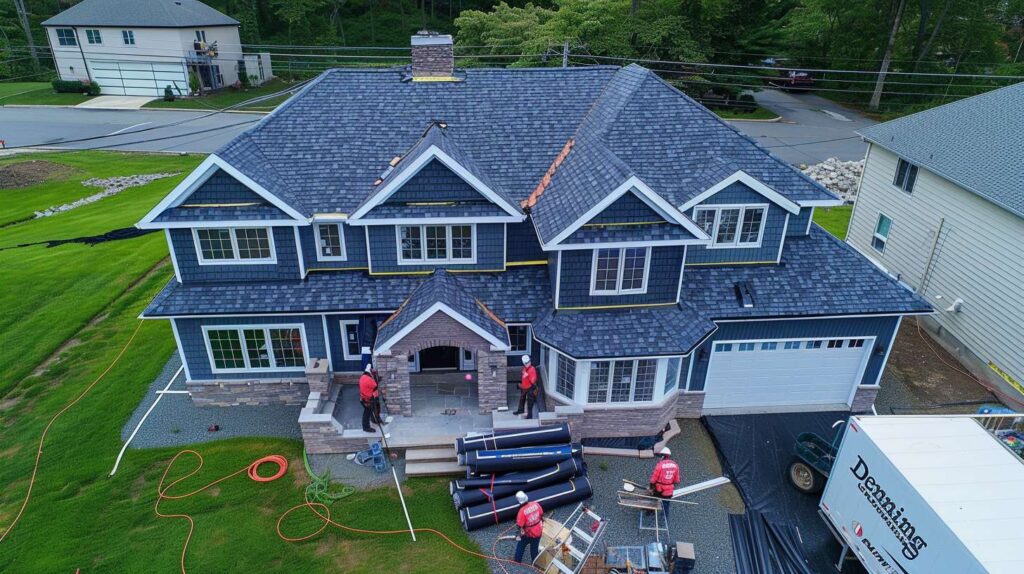
A roof in this neighborhood works more like a pocket watch than a warehouse lid: tiny parts, no room for slop. Before you hire anyone for a roof repair, roof replacement, or flat roof installation here, it’s worth asking how they diagnose leak paths – not just what they plan to install. A contractor who goes straight to materials without mapping water travel is going to miss the same thing the last person missed. But that’s not the part that gets people. What actually costs money is the scope that’s never written down: which penetrations are being resealed, how the drains are being treated, whether the new material is compatible with what’s adjacent. Get that in writing. Dennis Roofing handles both residential roofing and commercial roof repair in this neighborhood, and the standard starting point is always the same – find where water wants to go, then close every route before it gets there.
Do I need roof repair or roof replacement? +
Can you repair a flat roof without replacing the whole system? +
What if the leak seems to be around a skylight? +
Will storm damage repair help with an insurance claim roofing process? +
How often should a small Brooklyn roof get a roof inspection? +
If you want a roof inspection, a straight answer on whether you need a roof repair or a new roof, or emergency roof repair on a Fulton Ferry property, call Dennis Roofing. We work this neighborhood, we know what these buildings do to water, and we’ll tell you exactly what we find.