
Replacing a Metal Roof Is a Significant Investment – Here’s What That Looks Like
I started keeping a running log of Brooklyn metal roof replacement pricing after too many conversations where homeowners walked in with a number pulled from a national average and walked out confused about why their actual quote looked nothing like it – for Brooklyn properties, a realistic planning range runs anywhere from $9,000 to $38,000 or more installed, and that spread is wide on purpose because it’s an honest one. Two roofs with identical square footage can separate by thousands once you factor in panel type, tear-off layers, trim volume, and site access – the panel itself is just the starting point, not the full story.
Last Tuesday’s supplier sheet had one number, and Friday’s had another. After a homeowner in Bay Ridge called me at 7:12 a.m. convinced we had invented an overnight price increase, I emailed her three screenshots of quotes from the same panel profile taken over nine days – and even she said, “Okay, I get it now, this really does move.” That moment stuck with me because it proved customers don’t need less information about price; they need cleaner proof. Think of it this way: the panel is the ingredient, not the full dinner service. A busy kitchen doesn’t price itself on what the produce costs at the warehouse – it prices on everything it takes to get a finished plate to the table.
What Brooklyn homeowners usually pay for a metal roof replacement
4 Fast Facts Before You Read Further
Biggest Cost Swing
Labor and access, not the panel itself, drive the largest price differences between quotes.
Most Misunderstood Line
Trim and flashing. Many quotes understate scope here, and shortfalls show up in the final bill.
Brooklyn Factor
Staging and disposal logistics can shift a quote by thousands on properties with limited access or tight rear yards.
Best Use of Online Pricing
Use it to set a budget range and walk into the conversation informed – not to pick a contractor or evaluate a bid.
Why one quote climbs while another stays lower
Here’s the blunt part. Homeowners almost always look at the panel price first, treating it like the headline number that explains everything else – but, as Latasha Monroe, who has spent 17 years translating roof talk into plain English for Brooklyn homeowners, puts it, the panel is only the raw ingredient, and it’s the labor hours, roof geometry, and site conditions that cook the final number. Two contractors quoting the same job can still separate by four or five thousand dollars if one of them actually scoped the trim package, decking risk, and access time while the other assumed the easiest possible version of each.
Roof shape and edge detail
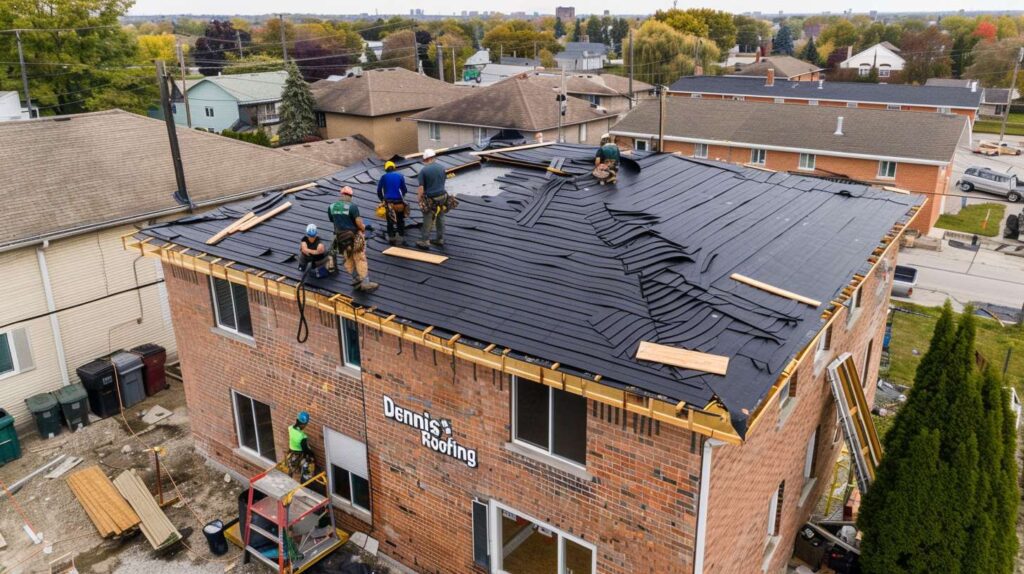
One sticky August afternoon near Prospect Park changed the way I explain estimates to people. A brownstone owner couldn’t understand why his quote ran so much higher than his cousin’s on a ranch house in New Jersey – same panel type, similar square footage on paper. By 4 p.m. I was standing at the job site with the estimator, looking at a narrow access point off a rear yard, overhead wires running just above staging height, and a setup that meant every single tear-off bundle had to be walked out by hand because no equipment could reach the back of the property. That’s classic Brooklyn: brownstones, attached homes, alley-only entries, and tight rear yards that turn a straightforward material job into a full-day choreography job. The cousin’s ranch house had a wide driveway and a roll-off dumpster parked ten feet from the ladder. The two jobs couldn’t have been more different, and the quotes reflected that honestly.
Tear-off, decking, and hidden repairs
Now, that’s the material – the rest is where the job becomes a real job. Beyond the panel choice, what actually builds out a metal roof replacement quote is: underlayment type and coverage, flashing at every wall, valley, and penetration, the trim package at rakes and eaves, the fastener system, a decking repair allowance for what you won’t know until tear-off is underway, and disposal – which on a tight Brooklyn street can mean dumpster permits, hand-carry labor, and coordination with the city. Each one of those is a real line, and any quote that leaves them vague is not a complete comparison.
Cost Drivers That Move Metal Roof Replacement Pricing in Brooklyn
| Cost Driver | How It Affects Price | Why It Matters on a Brooklyn Job |
|---|---|---|
| Panel system | Standing seam typically costs 30-50% more than exposed-fastener; material and labor both rise. | Standing seam is better suited to older Brooklyn structures with historic detail, but the cost difference is real and needs to be in the conversation early. |
| Slope/steepness | Steeper pitches require safety anchoring and slow down installation, adding labor hours. | Pitched rooftops on Brooklyn townhomes are common and steepen the labor cost without adding a single extra square foot of material. |
| Number of penetrations | Each chimney, skylight, or pipe requires custom flashing fabrication – costs stack quickly. | Older Brooklyn homes routinely have multiple chimneys and HVAC penetrations, sometimes more than newer builds anywhere else in the metro area. |
| Trim quantity | Eave trim, rake trim, ridge cap, valley flashing – linear footage adds up fast on complex rooflines. | This is the line most often understated in a low quote. If the scope doesn’t specify trim linear footage, the number is probably soft. |
| Tear-off layers | Each additional layer means more labor hours and more disposal weight – price scales up accordingly. | Many Brooklyn properties have had multiple roofing generations layered over the original. Don’t assume one layer without asking. |
| Sheathing/decking repair | Rotten or damaged decking found after tear-off requires immediate replacement before panels go down. | This is the line item that surprises people most – an allowance should be in every honest Brooklyn quote. |
| Access/staging | Tight properties require more labor time to move materials safely, sometimes with no equipment assist. | Attached homes and rear-yard-only access are the norm in many Brooklyn neighborhoods – this is a cost driver that only shows up in scoped estimates. |
| Disposal logistics | Dumpster permits, hand-carry labor, and haul-away fees are real cost items – not one generic line. | In dense areas like Park Slope or Flatbush, street permits for dumpsters can take coordination that adds both time and cost to the job. |
| Permit requirements | NYC DOB permits add cost and lead time – a quote that omits them may not reflect the full legal requirement. | New York City has specific permit requirements for roof replacement work. Any contractor who skips this line entirely is a red flag. |
| Warranty scope | Manufacturer warranties, contractor labor warranties, and what voids them are not the same across bids. | A lower-priced bid that carries no labor warranty leaves a Brooklyn homeowner exposed to full out-of-pocket cost on any installation defect found after the fact. |
What You Think You’re Comparing vs. What Contractors Actually Price
Ask these questions before you compare metal roof replacement estimates
If you were sitting across from me, the first thing I’d ask is: how easy is your roof to reach? Because before you can meaningfully compare two estimates, you need to know whether they’re actually describing the same job – same scope, same assumptions, same access plan. Don’t let yourself compare totals until every line matches line for line; otherwise you’re not comparing two quotes, you’re comparing two guesses at different versions of your roof.
Before You Call for Quotes – 8 Things to Verify
- Panel type and profile – ribbed, standing seam, corrugated? Make sure each bidder is pricing the same system.
- Exposed-fastener vs. standing seam – these are not interchangeable; labor and material costs are meaningfully different.
- Underlayment type – synthetic, self-adhering ice-and-water barrier, or standard felt? Spec should be explicit.
- Number of tear-off layers – ask if this was verified on-site or assumed. One versus two layers changes labor and disposal cost.
- Flashing and trim scope – all eaves, rakes, ridges, valleys, and penetrations should be itemized, not bundled under a vague allowance.
- Decking repair allowance – what happens if damaged sheathing is found? Is there a per-sheet price agreed to in advance?
- Debris removal method – dumpster, hand-carry, or truck-load? Who covers the permit cost and where does staging happen?
- Access limitations – alley-only entry, overhead wires, attached neighbor walls, or permit requirements for street staging should all be on the table before the quote is written.
Watch Out: Low-Panel Quotes That Hide the Real Cost
A quote that leads with an attractive panel price but goes vague on trim, flashing, underlayment, decking replacement, disposal, and access logistics is not a competitive bid – it’s an incomplete one. If a contractor can’t tell you exactly how much trim footage is included, what happens when bad decking is discovered, or who absorbs the cost if access takes longer than estimated, those are not minor details. They’re the parts that determine what you actually pay by the time the job is done. Ask for specifics on every line, and if a contractor can’t or won’t provide them, that tells you something important.
The quote line most people stare at is not the one that settles the budget
I remember a call from 8:03 on a rainy Brooklyn morning – it was February, the day after freezing rain, and the caller was a retired accountant in Bensonhurst who had done everything right: three bids, a neat spreadsheet, every number lined up side by side. He kept circling the panel cost line on each one as if that single number should answer the whole question. I told him the panel is the pan, not the kitchen – and after we walked through underlayment, trim details, fastening system, access plan, and disposal, he laughed and said exactly what a lot of people figure out too late: “So I was pricing the steak and ignoring the restaurant.” Circling the panel cost alone misses the systems underneath and around it, and on that Bensonhurst job the differences in those lines – not the panels – explained the entire spread between his three bids.
My personal read, after years of these conversations, is that the most useful estimate is never the one with the prettiest low panel number – it’s the one that exposes its own assumptions clearly enough that you know exactly what you’re agreeing to before a single nail goes in. Ask every bidder to mark what is assumed versus guaranteed, especially on decking repairs and disposal logistics; that one request separates contractors who have actually scoped your job from ones who gave you a range and called it a quote. Think of it like choosing a restaurant: you don’t just price the steak, you account for the kitchen, the service, and what it costs when something goes sideways.
A cheap panel number can still buy you an expensive roof job.
5 Myths That Distort Metal Roof Replacement Pricing
| Myth | Fact |
|---|---|
| “Metal pricing is mostly the panel.” | The panel is typically 30-45% of total installed cost. Labor, trim, underlayment, tear-off, and disposal fill in the rest – and those lines vary far more between jobs than panel price does. |
| “Square footage tells me enough.” | Square footage is just a starting point. Roof shape, pitch, penetrations, tear-off layers, and access conditions are what move the number – two identical footprints can quote thousands apart. |
| “Trim packages are basically included.” | Not automatically. Some quotes include minimal trim and call detailed flashing work an “upgrade” or “allowance.” The trim and flashing scope should be spelled out in linear feet, not implied. |
| “Disposal is a minor cost.” | On a difficult-access Brooklyn property, disposal logistics – permits, hand-carry labor, haul-away fees – can add $2,000 to $5,000 or more to a job. It’s not minor; it’s sometimes the biggest variable between two otherwise similar quotes. |
| “A lower quote means smarter buying.” | A lower quote often means a thinner scope – less trim detail, a smaller decking allowance, vague access assumptions. The gap between the low bid and the final bill is where that “savings” disappears. |
A smarter way to read the estimate
If you want a scope-first estimate that breaks out panel choice, trim, access, tear-off, and disposal as separate line items instead of rolling the real cost into one number, call Dennis Roofing. We’ll give you a clear picture of what your roof actually needs – so you can make a decision based on facts, not guesses.