
Looking for a Roofing Contractor in Brooklyn? Here’s Where to Start and What to Avoid
Start by checking how they inspect, not how they pitch
I think most people asking this already know something’s off. The hard part isn’t finding a roofing contractor in Brooklyn – the borough has no shortage of them. The hard part is filtering out the ones who sound completely certain before they’ve traced a single leak path or actually gotten on your roof.
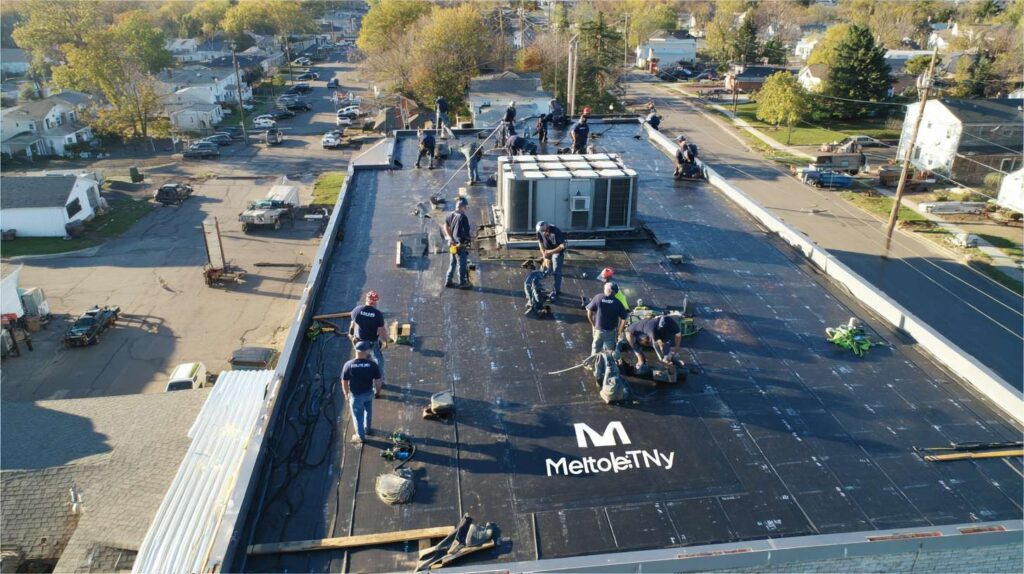
Seven in the morning on a wet Brooklyn roof tells you more than a polished estimate ever will. I was on a flat-roof row house in Bed-Stuy at 7:10 after a night of hard April rain, and the owner was convinced the whole roof had failed because water was coming through a second-floor light fixture. The membrane issue turned out to be small. The real problem was a mason had sealed weep paths during a facade repair, and the moisture had been traveling sideways through the wall assembly before it showed up inside. That roof was out of tune – the visible symptom and the actual failure weren’t even in the same place. If the first contractor on that job had only looked where the stain was, that homeowner could’ve lost thousands chasing the wrong problem.
⚠ Warning: Confidence Without Diagnosis
Don’t trust any contractor who proposes a full replacement, a silver coating, or broad “repair everything” language before they’ve physically checked your drains, penetrations, flashing transitions, parapet walls, and ventilation details. Those aren’t steps they get to skip because they’ve “seen this before.”
A stain is evidence. It is not a diagnosis.
Use the estimate to expose what a contractor missed
I remember one homeowner in Ditmas Park holding three bids like they were lottery tickets – flipping them over, comparing the bottom numbers, trying to make sense of why they were so different. Most estimates look comparable until you translate what’s missing from each one. As Marcus Webb, with 17 years in roofing and a specialty for spotting ventilation and patchwork issues on Brooklyn brownstones, would tell you: the number at the bottom means almost nothing if the scope above it doesn’t define what’s actually being done. I saw the same thing in Bay Ridge – an older couple with three estimates spread across a plastic patio table, and one contractor had written “new silver coat” as if that were a complete roofing plan. No insulation notes. No drain condition. No flashing scope. Nothing. I spent more time translating the other two bids than talking about my own.
Here’s my blunt opinion: if a contractor talks faster than he inspects, slow the whole meeting down. Ask him to stop. A legitimate written scope should define the materials by name and thickness, describe the flashing scope in linear feet, note insulation condition or deck findings, document drain and scupper performance, state tear-off assumptions clearly, and include warranty terms that aren’t buried in a handshake. If those things aren’t in the estimate, what you’re holding isn’t an estimate – it’s a guess with a number attached.
Here’s what separates a real diagnostic bid from a page that looks professional:
| Scope Item | Vague Bid | Usable Bid | Trustworthy Diagnostic Bid |
|---|---|---|---|
| Leak Source Identified | “Leaking roof repaired” | “Leak at rear parapet noted” | “Moisture entry confirmed at base flashing behind NE parapet; weep path blocked by prior repointing” |
| Photo Documentation | None provided | 1-2 photos attached | Labeled photo report of all penetrations, flashing transitions, drains, and visible failures included |
| Roof Area Measured | Not listed | “Approx. 1,200 sq ft” | “1,240 sq ft measured; includes rear addition at lower elevation” |
| Material Specified | “Quality roofing materials” | “Modified bitumen, 2-ply” | “Torch-applied modified bitumen, SBS 160 mil base + granulated cap; manufacturer listed” |
| Flashing Details Listed | “Flashing repaired as needed” | “Parapet flashing replaced” | “Replace lead boot at vent stack; reflash 8 linear feet of base flashing at rear parapet; counterflashing sealed at cap” |
| Drain/Scupper Condition | Not mentioned | “Drains cleaned” | “Clear drain and test flow rate; scupper opening at south wall partially obstructed – addressed in scope” |
| Insulation/Deck Notes | Not listed | “Insulation replaced if wet” | “Deck inspection after tear-off; wet insulation replacement at rear section priced as allowance per sq ft” |
| Cleanup/Disposal | Not mentioned | “Site cleaned up after job” | “Full tear-off debris removed; dumpster on-site Day 1; street-level cleanup included” |
| Warranty Language | “1 year warranty” | “Workmanship warranty included” | “5-year workmanship warranty on all flashing and membrane; manufacturer material warranty documentation provided at completion” |
| Payment Schedule | “50% upfront, balance on completion” | “30% deposit, rest on completion” | “30% deposit, 40% at mid-point after deck inspection sign-off, 30% at completion and walkthrough” |
Watch for Brooklyn-specific trouble spots before you approve any work
Before we talk price, I usually ask: what exactly did the last guy say was failing? Because in Brooklyn, that answer tells me a lot about whether he actually looked at the roof. Flat roofs in Bed-Stuy with tied-in rear additions, parapet walls in Park Slope that haven’t been repointed since the ’90s, old vent penetrations on Bay Ridge two-families, brownstone facades in Ditmas Park with cracked limestone lintels above the roofline – every one of those creates a different kind of misdirection. The leak doesn’t always come from where you think. Facade work, tied-in neighbor roofs, and old masonry interfaces above the roofline send moisture sideways, downward, and diagonally before it ever touches your ceiling.
A roof is a lot like an old piano – when one section shifts, the noise shows up somewhere else first. Spent years tuning uprights before I ever got on a roof, and that’s exactly how I still think about drainage, flashing, and ventilation: they’re a system, and when one element goes out of tune, you don’t hear it at the failure point – you hear it two rooms over, or a floor below, or three weeks after a rain event. The question I’d push any homeowner to ask isn’t just “where did the water come in?” It’s: where did it enter the assembly, how did it travel, and what roof detail allowed that travel? A contractor who can’t answer all three hasn’t finished diagnosing.
Most Misleading Symptom
Interior stain location
Water travels. Where it shows up is rarely where it entered.
Most Overlooked Item on Flat Roofs
Drain and scupper performance
Slow drains cause ponding that accelerates every other failure on the roof.
Most Expensive Mistake
Approving replacement before tracing the moisture path
A new roof over an unresolved masonry or drainage issue fails faster than the old one.
Most Common Vague Estimate Phrase
“Coating without scope”
If the coating plan doesn’t address drain condition, flashing, and seams – it isn’t a plan.
Avoid the repair moves that look reassuring and fail fast
What rushed patchwork usually does wrong
The truth about bad roofing decisions is that they usually start with panic, not damage. A homeowner gets a bucket on the floor, sees a dark ring spreading across the ceiling after a storm, and the next morning they’re handing a check to the first person who shows up with a ladder and a confident tone. That urgency is exactly what no-address operators and cash-price same-day guys count on. No written scope, no inspection report, no business address on Atlantic Avenue or anywhere else you could verify – just a guy with caulk and a story about how “this happens all the time.”
One summer Friday just before sunset in Park Slope, I got called to look at a roof that had been “fixed” that same week by someone the homeowner found online with a cash price and no traceable address. He had smeared roof cement around a vent stack near the rear of the building, skipped the base flashing entirely, and trapped water under the patch so completely it looked almost intentional. From the sidewalk on the block between 6th and 7th Avenue, it looked neat – tidy, even. But that’s not the part I’d focus on. The part that mattered was what was happening underneath: hidden water with nowhere to drain, flashing that was never installed, and a wood deck that had been absorbing moisture for who knows how long before I got there. That roof was already out of tune the minute the work was done. It just hadn’t started playing loud enough for anyone to notice yet.
| Myth | Real Answer |
|---|---|
| “If the leak stopped this week, the repair worked.” | Leaks stop when rain stops or when moisture finds a new travel path. No visible dripping doesn’t mean no active failure – it often means water is pooling somewhere you can’t see yet. |
| “The cheapest bid saves money.” | A cheap bid that skips flashing, ignores drain condition, or misidentifies the leak source usually means a second contractor call within 18 months. That second call costs more than the difference between bids. |
| “Roof coating is a repair plan by itself.” | Coating over a compromised membrane, blocked drain, or failed flashing is a cosmetic move. It delays the symptom and traps the failure. Coating has its place – but only after the underlying system is actually sound. |
| “A contractor can diagnose from interior photos alone.” | Interior photos show the result, not the cause. A reliable estimate requires roof access, physical inspection of penetrations and flashing transitions, and ideally a look at drain flow. Photos don’t replace boots on the roof. |
| “Fresh roof cement means the flashing was fixed.” | Roof cement applied over missing or failed flashing is a temporary seal at best. If the base flashing wasn’t replaced or properly set, the cement fails with the next freeze-thaw cycle or hard rain event – often within a single season. |
Finish with a short list of questions that force a real answer
You don’t need to sound like a roofing inspector to hold a contractor accountable. You just need to ask questions that require him to show his reasoning – not just recite a price. If he answers in generalities or gets impatient, that’s the diagnostic right there. The questions below aren’t trick questions. They’re the same things any contractor at Dennis Roofing would expect to be asked before walking a Brooklyn homeowner through an estimate.