
Brooklyn Commercial Roofing Replacement Service Cost Guide
In Brooklyn, commercial roofing replacement services can run anywhere from $8-$15 per square foot for straightforward projects to $20+ per square foot on complex, occupied buildings-and the only way to make sense of those numbers is to understand what’s inside them. After 21 years estimating and planning commercial replacements across every Brooklyn neighborhood, I can tell you the wide spread isn’t because contractors are randomly picking numbers; it’s because a 10,000-square-foot flat roof on a one-story warehouse in Sunset Park has almost nothing in common, cost-wise, with a 10,000-square-foot roof on a four-story mixed-use building in Crown Heights where tenants are living underneath and you’re working over active storefronts.
The difference comes down to six major cost components, and each one behaves differently depending on your building type, location within Brooklyn, current roof condition, and how the building is used during construction. Let me break down exactly what you’re paying for when you hire commercial roofing replacement services, using real Brooklyn projects to show how these numbers move.
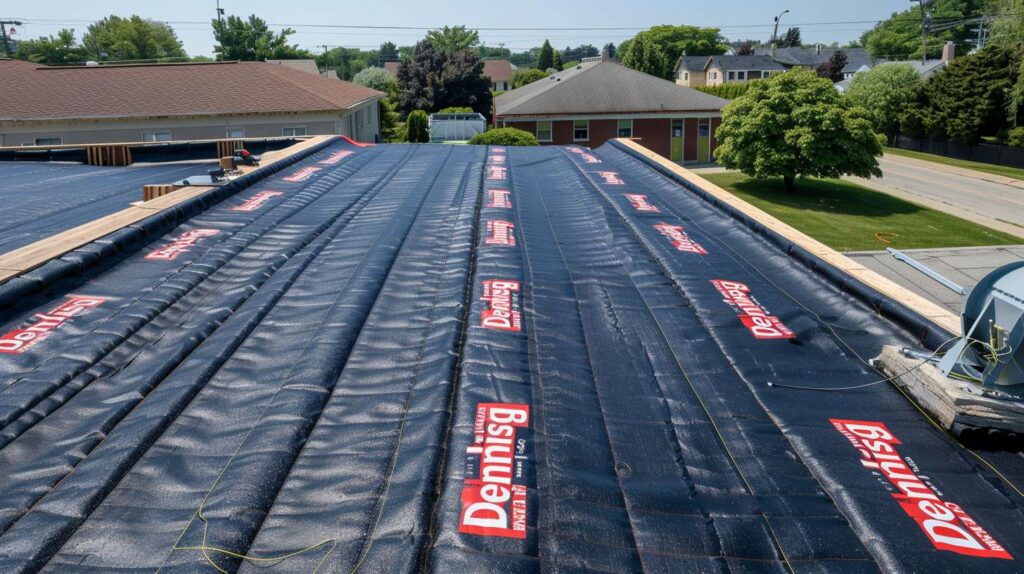
The Six Core Components of Commercial Roofing Replacement Cost
Every legitimate commercial roofing replacement estimate should account for these buckets. If your contractor isn’t addressing all six, you’re either getting an incomplete price or they’re hiding costs that will surface later as change orders.
Inspection, engineering, and design typically run $1,500-$4,500 depending on building size and complexity. This includes core sampling to see what’s under your existing membrane, moisture surveys if you suspect saturation, structural calculations if you’re adding insulation weight, and stamped drawings required for NYC Department of Buildings permits. On a straightforward 8,000-square-foot single-story building, this might be $2,000. On a landmarked building in Brooklyn Heights or a building where we’re investigating suspected deck damage, it can push $6,000.
Tear-off and disposal is where Brooklyn’s density really impacts cost. We’re not talking about a suburban site where you can drop a dumpster and toss debris from the roof edge. Most Brooklyn commercial buildings require sidewalk sheds, street closures coordinated with DOT, crane or Equipter lifts to lower debris without blocking sidewalks, and disposal fees that run $75-$110 per ton at metro-area transfer stations. For a typical modified bitumen or single-ply tear-off, figure $2.50-$4.50 per square foot just for removal and hauling. If you’re pulling off multiple layers-say, two generations of built-up roof plus saturated insulation-that number climbs to $5-$7 per square foot because disposal tonnage doubles or triples.
Materials account for the biggest swing in price. A basic EPDM single-ply system with code-minimum R-value insulation runs $3.50-$5.00 per square foot in materials. A premium TPO with enhanced puncture resistance and upgraded polyiso insulation pushes $5.50-$7.50. A full torch-down modified bitumen system with two-ply base and cap sheet lands around $4.50-$6.50. And if you’re stepping up to a 20-year NDL warranted TPO or PVC system with tapered insulation to eliminate ponding, you’re looking at $7.00-$9.50 per square foot in materials alone. I worked on a 12,000-square-foot warehouse replacement in East Williamsburg last year where the owner initially wanted the cheapest EPDM option at $4.10 per square foot materials, then switched to a 20-year warranted TPO with tapered insulation at $7.80 after I showed him the ponding issues on his current roof were causing a leak service call every 18 months at $850-$1,200 per visit.
Labor and safety is the reality check most building owners don’t see coming. In Brooklyn, union labor rates for commercial roofing run $75-$95 per hour fully burdened. Even non-union experienced crews cost $50-$65 per hour when you factor payroll taxes, insurance, and benefits. Installation labor typically adds $3.50-$6.00 per square foot depending on system complexity, roof access, and whether crews can stage materials on-site or need to shuttle everything up daily because there’s no secure overnight storage. Then add safety and site protection: OSHA-compliant edge protection and guardrails, sidewalk sheds if required by DOB, dust and debris containment for occupied buildings, traffic flaggers if you’re using a crane over a street. On a simple one-story building with good truck access and no occupied spaces below, safety might add $0.75-$1.25 per square foot. On a four-story walkup in Bed-Stuy where we’re protecting storefronts, coordinating with active tenants, and working over pedestrian sidewalks, safety and site protection can run $2.50-$4.00 per square foot.
Code-driven upgrades are where Brooklyn commercial projects separate from suburban jobs. NYC energy code requires minimum R-values that often mean adding two to four inches of polyiso insulation even if your existing roof has some insulation. If your building was built before 1968 and has a wood deck, expect to install a recovery board or DensDeck over the existing planks before the new membrane goes down-that’s another $1.50-$2.25 per square foot. Parapet walls often need new coping and flashing that meets current wind uplift standards. Roof penetrations for HVAC, plumbing vents, and exhaust fans need to be brought up to current waterproofing standards, which on an older building with 15-20 penetrations can add $3,500-$6,000 to the project. And if your building needs fire-rated roof assembly or enhanced wind uplift ratings because of height or exposure, materials and attachment costs increase accordingly.
Permits, inspections, overhead, and profit round out the estimate. NYC DOB permits for commercial roofing run $1,200-$3,500 depending on project scope and building classification. Inspections by DOB and special inspectors for fire-rated or critical assemblies add another $800-$2,200. Contractor overhead-insurance, bonding, project management, office costs-typically runs 12-18% of direct costs. Profit margins on commercial work range from 8-15% depending on project complexity and competition. When you add it all up, these “soft costs” contribute another $2.50-$4.50 per square foot to the final number.
Real Brooklyn Building Types and What They Actually Cost
Let me walk through four actual project profiles to show how these components combine into real-world pricing for commercial roofing replacement services.
Small single-story commercial building (Bay Ridge auto shop, 5,500 square feet): Single-layer modified bitumen tear-off, wood deck in good condition, good truck access, installed new TPO single-ply with code-minimum insulation. Minimal penetrations, straightforward parapet details, owner coordinated business closure during construction so no occupied-space protection required. Total installed cost: $52,800, or $9.60 per square foot. Breakdown: $1,800 engineering and design, $2.50/sq.ft. tear-off, $5.20/sq.ft. materials, $4.00/sq.ft. labor, $1.25/sq.ft. safety, $1.80/sq.ft. code upgrades (insulation and recovery board), $1,850 permits, plus overhead and profit.
Mid-size warehouse (Sunset Park, 18,000 square feet): Built-up roof tear-off with saturated insulation, concrete deck, crane required for debris removal and material staging, new fully-adhered TPO system with tapered insulation to address chronic ponding. Building operational during construction but no occupied spaces directly below roof. Total installed cost: $234,000, or $13.00 per square foot. The jump from the Bay Ridge project came primarily from disposal costs-we hauled 87 tons of saturated built-up roof and insulation-and the tapered insulation system, which added $2.40/sq.ft. over flat insulation but solved a drainage problem that had been costing the owner $4,500-$6,000 per year in leak repairs and production interruptions.
Mixed-use walkup (Crown Heights, 8,200 square feet): Four stories, residential apartments below, active ground-floor retail, modified bitumen tear-off, roof access via interior stairwell only (no exterior hoist capability). Installed TPO with enhanced insulation, required sidewalk shed over storefronts, dust containment and noise restrictions (no work before 8 AM or after 5 PM per lease agreements), daily material shuttling because no secure roof staging. Total installed cost: $156,400, or $19.07 per square foot. The premium over a comparable-size single-story building was entirely access, protection, and coordination: sidewalk shed rental ran $8,200 for six weeks, material handling and daily staging added $1.80/sq.ft., and tenant coordination plus restricted hours extended the schedule from three weeks to five-and-a-half, adding labor costs.
Office building (Downtown Brooklyn, 22,000 square feet): Six stories, fully occupied, required phased replacement to keep certain roof areas weathertight while others were open, upgraded to PVC with 20-year NDL warranty and full tapered insulation system, extensive HVAC and mechanical penetrations, fire-rated assembly required per building code, special inspection and third-party quality assurance. Total installed cost: $462,000, or $21.00 per square foot. This is the upper end of Brooklyn commercial roofing replacement pricing, driven by occupied-building logistics ($3.20/sq.ft. for protection and phasing), premium membrane and warranty ($8.40/sq.ft. materials), and the engineering and inspection requirements for a critical commercial building.
Cost Factors You Can Control and What’s Worth the Money
After estimating hundreds of Brooklyn commercial roofing replacement projects, I can tell you exactly where building owners should spend more and where they’re often wasting money on features that don’t deliver value.
Tear-off vs. recover: NYC building code allows roof recovers in many situations if you’re not exceeding weight limits and you don’t already have two roof layers. A recover-installing new membrane and insulation directly over an existing single-ply or modified bitumen roof-cuts your tear-off and disposal costs by $2.50-$5.00 per square foot. On that 18,000-square-foot Sunset Park warehouse, a recover would have saved approximately $67,500. We didn’t do it because moisture surveys showed the existing insulation was 40% saturated, and putting a new roof over wet insulation is guaranteed failure. But on buildings where the existing roof is dry and structurally sound, recover is often the smartest financial decision. The key is getting core samples and moisture surveys-spending $1,200 on investigation can either save you $50,000+ on tear-off or prevent you from making a $200,000 mistake by covering up problems.
Insulation strategy: Brooklyn’s code requires R-30 for most commercial roofs, which typically means four to five inches of polyiso insulation. You can meet that with flat insulation at $1.80-$2.40 per square foot or tapered insulation at $3.60-$5.20 per square foot. Tapered costs nearly double but creates positive drainage to eliminate ponding water-and ponding is the number-one cause of premature membrane failure and leaks on flat roofs. If your current roof holds water for more than 48 hours after rain, tapered insulation pays for itself in avoided leak repairs and extended membrane life. I estimate tapered systems reduce leak service calls by 60-70% over a 20-year roof life, which at $1,000-$1,500 per service call adds up to real savings. But if your existing roof drains well and you’re on a tight budget, flat insulation with strategic crickets at problem areas is a reasonable middle ground.
Membrane selection and warranties: Basic EPDM or TPO with a 10-year material warranty costs $3.50-$5.00 per square foot installed. Upgraded TPO or PVC with 15-year labor-and-material warranties runs $5.50-$7.50. Premium systems with 20-year NDL (no-dollar-limit) warranties cost $7.50-$10.00. The warranty upgrade from 10-year to 20-year costs roughly $2.50-$3.50 per square foot, or $22,500-$31,500 on a 9,000-square-foot roof. Is it worth it? For buildings you’re holding long-term, yes-assuming the contractor installing it is financially stable enough to honor warranty service 15 years from now. For buildings you’re selling within five years, probably not. The exception is if you’re trying to attract financing or purchasers who want clean inspection reports and long remaining roof life; in that case, the 20-year warranty is a balance-sheet and marketability asset, not just a construction decision.
Access and logistics: This is where careful planning saves serious money. If your building has an exterior wall where a crane can reach the roof without blocking traffic or requiring street closures, you’ll save $3,500-$6,500 compared to buildings where we’re shuttling materials through interior stairwells or rigging complex pulley systems. If you can coordinate your roofing replacement with other building work-say, façade repairs that already require a sidewalk shed-you split the shed cost and save $4,000-$8,000. If you can vacate a building or phase tenant spaces so we’re not working over occupied areas, you eliminate protection costs that run $1.50-$3.50 per square foot. On a recent 14,000-square-foot project in Greenpoint, the owner delayed the roof replacement by four months to align it with a planned tenant move-out on the top floor. That timing coordination saved $18,200 in occupied-space protection and noise-restriction labor costs.
Timing and Phasing Strategies for Brooklyn Commercial Buildings
One of the biggest advantages commercial building owners have-that residential owners don’t-is flexibility in project phasing. Commercial roofing replacement services don’t have to happen all at once, and in Brooklyn’s capital-constrained market, smart phasing often makes the difference between doing the work now or deferring it until problems get worse and more expensive.
Single-phase complete replacement is the standard approach and usually the most cost-effective per square foot because you’re mobilizing once, getting one permit, and running one set of safety infrastructure. But it requires the full capital outlay upfront-$150,000 to $300,000 for most Brooklyn commercial buildings-and it means the entire roof is under construction simultaneously, which creates logistics challenges for occupied buildings.
Two- or three-phase replacement splits the work across multiple budget years. We did this on a 26,000-square-foot industrial building in Bushwick where the owner had CapEx budget limitations but knew the roof needed replacement within 24 months. We prioritized the 12,000 square feet over the production floor and office (where leaks caused direct business impact) in Phase 1, then did the 14,000 square feet over the warehouse storage area (where leaks were annoying but not mission-critical) in Phase 2 eighteen months later. The phased approach cost about 12% more than single-phase would have-$312,000 vs. approximately $278,000-due to double mobilization and two permit fees, but it spread the cash outlay and let the owner protect operations first, storage second. For the right building and the right financial situation, that trade-off makes perfect sense.
Section-by-section replacement based on condition is another approach I use when core sampling shows different areas of a roof aging at different rates. Maybe the south- and west-facing sections are severely UV-damaged and ponding, while the north and east sections have another 3-5 years of useful life. Replacing the critical sections now and planning for the remaining sections in 2-4 years captures most of the benefit of a full replacement while deferring half the cost. The key is making sure the phase breaks work logically-you need clean tie-in lines and proper transition flashing, and you can’t leave valleys or drainage points half-done.
What Commercial Roofing Replacement Services Actually Include
When you’re comparing estimates from different contractors, it’s critical to know what’s included and what’s not. I see building owners comparing a $12.50/sq.ft. price from one contractor against a $16.00/sq.ft. price from another and assuming the lower number is the better deal, when in reality the first estimate doesn’t include permits, engineering, or several code-required upgrades that will become change orders later.
A complete commercial roofing replacement scope should include: engineering and stamped drawings for DOB permit; tear-off of existing roofing down to deck; disposal of all roofing debris; deck repairs as needed (though extensive deck replacement is usually an allowance or per-square-foot adder); new insulation meeting code requirements; new membrane fully installed per manufacturer specs; new base and counter flashing at parapets and walls; new pipe boot flashings at all penetrations; new edge metal and drip edge; new coping and cap flashing if existing is deteriorated; manufacturer warranty registration; DOB permit and inspection fees; and site protection including edge barriers and debris containment.
What’s usually not included, and you need to budget separately: structural repairs beyond basic deck patching; HVAC curb replacement or modification; skylight replacement; rooftop equipment disconnection and reconnection (your mechanical contractor typically handles this); interior ceiling or drywall repairs if we discover leaks caused damage; and sidewalk sheds or scaffolding if required by DOB for buildings over a certain height or with specific façade conditions-sometimes these are included, sometimes they’re a separate line item.
| Building Type & Size | Typical Cost Range (per sq.ft.) | Primary Cost Drivers | Realistic Timeline |
|---|---|---|---|
| Single-story commercial, 5,000-10,000 sq.ft. | $9.00-$13.50 | Membrane choice, insulation thickness, access quality | 2-4 weeks |
| Warehouse/industrial, 10,000-25,000 sq.ft. | $11.00-$16.00 | Existing roof condition, disposal tonnage, drainage improvements | 3-6 weeks |
| Mixed-use walkup, 6,000-12,000 sq.ft. | $16.00-$22.00 | Occupied-space protection, access limitations, coordination requirements | 4-7 weeks |
| Multi-story office/commercial, 15,000-30,000 sq.ft. | $18.00-$24.00 | Phasing, mechanical complexity, enhanced warranty requirements, special inspections | 6-10 weeks |
How to Get Accurate Brooklyn Commercial Roofing Replacement Pricing
The worst way to approach commercial roofing replacement services is to call three contractors, ask for prices over the phone, and go with the lowest number. You’ll either get wildly inaccurate estimates or you’ll get accurate estimates for three completely different scopes, and comparing them is meaningless.
The right approach starts with understanding your building. Get a roof inspection that includes core samples-not just someone walking the roof and eyeballing it, but actual destructive testing to see what’s under the membrane, whether insulation is wet, and what condition the deck is in. This runs $800-$1,800 but gives you and the contractors a common set of facts to estimate from. If three contractors are bidding on “replace existing modified bitumen roof” and one assumes there’s a single dry layer while another discovers during tear-off that there are three saturated layers, the change order fight that follows will cost you far more than the upfront investigation would have.
Provide all contractors with the same baseline information: building square footage, current roof system and approximate age, known issues like leaks or ponding, whether the building is occupied, any operational constraints (hours, access, tenant coordination), and your timeline. Ask each contractor for itemized pricing that breaks out tear-off, materials, labor, permits, and key assumptions. If one estimate is significantly lower, ask specifically what’s different-are they assuming a recover instead of tear-off? Are they proposing thinner insulation? Did they exclude something the others included?
For Brooklyn commercial buildings, I recommend getting estimates from contractors who have recent DOB permit history on similar buildings. The learning curve on NYC permitting and code compliance is steep, and contractors who primarily work in New Jersey or Long Island often underbid Brooklyn projects because they don’t understand the DOB process, special inspection requirements, or job-site logistics in a dense urban environment. You can verify this by asking for references on recent Brooklyn projects and checking DOB records to confirm permits were actually pulled and closed.
Expect the estimating process to take 2-4 weeks from initial contact to receiving detailed proposals. Contractors who provide a price within 24 hours of seeing your building are either guessing or using a price they gave someone else and hoping it’s close enough. The contractors who spend time measuring, doing core samples, reviewing building records, and calculating actual costs are the ones who will deliver accurate pricing and complete projects without constant change orders.
When to Replace and What Happens If You Wait
The decision to move forward with commercial roofing replacement services usually comes down to either preventive replacement-you know the roof is nearing end of life and you’re replacing it on your timeline-or reactive replacement, where leaks or failures force your hand. Preventive is always cheaper.
A commercial roof that’s replaced at 18-22 years of age, just as it’s approaching the end of its serviceable life but before major leaks develop, costs the baseline numbers I’ve discussed throughout this guide. A commercial roof that’s run to failure-say, 25-28 years old with active leaks causing interior damage-costs 15-35% more because now you’re doing emergency repairs to protect the building while planning the replacement, you’re dealing with deck damage from water infiltration, you’re paying for interior restoration, and you’ve lost leverage on timing and contractor selection because you need the work done immediately.
I worked with a client in Gowanus who postponed a planned replacement on a 16,500-square-foot roof for three years, trying to squeeze a few more years out of a 23-year-old EPDM roof that had minor seam issues but wasn’t actively leaking. In year 26, they had a major seam failure during a heavy rain that flooded their second-floor office space-ceiling tile replacement, drywall and insulation, computer equipment losses, business interruption while we did emergency patching, then the full roof replacement four months later. The total cost was $261,000 for the roof replacement plus $47,500 for interior restoration and emergency work, versus the $228,000 I had estimated three years earlier for planned replacement. The three-year delay cost them $80,500 in avoidable expenses.
The right time to replace a Brooklyn commercial roof is when inspection data tells you you’re at 75-85% of expected service life and before you’re experiencing frequent leaks. For most single-ply and modified bitumen systems, that’s around 18-22 years. For built-up roofs, it’s 15-20 years. For PVC and premium systems, it’s 22-28 years. Get inspections starting at year 15 or 16, track the condition annually, and plan replacement when you have 2-3 years of useful life remaining. That gives you time to budget, get multiple estimates, coordinate with other building work, and choose your timing instead of having weather and leaks choose it for you.
At Dennis Roofing, we’ve completed commercial roofing replacement services on more than 140 Brooklyn buildings over the past two decades, from small single-story shops to large multi-story occupied office buildings. Our approach is straightforward: detailed inspection and core sampling upfront, itemized estimates that show exactly what you’re paying for, planning that considers your budget and operational needs, and installation by experienced crews who understand Brooklyn’s unique logistics and code requirements. If you’re evaluating commercial roofing replacement costs for a Brooklyn building, we’ll provide the inspection data, cost breakdown, and phasing options you need to make an informed decision on your timeline. The best commercial roofing investment is one you make based on facts, planning, and clear numbers-not one forced by emergency.