
When Your Commercial Roof Can’t Be Saved, You Need the Right Contractor to Replace It
The Leak You See Is Usually Late to the Party
Watch what happens when nobody fixes the flashing. The ceiling stain your maintenance crew keeps mopping up isn’t where the problem started – it’s where the problem finally ran out of places to hide. Forget the stain on the ceiling for a second, because what matters is everything that already failed before a single drop hit the tile inside.
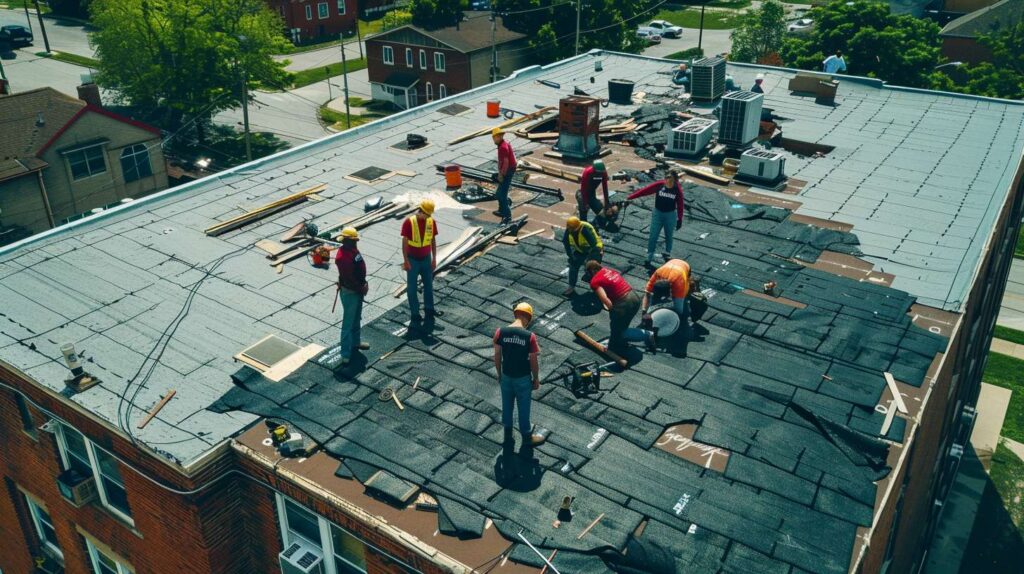
Water follows weak points. It travels sideways through saturated insulation, rolls along seams, pools behind parapet walls, and creeps through cracked penetrations before it ever drips down to where someone notices it. Water always leaves fingerprints if you know where to look – and on a Brooklyn flat roof, those fingerprints show up at flashing transitions, around rooftop equipment curbs, and along edge metal that’s been quietly rusting for years. By the time a bucket comes out on the top floor, the roof assembly has usually been in failure mode for a while.
⚠ Warning: Why Another Patch Can Cost You More Later
Patching over trapped moisture, rusted edges, or a roof that’s already been layered over multiple times doesn’t fix the system – it hides the damage. That hidden damage keeps spreading. Wet insulation saturates outward. Rust at the metal edge weakens the deck attachment. Multi-layer patchwork makes tear-off heavier and more expensive. Every temporary fix applied over a failing assembly increases the scope – and the cost – of the replacement that’s coming anyway.
Quick Reality Check: Brooklyn Commercial Roof Failures
Fact 1
Visible leak = often a late-stage symptom of failure that started somewhere else entirely.
Fact 2
Wet insulation spreads sideways across the roof deck before it ever drips down into the building.
Fact 3
Parapet and edge details fail more often than owners expect – and are almost always the actual source.
Fact 4
Replacement decisions should be based on test cuts and system condition – not on hope or guesswork.
Signals That Tell Me the Roof Is Finished
At 6 a.m. on a Brooklyn roof, the puddles tell the truth before the owner does. I’m Joe Santangelo – 22 years on Brooklyn commercial roofs, specializing in older mixed-use buildings with patched-over penetrations, strange rooftop additions, and parapet-heavy rooflines that have been worked on by whoever was cheapest that year. I was on a flat roof in Sunset Park at 6:10 in the morning after a night of wind-driven rain, and the super kept insisting the problem had to be coming from an HVAC curb we’d replaced the year before. I followed the wet insulation trail past two old patch jobs before I found it – a parapet wall flashing that had been “repaired” by three different crews over the years, each one covering what the last one left behind. That was one of those mornings where I had to tell the owner straight: this roof wasn’t losing a battle in one corner. It was done everywhere.
What Repeated Repairs Are Really Telling You
When you’re calling a roofer for the same building two or three times in 18 months, that’s not bad luck – that’s the roof telling you something. Patch maps that spread across the membrane, wet seams along edges, rust bleeding out from underneath the metal, and the discovery that there are already two or three roof layers up there: every one of those is a data point. None of them point toward another repair. They point toward a system that’s past its useful life.
What do I ask first when a customer says, “Can’t you just repair it?” I ask how far the moisture has traveled from where the leak shows up inside. I ask how many separate systems are buried under that surface. I ask whether anyone has checked if the deck is still sound, or if everyone’s been working from the top down and hoping for the best. Set the bucket aside and look at the assembly. That’s the only way to know what you’re actually dealing with.
| Roof Condition | Usually Repairable? | Why It Matters | What a Replacement Contractor Checks Next |
|---|---|---|---|
| Single isolated puncture or seam split, dry substrate | Yes | Damage is contained, deck is intact, no moisture migration has occurred yet. | Confirms dry insulation around the repair zone before closing it up. |
| Flashing failure at one penetration, first occurrence | Sometimes | Depends entirely on whether moisture has already traveled into the insulation below the flashing. | Cuts a test section to measure saturation spread before recommending repair scope. |
| Multiple patch locations across the field, wet insulation confirmed | No | Saturation has spread beyond any patch perimeter. New patches will seal moisture in, not out. | Evaluates full tear-off scope and deck condition across the entire affected area. |
| Two or more existing roof layers, edge rust, parapet damage | No | Layered systems hide structural and moisture problems. Edge rust indicates long-term water intrusion at the assembly boundary. | Assesses full removal, deck repair needs, drainage correction, and parapet rebuild requirements. |
Field Signs the Roof System Is at End of Service Life
-
1
Recurring leaks in different locations – water isn’t chasing one defect, it’s finding every opening the failing system offers. -
2
Visible bubbling, ridging, or membrane separation – the assembly has lost adhesion and is trapping moisture beneath the surface. -
3
Rust staining or soft spots at metal edges and drip edges – structural integrity at the roof perimeter is compromised. -
4
Two or more existing roof layers confirmed on inspection – weight loading is excessive, and prior failures are buried and unknown. -
5
Wet or compressed insulation confirmed by test cut – R-value is gone and continued moisture movement will reach the deck. -
6
Repair history with no documented moisture verification – previous crews chased visible symptoms and never confirmed what was happening below the surface.
Before You Sign Anything, Make the Contractor Show Their Thinking
Here’s my opinion: if you’re patching over wet insulation, you’re buying the same problem twice. A legitimate commercial roofing replacement contractor should be able to walk you through the tear-off scope before you commit to anything – how much of the assembly comes off, what the deck review process looks like, where the drainage corrections need to happen, how edge metal and flashing details get rebuilt, and what the plan is to protect your tenants or operations during the work. If a contractor gives you a number without opening test cuts or showing you a moisture finding, that’s not a proposal. That’s a guess with your money attached to it.
If the contractor cannot show you how the water traveled, why would you trust him to stop it?
Before You Call: What to Have Ready for a Commercial Roofing Replacement Contractor
Pull this information together before your first conversation. It saves time and lets a real contractor give you a meaningful evaluation from the start.
-
Roof age if known – approximate installation year, even if it’s a rough estimate from prior ownership records. -
Number of prior repairs – how many times has someone been called out, and did any of them include a written scope or warranty? -
Leak locations – where on the roof and where inside the building. Mark them on a sketch if you can. -
Interior damage pattern – staining, mold signs, ceiling tile damage, or any soft spots in the deck below the roof. -
Rooftop equipment changes – any new HVAC units, added conduit, satellite dishes, or penetrations added since the last roof installation. -
Access restrictions – narrow sidewalks, tenant hours, loading zones, or proximity to busy corridors like Atlantic Avenue that affect staging and dumpster placement. -
Whether test cuts or moisture scans were offered – any contractor who hasn’t proposed either of these in their assessment process hasn’t fully evaluated your roof.
How Replacement Decisions Get Made on Real Brooklyn Roofs
I remember peeling back one corner in Red Hook on a gray Friday morning and smelling the failure before I fully saw it. That building on Van Dyke Street had been dripping on top-floor tenants for two seasons, and once we opened the roof we found the whole story: old membrane, older membrane underneath it, trapped moisture compressed between the layers, and rust working through the metal edge from the inside out. That’s what a roof looks like when it’s been acting as a sponge for years. No patch was going to fix that. What that property needed was someone who knew how to take the whole assembly apart, assess what the deck still had left, and rebuild it right. Hiring a replacement contractor with real experience on layered Brooklyn roofs – not just a crew with buckets of coating – is what made the difference between a lasting fix and another round of wishful thinking.
One August afternoon in Bushwick, the tar was soft enough to grab your boots, and a restaurant owner wanted one more coating to limp through the summer. I cut a test section near a drain and the insulation came up black, wet, and sour-smelling in sheets. Standing there with the lunch rush starting downstairs, I told him straight: another coating would seal that moisture in and push the deck repair into the next project budget too. The real insider tip here isn’t about the coating – it’s about the drain. Forget the stain on the ceiling for a second, and ask where the water wants to go after the new roof is installed. Toward the drains, away from edges and penetrations. If the replacement plan doesn’t correct how water moves across that field, you haven’t fixed the problem, you’ve just reset it.
The Right Sequence: Commercial Roof Replacement Evaluation & Project Steps
-
1
Review leak history and repair map. Gather every documented repair, callback, and leak location. A contractor who skips this step doesn’t understand the failure pattern they’re inheriting. -
2
Inspect penetrations, edges, and drainage. Walk every parapet transition, rooftop equipment curb, pipe boot, and drain. These are the places where failures originate – not the middle of the field. -
3
Perform test cuts or moisture verification. Open the assembly at representative locations to confirm insulation condition and measure how far moisture has actually traveled from each reported leak zone. -
4
Define tear-off scope and deck repair needs. Determine what layers must come off, document deck conditions found, and identify any structural repairs required before the new system goes down. -
5
Select replacement system and full detail package. Choose membrane type, insulation assembly, edge metal, flashing details, and drainage corrections – designed as a complete system, not a collection of separate decisions. -
6
Schedule occupant protection, staging, and final quality checks. Plan access, debris removal, weather windows, and end-of-project inspection to confirm seams, terminations, and drainage points are closed correctly.
What a Contractor Should Be Able to Explain Without Getting Vague
Questions Owners Ask Right Before They Commit
Blunt truth – commercial roofs rarely die all at once. What usually happens is a slow accumulation of ignored signals: flashing that got touched up, insulation that absorbed one wet winter too many, a drain that’s been half-clogged for two years. By the time you’re calling Dennis Roofing to talk about full replacement, the roof has already been telling you for a while. The goal here isn’t finding the cheapest tear-off crew on the borough – it’s hiring a commercial roofing replacement contractor who can explain where the failure path started, what the replacement has to fix, and which details in the new assembly are the ones that will actually keep the next roof honest.
If your Brooklyn building keeps leaking and the roof is showing full-system failure, call Dennis Roofing to have a commercial roofing replacement contractor inspect the full assembly and explain the replacement scope in plain terms – no vague proposals, no guesses. Call Dennis Roofing today and get a straight answer about what your roof actually needs.