Professional Cedar Roof Replacement Services in Brooklyn, NY
How do you know when it’s time to stop repairing your cedar roof and finally replace it? If you’re in Brooklyn with a cedar roof that’s leaking in the same spots year after year, showing curling shakes across multiple sections, or costing you $1,200-$1,800 in emergency repairs every spring, you’ve likely crossed that line. A full cedar roof replacement in Brooklyn typically costs $14,500-$28,000 depending on roof size, pitch, and material choice-but once you’re past the 25-year mark on your existing cedar roof, replacement becomes the smarter long-term investment than patching. At Dennis Roofing, we’ve led cedar roof replacements across Park Slope, Ditmas Park, Bay Ridge, and Carroll Gardens for the last decade, and the homeowners who wait too long end up paying for both the repair and the replacement within the same year.
When Cedar Repair Stops Making Sense
Three years ago we tore off a cedar shake roof on a Ditmas Park Victorian that had been repaired eleven times in eight years. The owner kept calling roofers for spot fixes-flashing around the turret, shakes near the valley, ridge caps that kept blowing off-but nobody told him the real problem: his deck sheathing was rotted in four different areas, and every repair was just covering structural damage that kept spreading. That’s the difference between cosmetic aging and structural failure.
Cosmetic aging is what happens naturally to cedar: color fading from honey to silver-gray, minor cupping on individual shakes, moss growth in shaded areas. Structural failure is splitting that goes all the way through the shake, multiple leaks in different roof sections, visible sagging along ridge lines, and shakes that have lost their attachment and slide under hand pressure. If you’re seeing three or more of these signs, you’re looking at replacement:
- Widespread splitting and cracking across 30% or more of the roof surface
- Curling shakes that won’t lay flat even after moisture, indicating the wood fibers have permanently deformed
- Exposed nail heads and missing fasteners where shakes have pulled away from the deck
- Soft or spongy spots when you walk certain sections of the roof
- Interior ceiling stains in multiple rooms, not just around one chimney or valley
- Granular debris in gutters-wait, that’s asphalt. For cedar, look for wood fibers and chunks breaking down.
The real tell? When a qualified roofer inspects your deck and finds deterioration in the sheathing or rafters underneath. At that point, you’re not just replacing shakes-you’re rebuilding structure, and the math changes completely. A repair that costs $2,800 might only buy you 18 months before the next failure, while a replacement that costs $18,000 gives you 30-40 years with proper maintenance.
What Makes Brooklyn Cedar Replacement Different
Brooklyn isn’t Montana. We’ve got coastal humidity rolling in from the harbor, tree canopy on half the residential blocks, and row house configurations where your roof line touches or overlaps your neighbor’s. Those conditions shape every cedar replacement decision. Last summer we replaced a cedar roof on a Carroll Gardens brownstone where the north-facing slope-completely shaded by a massive London plane tree-was failing ten years faster than the south-facing slope. The shaded side stayed damp after every rain, never dried out fully, and the shakes rotted from the inside. The sunny side looked almost new.
That’s why we talk about treatment, exposure, and ventilation before we talk about price. Brooklyn cedar roof replacement means choosing between:
Untreated Western Red Cedar: Beautiful natural aging, lowest upfront cost ($14,500-$19,000 for typical 1,600-2,000 sq ft roof), requires annual maintenance including moss treatment and inspection. Ideal for sunny, well-ventilated roofs with minimal tree cover. Lifespan: 25-35 years with maintenance.
Preservative-Treated Cedar: Factory pressure-treated for rot and insect resistance, better performance in shaded or moisture-prone areas, costs about 20% more ($17,500-$23,000 for same roof size). The treatment doesn’t stop aging or color change, but it dramatically slows interior rot. We use treated cedar on any roof with significant tree shade or north-facing exposure. Lifespan: 35-45 years.
Fire-Rated Cedar: Required in some Brooklyn areas with strict building codes, treated for Class B or Class A fire rating, adds another 15-25% to material cost. If your insurance company or local code requires it, there’s no decision to make-but the durability benefits are the same as standard treated cedar. Lifespan: 35-45 years.
Shingle vs Shake: How It Changes Cost and Performance
We replaced a Bay Ridge semi-detached roof two winters ago, and the homeowner was stuck between cedar shingles and hand-split shakes. Shingles are sawn smooth on both sides, lay flatter, weigh less, and cost about $600-$900 less in material for an average roof. Shakes are split, textured, thicker, and create that classic rustic look you see on historic Brooklyn homes. The aesthetic difference is obvious when you’re standing on the sidewalk-shakes have depth and shadow lines that shingles don’t.
But there’s a performance trade-off. Shakes shed water faster because of their texture and thickness (usually 3/4″ vs 1/2″ for shingles), but they’re also harder to install properly and require more precise spacing and underlayment detailing. On a steeply pitched brownstone roof-common in Park Slope and Prospect Heights-shakes perform beautifully because gravity does the work. On a lower-pitch roof (4/12 or 5/12), which we see more often in Midwood and Marine Park, shingles are often the smarter choice because they seal tighter and leave fewer gaps for wind-driven rain.
| Cedar Type | Thickness | Cost Per Square Foot | Best Brooklyn Application | Expected Lifespan |
|---|---|---|---|---|
| Cedar Shingles (Untreated) | 1/2″ | $8.50-$11.00 | Sunny roofs, moderate pitch | 25-30 years |
| Cedar Shingles (Treated) | 1/2″ | $10.00-$13.50 | Shaded roofs, coastal areas | 35-40 years |
| Cedar Shakes (Untreated) | 3/4″ | $9.50-$12.50 | Steep pitch, architectural detail | 28-35 years |
| Cedar Shakes (Treated) | 3/4″ | $11.50-$15.00 | Premium projects, historic restoration | 40-50 years |
Note: Costs include material only. Full installation typically adds $4.50-$7.00 per square foot depending on roof complexity, height, and access.
The Underlayment Decision Nobody Talks About
Here’s where most cedar replacements go wrong: contractors focus on the visible wood and skip the conversation about what goes underneath. Traditional cedar roofs used felt paper-15 or 30-pound-and nothing else. That was fine in 1950 when cedar was cheaper, homeowners expected to replace roofs every 20 years, and nobody cared about energy efficiency. In 2025, if you’re spending $18,000-$25,000 on a cedar roof replacement in Brooklyn, you need modern underlayment that does three things felt paper never did: stops water infiltration at the deck level, allows the cedar to breathe so moisture escapes, and adds a secondary weather barrier that extends roof life even when individual shakes fail.
We spec synthetic underlayment on every cedar replacement now-specifically products like GAF Deck-Armor or similar breathable synthetics. They cost about $450-$750 more than felt for an average Brooklyn roof, but they don’t tear during installation, don’t absorb moisture, and provide far better protection during that three-to-five-year window when homeowners delay replacing a few failed shakes. On the Ditmas Park Victorian I mentioned earlier, we found the original felt paper had essentially composted into the deck sheathing. When we pulled up the old cedar, the felt came up in damp clumps mixed with sawdust and mold. The synthetic we installed will outlast the cedar itself.
For high-exposure areas-ridge lines, valleys, eaves, and sidewalls-we also install ice-and-water barrier even though Brooklyn isn’t Minnesota. Why? Because wind-driven rain during nor’easters behaves like snow melt: it doesn’t run straight down, it moves sideways and upward under shakes, and it finds every gap in your primary roofing layer. That extra $200-$350 in peel-and-stick membrane at vulnerable transitions has saved more callbacks than any other single detail change we’ve made in ten years.
Ventilation: Where Cedar Roofs Live or Die
A brownstone in Cobble Hill, about six years ago. Beautiful cedar shake roof, replaced by another contractor three years before we got the call. The homeowner was furious: shakes were already cupping on the back slope, dark staining was showing up along the ridge, and two shakes near the bathroom vent had split vertically. The roof was failing at year three of a promised 30-year life. We pulled a few shakes and immediately saw the problem-zero ventilation. No soffit vents, no ridge vent, and the attic space was cooking at 140°F during summer. The cedar was baking from below and weathering from above, aging at triple speed.
Cedar needs to breathe. The wood expands and contracts with humidity and temperature changes, and if you trap heat and moisture under the deck, you accelerate every form of deterioration: splitting, cupping, rot, and even fastener failure as the wood pulls away from nails. Proper cedar roof replacement includes:
- Continuous soffit or eave venting to pull cool air into the attic space
- Ridge venting or gable vents to exhaust hot, moist air at the peak
- Ventilation baffles installed between rafters to maintain clear airflow channels even with insulation present
- Proper spacing between shakes (usually 1/4″ to 3/8″) to allow the cedar itself to dry between rain events
On row houses and brownstones, ventilation is tricky because you’re often working with a shared party wall and limited attic access. We’ve installed solar-powered attic fans, added custom fabricated ridge vents that match historic profiles, and even cut new soffit vents into decorative cornices-whatever it takes to move air. The cost for ventilation upgrades during a cedar replacement runs $800-$2,400 depending on what exists and what the building needs, but it’s the difference between a roof that lasts 30 years and one that fails at 15.
What a Professional Cedar Roof Replacement Includes
When Dennis Roofing tears off and replaces a cedar roof in Brooklyn, the process takes 4-8 days depending on size and complexity. Here’s what actually happens, because most homeowners don’t see the work that matters most:
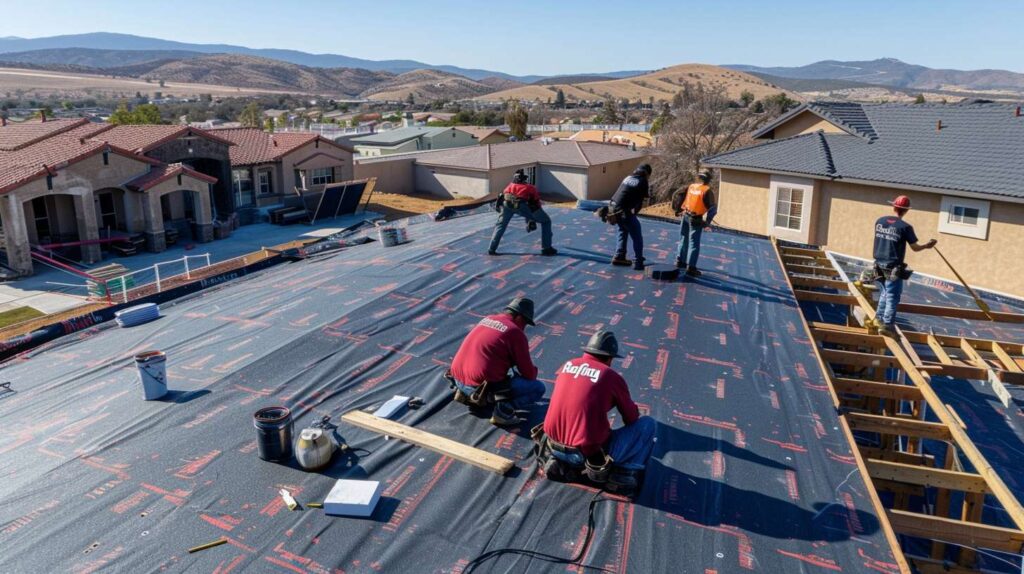
Day 1: Tear-Off and Deck Inspection. We strip the old cedar down to the roof deck, working in sections to keep the building protected. As each section comes off, we’re inspecting every square foot of sheathing for soft spots, rot, and structural damage. If we find bad sheathing-and we usually find some-we replace it immediately with new CDX plywood or OSB before moving forward. On Brooklyn row houses, we also inspect and photograph the condition of shared walls and flashing where roofs meet.
Day 2: Deck Repairs and Underlayment. Any damaged sheathing gets replaced, then we install the full underlayment system: synthetic breathable base layer across the entire deck, ice-and-water barrier at eaves, valleys, and penetrations, and ventilation baffles if we’re upgrading attic airflow. This is also when we address any structural improvements-adding blocking, reinforcing rafters, upgrading attachment points for heavy snow loads.
Days 3-6: Cedar Installation. Starting at the eave and working up, we install the cedar shingles or shakes with proper exposure (typically 5″ to 7″ for shingles, 7″ to 10″ for shakes), correct spacing for expansion, and stainless steel or hot-dipped galvanized nails that won’t stain the wood. Each course overlaps the one below by at least two layers, and we’re constantly checking alignment, spacing, and fastener placement. Valleys get woven or metal-lined depending on pitch and water volume. Ridge caps get custom-fitted and mechanically fastened, not just nailed.
Days 7-8: Flashing, Trim, and Final Details. All metal flashing around chimneys, skylights, and wall intersections gets replaced with new copper or coated steel. We install new drip edge at eaves and rakes, seal all penetrations, and add custom fabricated counter-flashing where the roof meets masonry walls-critical on Brooklyn brownstones. Final inspection covers every nail, every flashing seam, and every ridge cap, then we clean the site and haul away all debris.
Why Brooklyn Costs Run Higher Than National Averages
You’ll see online calculators suggesting cedar roof replacement costs $10-$15 per square foot. That might be accurate in rural Pennsylvania or suburban Texas. In Brooklyn, real-world costs run $13-$20 per square foot installed, and here’s why: permit fees in NYC run $300-$600 depending on scope, disposal costs are double the national average because we’re hauling to designated facilities, and labor rates reflect the skilled trades market in a dense urban area. A three-man crew doing cedar replacement in Brooklyn earns $180-$240 per hour in combined labor cost, compared to $120-$150 in most other markets.
Then there’s access. We’ve done cedar replacements in Brooklyn where we couldn’t get a dumpster closer than 80 feet to the building, required street permits for scaffolding, and had to hand-carry every bundle of shakes up three flights of interior stairs because there was no exterior access. One project in Brooklyn Heights required us to crane materials onto the roof from the street-at $1,400 for four hours of crane time-because the building was mid-block with no alley access and the interior stairs were too narrow for 18″ bundles.
So when we quote a cedar roof replacement, the price reflects real conditions: your specific building access, disposal logistics, permit requirements, and the complexity of your roof geometry. A simple gable roof on a detached house in Marine Park might come in at $14,500 for 1,800 square feet. A complex hip-and-valley roof on a Park Slope brownstone with three skylights, two chimneys, and scaffolding requirements might cost $26,000 for the same square footage. Both are fair prices for wildly different projects.
How Cedar Will Age on Your Brooklyn Block
One question we hear constantly: “What will my roof look like in five years?” New cedar is gorgeous-warm honey tones, tight grain, that fresh-cut smell. But cedar changes fast. Within six months, untreated Western Red Cedar starts silvering, especially on sun-exposed slopes. Within two years, you’ll have full gray patina on most of the roof. Some homeowners love that look; it’s the classic weathered aesthetic you see on historic homes across brownstone Brooklyn. Others hate it and want to maintain the warm wood tone.
If you want to slow or prevent silvering, you need to apply a semi-transparent penetrating stain or UV-blocking treatment every 3-5 years. That’s an additional maintenance cost of $1,200-$2,400 per treatment depending on roof size and access. Treated cedar still silvers, but more slowly and more evenly-you get that uniform gray color instead of blotchy dark and light patches. Neither approach is right or wrong; it’s about what fits your vision for the house and how much ongoing maintenance you want to commit to.
Moss and algae growth is another reality in Brooklyn, especially on tree-shaded blocks in Carroll Gardens, Windsor Terrace, and Prospect Lefferts Gardens. Moss doesn’t necessarily damage cedar immediately-it’s more of a long-term moisture retention issue-but it definitely changes the appearance. We recommend annual soft-wash cleaning with a zinc- or copper-based treatment that prevents biological growth without pressure washing, which can damage shake texture and remove wood fibers. Cost runs $350-$650 annually depending on roof size.
Questions to Ask Before Signing a Cedar Replacement Contract
Not every roofer who works in Brooklyn has deep cedar experience. Asphalt shingle installation is straightforward-there’s less variation in technique and materials. Cedar is different. The spacing, the fasteners, the underlayment, the ventilation-all of it requires specific knowledge and judgment calls that come from repetition. Before you sign a contract for cedar roof replacement, ask these questions and listen carefully to the answers:
- “What underlayment are you planning to use, and why?” If they say “30-pound felt” without mentioning breathability or synthetic options, they’re not current.
- “How will you address ventilation during this replacement?” If they don’t proactively bring up soffit vents and ridge vents, they’re missing a critical performance factor.
- “What fasteners do you use for cedar, and what’s the nailing pattern?” Correct answer includes stainless or hot-dipped galvanized, two nails per shake, positioned 1″ from edges and 1-2″ above the exposure line.
- “Do you replace deck sheathing as needed, and is that included in your quote or extra?” Some contractors lowball the estimate, then hit you with change orders when they find rot. Get clarity upfront.
- “What’s your plan for protecting the interior during tear-off?” Brooklyn row houses often have finished attics and living spaces directly below the roof. A professional crew tarps from inside, uses plywood protection, and minimizes dust infiltration.
The contractor who can answer these questions in detail, reference specific Brooklyn projects, and explain the trade-offs between materials and methods-that’s who you want doing your cedar roof replacement. Price matters, but it shouldn’t be the only factor. A roof installed correctly costs the same over 30 years as a roof installed cheaply that fails at 15 and needs early replacement.
Why We Still Recommend Cedar for the Right Brooklyn Homes
Full transparency: cedar isn’t the lowest-maintenance roofing option. That would be standing seam metal or high-end synthetic slate. Cedar requires attention, periodic treatment, and occasional shake replacement over its life. But for certain Brooklyn homes-particularly brownstones, historic Victorians, and architecturally distinct houses in landmark districts-cedar is still the best choice. It’s authentic to the building’s era, it adds warmth and texture that no synthetic can match, and it genuinely improves curb appeal and resale value in neighborhoods where architectural detail matters.
We’ve seen appraisals jump $40,000-$70,000 on Park Slope and Cobble Hill brownstones after a quality cedar roof replacement, not because the roof itself added that value, but because buyers in those markets are specifically looking for well-maintained historic details. A fresh cedar roof signals that the owner cares about the building’s character and has invested in proper restoration. That matters in Brooklyn’s preservation-minded neighborhoods in ways it wouldn’t in a suburban subdivision.
At Dennis Roofing, we’ve spent the last decade helping Brooklyn homeowners make smart decisions about cedar roof replacement-balancing aesthetics, performance, budget, and long-term value. If you’re looking at your aging cedar roof and wondering whether it’s time to replace or if you can get another few years, give us a call. We’ll come out, inspect the roof and the deck structure, and give you an honest assessment of where you stand. Sometimes that means replacement. Sometimes it means targeted repairs and a maintenance plan. Either way, you’ll know exactly what your roof needs and what it’ll cost, explained in plain terms by someone who’s done this work on hundreds of Brooklyn roofs just like yours.