
Expert Asbestos Roof Replacement Services in Brooklyn, NY
What really happens when you replace an asbestos roof on a Brooklyn home? It’s not a hazmat movie scene with space suits and sirens, but it is a tightly regulated, multi-stage process that requires licensed asbestos abatement specialists, strict containment protocols, and complete documentation before anyone can install your new roofing system. The entire project-from testing through final disposal-typically runs $12,500-$28,000 for a typical Brooklyn brownstone or two-family home, depending on roof size, material type, and whether you’re removing cement-asbestos shingles, corrugated panels, or transite siding integrated with the roof edge.
I’ve coordinated asbestos roof replacements across Brooklyn for nearly 25 years, and the biggest source of confusion isn’t the health risk-it’s who does what, when, and why three different contractors need to touch your roof before you see a single new shingle. Let me walk you through exactly how this works, what the regulations actually require, and the decisions you’ll face as a Brooklyn property owner dealing with an asbestos roof that’s reached the end of its life.
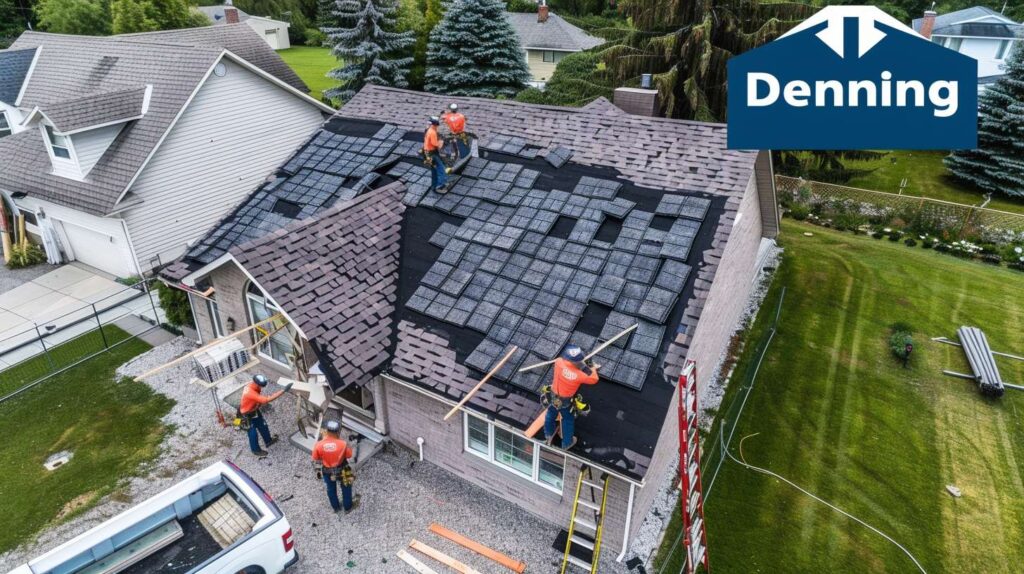
Understanding Asbestos Roofing Materials Common in Brooklyn
Before we discuss replacement, you need to know what you’re actually dealing with. Brooklyn’s housing stock-built heavily between 1900 and 1960-contains three main types of asbestos roofing:
- Cement-asbestos shingles: Flat or textured tiles that look like slate, installed on brownstones and attached row houses throughout Park Slope, Brooklyn Heights, and Fort Greene. These typically contain 20-40% asbestos fiber.
- Corrugated asbestos-cement panels: Wavy sheets found on flat-roof parapets, garage roofs, and small commercial buildings in Sunset Park, Red Hook, and industrial-edge neighborhoods. Common on buildings from the 1940s-70s.
- Transite panels and flashing: Flat asbestos-cement boards used at roof edges, around chimneys, and as cant strips on low-slope roofs. Often integrated with built-up tar roofing systems.
You cannot tell if a material contains asbestos just by looking at it. That’s not opinion-that’s New York City building code and EPA regulation. Any roof material installed before 1980 must be tested by a certified asbestos inspector before removal or disturbance. I’ve seen contractors eyeball a roof and say “that’s not asbestos” based on nothing but a hunch, then discover during demolition that they’ve just created an illegal asbestos release that triggers stop-work orders and five-figure remediation costs.
The Three-Stage Process: Testing, Abatement, and Replacement
A proper asbestos roof replacement in Brooklyn happens in distinct phases, each with its own specialists and regulations.
Stage 1: Inspection and Testing
A licensed asbestos inspector visits your property, collects samples from different roof areas (you need multiple samples because composition can vary across a single roof), and sends them to an accredited lab for polarized light microscopy analysis. Cost: $400-$750 for a typical residential inspection. Turnaround: 3-7 business days.
If the lab confirms asbestos content above 1%, you’re legally required to follow asbestos abatement procedures. There’s no threshold where “a little bit of asbestos” means you can skip the rules. One percent triggers full compliance with New York State Labor Law Article 30 and NYC DEP asbestos regulations.
Stage 2: Licensed Asbestos Abatement
Here’s where most homeowners get confused: your regular roofing contractor cannot remove asbestos roofing materials, even if they’ve “done it before” or “know how to be careful.” New York requires an EPA-licensed asbestos contractor with specific insurance, trained workers holding asbestos handler certificates, and a dedicated supervisor with an Asbestos Handling License (AHL).
The abatement process includes:
- Filing an ACP-5 asbestos project notification with NYC DEP at least 10 business days before work begins (required for projects over 10 square feet or 25 linear feet)
- Establishing containment barriers, negative air pressure, and designated decontamination areas
- Wetting materials throughout removal to prevent fiber release
- Double-bagging all asbestos waste in 6-mil poly bags labeled with asbestos warnings
- Air monitoring during and after removal to confirm fiber levels stay below 0.01 fibers per cubic centimeter
- Transporting waste to an approved asbestos disposal facility with complete chain-of-custody documentation
For a 1,200-square-foot brownstone roof with cement-asbestos shingles, abatement typically runs $8,000-$15,000 and takes 3-5 days depending on complexity, access, and weather. That cost covers labor, containment materials, air monitoring, disposal fees (often $85-$125 per ton), and all required documentation.
Stage 3: New Roofing Installation
Only after the abatement contractor completes removal, passes final air clearance testing, and provides you with disposal manifests can the roofing crew begin installing your new system. At this stage you’re working with a traditional roofing contractor-that’s Dennis Roofing’s specialty-selecting materials, warranties, and details for a roof that will outlast the one you just removed.
Most Brooklyn homeowners replacing asbestos roofs choose architectural asphalt shingles ($4,500-$8,500 installed), metal roofing ($9,000-$16,000), or synthetic slate ($12,000-$22,000) depending on the building’s architectural style and their budget. The installation timeline is 2-4 days for typical residential projects.
Can You Roof Over Asbestos Materials Instead of Removing Them?
Sometimes, yes-but the conditions are narrow and the decision requires careful analysis.
New York regulations allow “encapsulation” or covering asbestos roofing if the existing roof is intact, firmly attached, and won’t be disturbed during new roof installation. I’ve successfully supervised roof-over projects on flat commercial roofs where corrugated asbestos panels were stable and we installed a completely separate metal roofing system on new framing above the old surface, with zero penetration or disturbance of the asbestos layer.
But here’s the reality for most Brooklyn residential projects: cement-asbestos shingles on pitched roofs are usually brittle, cracked, or loosely attached after 60-80 years of freeze-thaw cycles and storm exposure. You can’t install new roofing over a deteriorating substrate-the new roof will fail within years, and you’ve now trapped friable asbestos under your expensive new system. Roof-over only makes sense when the asbestos material is in genuinely good condition, completely sealed, and the building structure can support the added weight.
The other factor: future responsibility. When you encapsulate asbestos instead of removing it, you’re deferring the problem. The next roof replacement-20, 30, 40 years from now-will require asbestos abatement plus removal of whatever roofing system you install today. For most Brooklyn homeowners planning to stay in their homes or sell within a realistic timeframe, complete removal eliminates ongoing disclosure requirements and future liability.
Regulations, Permits, and Documentation You Cannot Skip
Brooklyn asbestos roof replacements involve multiple regulatory touchpoints. Skipping any of them exposes you to stop-work orders, fines starting at $5,000, and personal liability if workers or neighbors are exposed to asbestos fibers.
| Requirement | When It Applies | Filing Timeline | Cost |
|---|---|---|---|
| ACP-5 Asbestos Notification (NYC DEP) | Projects disturbing >10 sq ft or 25 linear ft of asbestos | 10 business days before work starts | $150-$300 filing fee |
| Asbestos Air Monitoring | All abatement projects | During and after removal | $800-$1,500 per project |
| Waste Disposal Manifests | All asbestos waste transport | Before waste leaves site | Included in disposal fees |
| DOB Alteration Permit (Alt-1 or Alt-2) | When structural work is part of roof replacement | Before construction begins | $500-$2,500 depending on scope |
| Final Air Clearance Report | All abatement projects | Before roofing crew starts work | Included in monitoring costs |
I keep copies of every air clearance report and disposal manifest for my clients because these documents prove legal compliance if questions arise during property sales, refinancing, or insurance claims. A complete paper trail-from initial lab results through final disposal receipts-is your protection against future liability claims.
Real Project Timeline: Bay Ridge Two-Family Asbestos Roof Replacement
Let me walk through an actual project to show how these stages connect in real time. Last fall we coordinated a complete asbestos shingle removal and architectural shingle installation on a 1925 two-family home in Bay Ridge. The roof was 1,400 square feet with cement-asbestos shingles over wood sheathing.
Week 1: Asbestos inspector collected six samples from different roof areas and chimneys. Lab confirmed 32% chrysotile asbestos content. Inspector provided written report with recommendations.
Week 2-3: Homeowner obtained quotes from three licensed asbestos contractors, selected one, and the contractor filed ACP-5 notification with NYC DEP. We coordinated scheduling between abatement and roofing crews during this waiting period.
Week 4: Abatement crew arrived, established containment, and removed all asbestos shingles over four days. Air monitoring ran continuously. Waste was transported to an approved facility in Pennsylvania with complete manifests.
Week 5: Final air clearance testing confirmed fiber levels below regulatory limits. The abatement contractor provided clearance letter and all documentation. Dennis Roofing started roof installation the next day-new sheathing inspection, ice-and-water barrier, synthetic underlayment, and GAF Timberline HDZ shingles. Installation took three days.
Total timeline from first inspector visit to finished roof: five weeks. Total cost: $22,400 ($13,800 for abatement, air monitoring, and disposal; $8,600 for new roofing system).
What Drives Cost Variation in Brooklyn Asbestos Roof Projects
You’ll see wide price ranges because every asbestos roof replacement involves site-specific factors that dramatically affect labor, containment complexity, and disposal volume.
Roof access and height: A single-story garage with truck access costs far less to abate than a four-story brownstone where every bag of asbestos waste must be hand-carried down interior stairs through occupied apartments. Scaffolding, hoisting equipment, and additional containment for multi-story buildings can add $3,000-$7,000 to abatement costs.
Material type and attachment method: Corrugated panels screwed to wood framing come off faster-and cheaper-than individual cement shingles nailed to sheathing where each fastener must be carefully extracted. Shingle removal generates more debris volume, increasing disposal costs proportionally.
Underlying roof condition: If the abatement crew discovers deteriorated sheathing, rotten rafters, or structural issues under the asbestos roofing, you’re now looking at carpentry work before new roofing installation. We budget a 15-20% contingency for hidden conditions on buildings over 80 years old.
Disposal distance: Asbestos waste must go to specifically licensed facilities. The nearest approved landfills to Brooklyn are in Pennsylvania and upstate New York. Transportation costs-$400-$900 depending on load size-are unavoidable, and some abatement contractors pass through fuel surcharges for longer hauls.
Seasonal demand and scheduling: Asbestos abatement work slows down in winter because containment systems and wetting procedures don’t work reliably in freezing temperatures. Spring and fall are peak seasons, and you’ll pay premium rates ($50-$75 per hour higher) for immediate-start projects during these windows.
Choosing Contractors: The Red Flags That Should End the Conversation
After 24 years coordinating these projects, I can spot a problematic contractor in the first five minutes of conversation. Here’s what should immediately disqualify any company you’re considering for asbestos roof work:
“We can handle the whole job-removal and new roof-as one package.” Unless the company employs both licensed asbestos abatement specialists and separate roofing crews under distinct licenses and insurance policies, this is illegal. Combination rarely meets regulatory requirements correctly.
“Asbestos isn’t really dangerous if you’re careful and keep it wet.” This reveals fundamental ignorance of fiber exposure science and regulations. Wetting is one control method among many required procedures. Any contractor downplaying asbestos risk will cut other corners you can’t see.
“We don’t need to file notifications for small residential projects.” False. Size thresholds are clearly defined-10 square feet or 25 linear feet triggers ACP-5 filing. A contractor willing to skip notifications will skip air monitoring, proper disposal, and documentation too.
“Let me give you a price right now without testing.” Impossible. Until lab analysis confirms asbestos content and type, no contractor can accurately estimate abatement scope, containment requirements, disposal volume, or labor hours. Quotes before testing are guesses that always underrun actual costs.
“We’ll dispose of the waste at a regular construction dump to save you money.” This is a felony. Asbestos waste goes only to facilities specifically permitted to accept it, with complete tracking documentation. Illegal disposal exposes you to EPA enforcement, cleanup liability, and fines up to $25,000 per day of violation.
Why Dennis Roofing Coordinates Full-Service Asbestos Roof Replacements
We don’t perform asbestos abatement-we’re roofing specialists, not licensed asbestos contractors. But we do coordinate the entire project from testing through final installation because Brooklyn homeowners need a single point of contact who ensures every stage meets code, stays on schedule, and transitions smoothly to the next phase.
When you work with Dennis Roofing on an asbestos roof replacement, we handle:
- Connecting you with certified asbestos inspectors we’ve worked with on dozens of Brooklyn projects
- Reviewing lab results and explaining what they mean for your specific roof
- Coordinating bids from licensed abatement contractors we’ve successfully partnered with
- Verifying all ACP-5 notifications, insurance certificates, and worker certifications before work begins
- Scheduling roofing installation to start immediately after final air clearance
- Managing the roofing phase-materials, installation, inspection, warranty registration
- Providing you with a complete project file containing all testing, abatement, and roofing documentation
This coordination eliminates the communication gaps that delay projects and cost money. The abatement contractor knows we’re starting installation the day after clearance, so they schedule accordingly. We know the abatement timeline, so we order roofing materials to arrive exactly when needed. You don’t chase three different companies for updates-you get one consistent contact managing the whole project.
After Replacement: What You Need to Know About Your New Roof and Property Value
Once your asbestos roof is gone and a modern roofing system is installed, several important facts affect your property and future plans.
Disclosure requirements change: New York property disclosure law requires sellers to report known asbestos-containing materials. After complete removal with proper documentation, you can accurately state that asbestos roofing has been professionally abated and is no longer present. This removes a major negotiation obstacle and inspection concern for buyers.
Insurance implications: Some insurance carriers charge higher premiums or limit coverage on properties with known asbestos materials. Removal eliminates this underwriting factor. Keep your disposal manifests and air clearance reports with your property files-insurers may request them during policy underwriting.
Future maintenance is straightforward: With modern roofing materials, you’re back to normal maintenance schedules. No special precautions, no restricted contractor pool, no regulatory notifications for routine repairs. Architectural shingles need inspection every 3-5 years, metal roofing every 5-7 years, with standard maintenance that any qualified roofer can perform.
You’ve increased functional property value: While you may not recoup 100% of abatement costs in immediate resale value, you’ve eliminated a deferred maintenance liability that would have fallen on you eventually-or become a massive negotiating point with buyers who would have demanded price reductions, escrow holdbacks, or walked away entirely.
I recently helped a Crown Heights homeowner sell a three-family building two years after we replaced an asbestos roof. The buyer’s inspector found the disposal manifests and clearance reports in the property file, confirmed the work was done to code, and the sale closed without a single roofing-related negotiation. That’s the position you want to be in: clean documentation, zero lingering liability, and a roof system that will protect the building for the next 25-40 years.
If you’re facing an aging asbestos roof on your Brooklyn property, the process ahead is regulated, multi-stage, and requires specialists at each phase-but it’s also completely manageable when you work with experienced professionals who know the requirements and handle projects like yours regularly. Dennis Roofing has coordinated asbestos roof replacements across every Brooklyn neighborhood, and we can walk you through testing, abatement coordination, and final roofing installation with the transparency and documentation you need for a safe, legal, properly completed project. Call us at [phone number] to discuss your specific roof and get a clear picture of timeline, process, and costs for your property.