
Your Metal Roof Has a Problem – Here’s What We Do About It
Why the Spot You Notice Usually Is Not the Spot We Repair
Noticing early is the part most people don’t manage to do. And here’s the counterintuitive part – even when they do catch something, the drip, stain, or bang they noticed is rarely sitting above the actual failure point. Metal roofs move water along seams, under laps, and across panel faces before it ever shows up indoors, which means the place you’re pointing to and the place we need to fix are often separated by six feet or six panels.
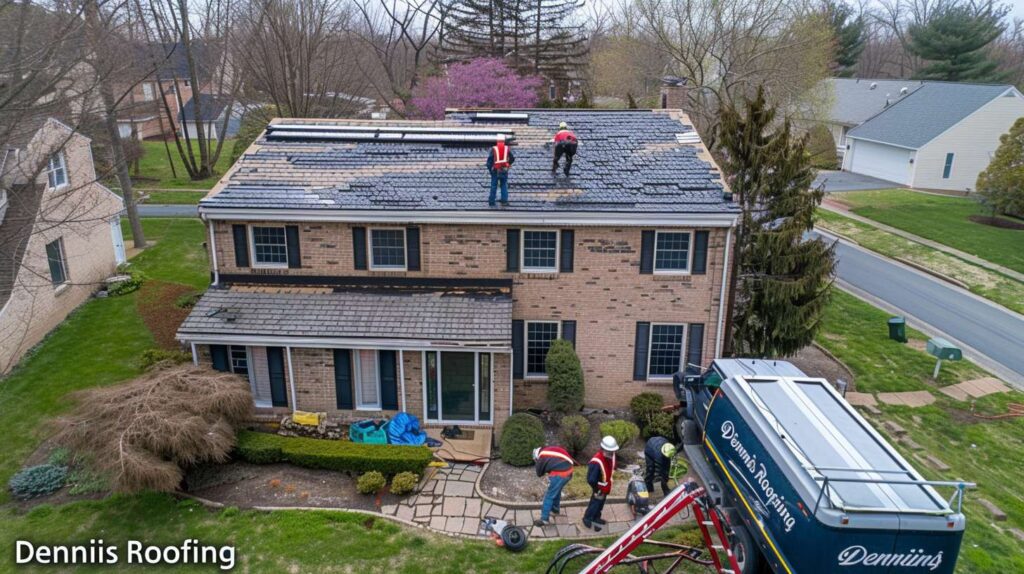
Three loose fasteners can create a whole afternoon of confusion. Water doesn’t fall straight down through metal – it travels sideways along overlapping seams, reverses direction at panel edges, and follows the path of least resistance until gravity wins somewhere it shouldn’t. That’s what makes interior stains such unreliable maps. I’m Ray Okonkwo, and I’ve been doing roofing work in Brooklyn, NY for 17 years, with earlier specialty work in sheet metal movement and fastener failure going back to transit platform canopies where a bad fastener could mean a flooded platform by morning. My personal opinion, and I’ll say it plainly: waiting for a visible interior leak before calling is the most expensive way to handle a metal roof problem. The real question isn’t where is it wet – it’s what isn’t being allowed to move, drain, or breathe the way it was designed to. A roof that’s been pinned in the wrong places, smeared over, or clogged at transitions will tell you a false story every time.
Quick Facts – What This Helps You Determine
Most Misleading Symptom
Interior stain – it shows where water landed, not where it entered
Most Common Hidden Cause
Backed-out fasteners near flashing, allowing sideways water travel
What Worsens the Problem
Sealing over movement points, which redirects water and traps moisture
Best Next Step
An inspection that follows the water path backward from symptom to source
Myth vs. Fact – Common Assumptions Brooklyn Property Owners Make
| Myth | What Actually Happens on a Metal Roof |
|---|---|
| “The drip marks the hole.” | Water travels along seam laps and panel undersides before it drips. The actual entry point can be several feet upslope or to the side of where it falls indoors. |
| “Bang noise means the panel is loose everywhere.” | Banging during heat cycles usually means one section is restricted from expanding while the rest of the panel moves freely. The noise is a thermal movement problem, not a global fastener failure. |
| “More sealant always helps.” | Adding sealant to a joint or transition that needs to move traps expansion force and redirects water. It may stop a drip for one season, then fail harder the next – often worse than before. |
| “Rust only matters if there’s already a leak.” | Rust at a transition or debris line indicates trapped moisture compromising the metal from below – often invisible from above. By the time a leak appears, the corrosion has already spread. |
| “If someone patched it last year, this can’t be the same issue.” | Prior patches applied over movement points frequently cause repeat failures. The old material must be removed before a proper repair can begin, which often makes the second repair larger and more expensive. |
Where We Look First on Brooklyn Metal Roofs
Movement Points That Fail Before the Field of the Roof
I’ll tell you what I ask the minute I step onto a metal roof in Brooklyn: where does it move, and where is it trapped? That sounds reasonable, but roofs don’t work by reasonable guesses – they work by physics, drainage slope, and how whoever installed the flashing handled the transitions. And in Brooklyn, no two roofs give you the same variables. A small commercial shop along 39th Street in Sunset Park drains differently than a brownstone rear extension in Bed-Stuy, where leaves pack behind parapet walls and sit damp for days after a storm. Flat rear additions in particular trap debris at curb edges in ways that redirect water before it even reaches the drainage point. Local roof type matters. Debris pattern matters. The direction of panel laps matters more than most people expect.
I remember a wet Tuesday just after 6:00 in the morning in Sunset Park, standing on a painted metal roof over a small machine shop while the owner kept insisting the leak had to be “coming through the middle somehow.” It had rained overnight, and every panel looked clean from a distance – but one row of fasteners near the curb flashing had backed out just enough to let water travel sideways before dropping inside. That was one of those jobs where the stain indoors lied to everybody. The water had found a path along the panel overlap, followed the seam direction toward the low point, and dropped through a gap that had nothing to do with the middle of the roof. The stain was evidence. It wasn’t a map.
If the water had enough room to travel, the stain is evidence, not a map.
Decision Tree – Identify the Likely Category of Problem Before You Call
💧 Active leak during rain
→ Does the stain appear near a skylight, curb, or parapet wall?
Yes: Likely flashing failure or sideways water travel along seam – inspect transitions first.
No (open ceiling area): Likely backed-out fasteners or failed lap – trace panel path upslope from stain.
🔊 Banging or popping noise
→ Does the sound happen when temperatures change (morning/afternoon), not just during rain?
Yes: Movement restriction – one panel section is pinned while adjacent areas expand freely.
No (only during storms): Panel fastening issue at edge or corner – inspect perimeter clips and fastener tightness.
🔴 Rust or discoloration
→ Does debris collect nearby – leaves, standing water, parapet runoff?
Yes: Trapped moisture at transition or edge – corrosion is likely deeper than it appears from above.
No: Surface oxidation or coating failure – inspect for pitting before ruling out structural damage.
🔧 A previous patch failed
High probability of incompatible repair applied over a movement point – old material must be removed before a proper repair can hold.
Drainage Trouble Around Parapets, Curbs, and Edges
First Inspection Targets by Symptom
| Symptom Noticed | First Area We Inspect | Why That Area Is Suspect |
|---|---|---|
| Leak near the middle of the room | Panel seams and fastener rows upslope from the stain | Water travels along seam overlaps before dropping – the entry point is almost never directly above the stain |
| Drip near a skylight corner | Skylight curb flashing and sealant at all four corners | Corners are where flashing lifts first; sealant at curb-to-panel transitions breaks down under thermal movement |
| Storm banging noise | Perimeter fasteners and panel clips, especially at edges | Edge panels lift and reset under wind load when fasteners back out; the sound pinpoints where restraint has failed |
| Rust near a parapet | Base flashing and the gap between parapet wall and roof panel | Parapets trap debris and hold moisture against the metal; corrosion often hides under leaves or dried organic buildup |
| Repeat leak after sealant patch | The patched area itself, plus all movement points adjacent to it | Sealant applied over an expansion joint forces movement elsewhere; the repeat failure is usually at the edge of the old patch, not through it |
What Failed Repair Attempts Usually Tell Us
Here’s the blunt version: metal does not forgive lazy repairs. One August afternoon in Flatbush, the roof was so hot my glove prints stayed in the panel dust, and a homeowner told me another crew had already “sealed everything.” What they had really done was smear roof cement over an expansion point on a metal section that needed to move. By the time I got there, the sealant had split like dry skin, and the panels had started forcing water toward a skylight corner rather than toward the drain. The patch wasn’t just ineffective – it had become the problem. A well-intentioned sealant application in the wrong place can reroute water for an entire season before anyone connects the dots.
Here’s the insider tip worth remembering: if you’re looking at a repair area that’s overly smeared, wider than the original flashing detail, or showing brittle cracks at its edges, don’t assume it’s a surface problem. Assume someone treated a movement joint as a hole. The smear is almost always covering something that needed to flex, not fill. I tell customers the same thing I’d tell anyone on a job site – distrust an oversized repair more than you distrust the original damage, because at least the original damage is honest about what it is.
⚠ Warning – Repeated Caulking Can Make the Next Repair Larger
Adding product over a moving joint, active seam, curb flashing, or transition detail does not stop the underlying movement – it redirects it. Each application traps moisture beneath it, conceals developing corrosion, and forces expansion forces sideways into adjacent details. By the time the next repair is needed, the old failed material must be fully removed before anything durable can bond to the metal surface. That removal adds labor and almost always reveals damage that wouldn’t have spread if the movement point had been addressed correctly the first time.
Signs That Mean You Should Call for Metal Roof Repair Services Now
Symptoms That Can Wait a Little
What would I have you look at first if this were my building? Start at the fasteners. If any are visibly lifting or sitting proud of the panel surface, that’s not cosmetic – that’s a water path waiting to open. Walk the perimeter and look at every transition: where panel meets parapet, where a curb sits in the field of the roof, where the edge drip detail stops. Split sealant at any of those points means movement already won that fight. A stain that grows wider after wind-driven rain, not just vertical rain, tells you the entry is coming in at an angle – usually a lapped edge that’s been lifted. And if you hear the same bang or pop at the same time of day, two or three days in a row, the roof is telling you exactly where it’s pinned when it shouldn’t be.
On a Bed-Stuy job at sundown, I learned not to trust the stain. I was on a brownstone extension, with thunder building but not yet breaking, when I found a line of corrosion hiding under leaves packed behind a parapet detail near the back of the property. The customer had focused entirely on the banging noise during storms, and honestly that was reasonable – it was loud. But the banging was a secondary symptom. The real issue was trapped moisture eating away at a transition piece nobody could see from the ladder. I had to hold my flashlight low across the metal surface so the pitting would cast shadows you could actually read. That’s not a trick – it’s just physics. And that job reminded me, again, that by the time noise or stains show up, a metal roof has usually been trying to tell you something for a while.
Symptoms That Should Not
How Our Service Visit Turns a Vague Symptom Into a Specific Repair Plan
A metal roof behaves a lot like a jacket zipper – once one section stops lining up, the trouble spreads in both directions. Our visit starts with a symptom review: when it happens, what changes it, and what’s been done to it before. From there, we trace the roof path from the high drainage points down through transitions, seams, and edges to wherever water or restriction is most likely to concentrate. We’re testing fasteners for movement, checking seams for gap and lap integrity, looking at every flashing detail for lift or split, and noting whether prior patching changed water flow in ways that created a secondary failure. Once we know whether the issue is fasteners, seam behavior, flashing, trapped debris, corrosion, or a failed prior repair, the scope becomes specific. The goal isn’t to find reasons for a bigger job – it’s to stop guessing and match what we fix to what actually failed.
Call Dennis Roofing for metal roof repair services in Brooklyn before a misleading symptom turns into a structural problem that costs three times as much to fix.