
Commercial Metal Roofing Takes a Different Kind of Contractor – Here’s What We Offer
This is not just tougher roofing – commercial metal roofing is a specialty assembly where small installation mistakes around movement, penetrations, and transitions turn into expensive, slow-moving failures that don’t show up until the damage is already done. What separates a metal roofing specialist from a general commercial roofer isn’t the tools they carry; it’s whether they understand the system before they touch it.
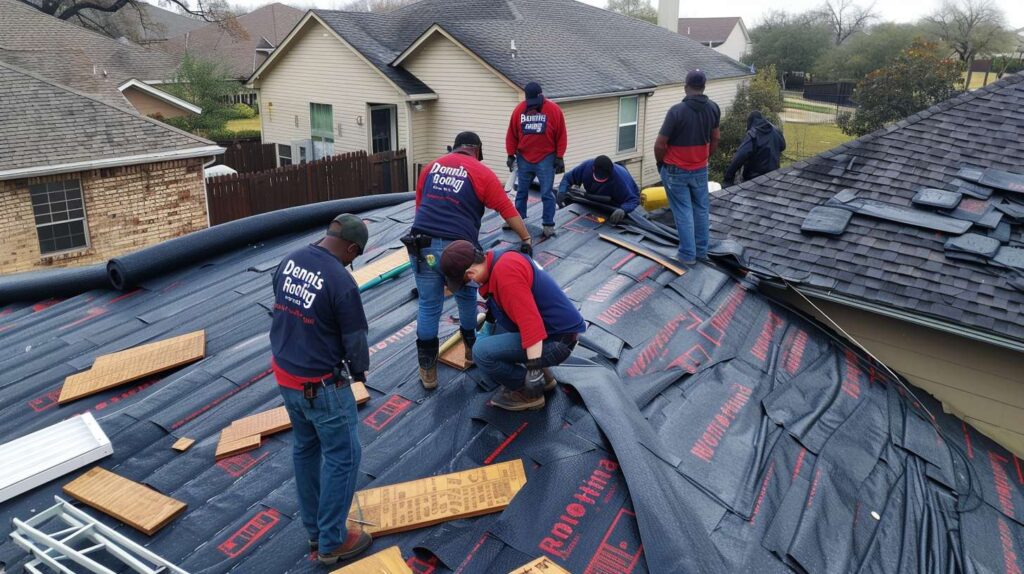
Why commercial metal roofing fails in expensive, quiet ways
Thirteen years in, here’s the part people still underestimate: a commercial metal roof can look completely intact from the rooftop hatch and still be failing at six different details simultaneously. The panels hold. The seams look tight. And water is moving behind everything anyway, because the contractor who installed it understood metal as a material but not as a system. That’s the distinction that costs building owners the most.
Following the water is how you find where the system actually broke down – and water on a commercial metal roof doesn’t move like it does on a sloped residential system. It hesitates at raised edges, merges at parapet corners, slows down around curbs, and eventually crashes through the one opening nobody bothered to respect. It moves like Brooklyn traffic at a construction-narrowed block: patient until it isn’t, and then it finds the gap. The damage that shows up inside a building is almost never directly below where the water entered the roof plane.
| Myth | What actually happens on commercial metal roofs |
|---|---|
| “Metal is metal, so any roofer can install it.” | Commercial metal roofing requires system-specific detailing at clips, curbs, transitions, and edges. A roofer experienced only in flat or shingle systems won’t know how to handle panel movement, clip selection, or metal-to-masonry transitions – and those omissions are exactly where failures begin. |
| “If the roof is new, leaks must be elsewhere.” | New metal roofs fail regularly – not because the panels are defective, but because the detailing at curbs, wall transitions, and penetrations was done by someone unfamiliar with how commercial metal systems behave under wind-driven rain and thermal cycling. |
| “Leaks always show up directly over the damaged panel.” | Water enters at one point and travels laterally across underlayment, insulation, or decking before dripping through the ceiling. The interior stain can be three or four bays away from where the roof was actually breached – which is why surface-only inspections miss most metal roof failures. |
| “Standing seam means maintenance-free.” | Standing seam panels are durable, but the system still requires periodic inspection at curbs, penetrations, panel ends, and edge metal. The seams hold; the details around them are where ongoing maintenance matters most. |
| “If it looks straight from the street, the installation is fine.” | Visual alignment says nothing about clip selection, movement allowance, or how penetrations were flashed. A roof can be geometrically clean and technically wrong throughout – and that mismatch won’t become obvious until the first hard rain or the first serious temperature swing. |
⚠ The Hidden Cost of Hiring a General Roofer for a Specialty Metal System
- Failed curb flashing – Rooftop unit curbs treated as obstacles rather than active leak points, with inadequate cap flashing and no saddle work.
- Locked panels with no movement allowance – Fixed fasteners used where floating clips were required, leaving the system no room to expand and contract through seasonal temperature swings.
- Bad wall transitions – Metal-to-masonry junctions sealed with caulk alone, with no counter-flashing embedded in reglets or proper step flashing sequencing.
- Mismatched clips – Wrong clip type for the panel profile, causing stress points along the seam line that open over time.
- Edge details that let wind-driven rain travel behind panels – Perimeter edge metal without proper drip edge geometry or seating, leaving a direct pathway for horizontal rain to work back under the panel ends.
Most expensive commercial metal failures start in details that looked minor during install.
Where our crews focus first on Brooklyn commercial roofs
Edges, terminations, and the places water changes direction
On a Brooklyn warehouse roof, the trouble usually starts at the edges, not the middle. Spend any time working the North Brooklyn warehouse blocks – the ones stretching toward the Brooklyn Navy Yard corridor – and you start to understand what wind exposure off a wide industrial street does to a roof’s perimeter. Those low-slope warehouse roofs take wind-driven rain from unexpected angles, and the edge metal, parapet transitions, and panel terminations take the full force of it. The field panels in the center of those roofs are usually fine. It’s the perimeter that’s quietly failing.
If I’m talking to an owner across a hatch door, I usually ask this first – who’s detailing your penetrations? Because as Chris Tobin, 13 years into roofing after crossing over from elevator modernization and now focused on commercial metal roof details around parapets, curbs, and penetrations, I’ve learned that the answer to that one question tells me almost everything I need to know about whether the rest of the roof was done correctly. Contractors who treat penetrations casually treat everything casually. It’s that consistent.
Following the water from the edges into the penetrations and then along the wall transitions is how the pattern reveals itself. And here’s the insider detail worth paying attention to: if a building manager mentions that the same curb or wall transition gets touched up with sealant every year or two, that’s not a one-off repair situation – that’s a failed detail strategy. Sealant on a metal roof is maintenance. Repeated sealant at the same exact location is evidence that the underlying flashing detail was never right to begin with, and caulk has been covering for it ever since.
| Roof Detail Area | Typical Failure We Find | What the Owner Notices | Why This Needs Metal-Specific Skill |
|---|---|---|---|
| Parapet transitions | Cap flashing not properly lapped or anchored; water infiltrates behind the counterflashing | Interior wall staining near the roofline, often blamed on window frames | Requires understanding of metal-to-masonry sequencing and thermal movement at the parapet cap |
| Rooftop unit curbs | Curb flashing not integrated with the panel run; no saddle or cricket on the upslope side | Dripping near HVAC units; ceiling tiles stained directly under equipment | Metal roof curbs require custom pan flashing integrated into the seam profile – not a generic curb wrap |
| Pipe penetrations | Generic pipe boots installed without matching the panel profile; sealant used as the primary waterproofing | Slow drip pattern that worsens in heavy rain; often misread as a pipe leak | Pipe penetrations on metal require profile-specific boots and correct pitch pocket detail – not off-the-shelf rubber boots |
| Panel end laps / terminations | Inadequate sealant tape between lapped panels; no backup mastic at exposed panel ends | Intermittent leaking that seems to track with wind direction – because it does | End laps are a system detail – they require the correct butyl tape and lap geometry for the specific panel profile being used |
| Wall-to-roof transitions | Metal roof terminated against masonry with surface-applied sealant only; no embedded counterflashing | Water line along an interior masonry wall, often appearing days after a storm | Masonry-to-metal transitions require reglet cuts or through-wall flashing – caulk alone fails within two or three thermal cycles |
| Perimeter edge metal | Edge metal undersized for the panel thickness; no drip edge geometry to redirect water away from the fascia | Fascia staining, soffit damage, or water entering at the top of exterior walls near the roofline | Edge metal must be coordinated with panel height and seam profile – a mismatch creates a gap that captures wind-driven rain |
What Dennis Roofing Includes When Evaluating a Commercial Metal Roof
- ✔ Attachment method review – confirming the correct clip type and fastener pattern for the panel profile and roof span
- ✔ Movement allowance review – checking whether the system was installed with adequate thermal expansion capacity at panel ends and fixed points
- ✔ Curb and penetration detailing – inspecting all rooftop unit curbs, pipe penetrations, and equipment supports for proper integration with the panel system
- ✔ Edge and parapet inspection – reviewing perimeter edge metal, parapet cap flashing, and counterflashing for proper termination and lap geometry
- ✔ Drainage path review – mapping how water moves across the roof plane and whether it’s being directed toward functional drains or collecting at detail failures
- ✔ Transition inspection – evaluating every wall-to-roof and slope-change transition for flashing continuity and masonry-to-metal compatibility
- ✔ Repair vs. replacement recommendation – a direct, documented assessment of whether targeted correction or a full system replacement makes more sense for this building
How a specialist contractor handles movement, not just leaks
Metal roofing works a lot like traffic in this borough: if movement wasn’t planned, something backs up fast. Every metal panel expands and contracts with temperature, and on a Brooklyn commercial building that sees February wind chill and August heat bursts in the same twelve months, that movement is significant. The system handles it through floating clips that let panels slide at fixed points, through controlled fastener patterns, and through expansion details at curbs and walls. Get the clip selection wrong or pin a panel that should float, and you’re not just creating stress – you’re building a failure point that gets worse with every temperature swing. Personally, I’d rather walk away from a rushed metal job than install a system that can’t move correctly. A tight schedule doesn’t fix a roof that pops its seams in August.
What Our Commercial Metal Roofing Process Looks Like
Site Walk & Leak-Path Mapping
We walk the full roof plane and trace the probable water path from symptom back to source. You’ll receive a written summary of observed conditions and photo documentation of every area flagged during the walk.
Detail Inspection at Edges, Curbs & Transitions
Every parapet, curb, penetration, and wall transition gets a close-up inspection – not just a general scan. You’ll get annotated photos of each detail area, with a plain-language note on what we found and what it means.
Movement & Attachment Review
We assess clip type, fastener patterns, and whether the system has the room to expand and contract correctly. If we find locked panels or mismatched clips, that goes into the written scope – with photos – before any work is priced.
Repair or Replacement Scope with Material Match
We identify whether targeted corrective work or full replacement is the right call, and we spec materials to match the existing profile, gauge, and finish. You’ll see the recommended scope in writing before we schedule anything.
Execution & Final Water-Path Check
Work gets done to spec, and we do a final walk following the water path from every corrected detail to confirm drainage continuity. You get a post-work photo set showing the completed details and confirmation that the drainage path is clear.
| General Commercial Roofer Approach | Commercial Metal Specialist Approach |
|---|---|
| Diagnosing leaks: Scans for visible panel damage; often patches the stained area without tracing the water path back to the entry point. | Diagnosing leaks: Maps the full water path from interior symptom to roof entry point; inspects detail areas first because that’s where metal roof leaks actually begin. |
| Handling penetrations: Installs a standard pipe boot or wraps the curb with generic flashing material; seals with caulk as the primary waterproofing layer. | Handling penetrations: Specifies profile-specific boots and correctly sequenced flashing integrated into the panel run; caulk is secondary backup, not the system. |
| Accounting for thermal movement: Fastens panels without considering expansion; may use fixed fasteners in locations requiring floating clips. | Accounting for thermal movement: Selects clip type based on panel length, material, and local temperature range; confirms movement allowance at fixed points before installation. |
| Material matching: Substitutes available panels for damaged sections without confirming profile, gauge, or finish compatibility. | Material matching: Sources panels that match the existing profile exactly; mismatched panels create edge gaps and seam irregularities that become new failure points. |
| Transition detailing: Applies sealant at wall-to-roof transitions and calls it done; may not cut reglets or install counterflashing in masonry. | Transition detailing: Cuts reglets, installs embedded counterflashing, and sequences the metal-to-masonry detail correctly – because sealant alone at a masonry wall fails fast. |
What we’re actually offering when you call Dennis Roofing
Repair, corrective detail work, and replacement planning
I’ll put it plainly: what we offer isn’t generic metal roofing. It’s commercial metal roof diagnosis, targeted detail correction, active leak repair, retrofit guidance, and full replacement planning where the scope actually calls for it. That distinction matters, and a call from a warehouse tenant near the Brooklyn Navy Yard made it concrete for me. It was a Sunday, after a night storm – the kind that hits the Navy Yard corridor with wind off the water – and the tenant described water dripping onto boxed inventory in one neat, almost surgical line across the ceiling. When I got up there, the field panels were fine. The problem was a rushed transition where the metal roof met a masonry wall; the crew had surface-applied a bead of sealant and called it complete. The detail told me immediately – these were roofers who knew flat work, maybe shingles, but not commercial metal. The age of the roof had nothing to do with it. Contractor fit was the whole issue.
Back on that Flushing job, the roof taught the same lesson I keep seeing. It was a gray February morning off Flushing Avenue, early enough that the wind was still mean, and the owner kept insisting the roof was new – couldn’t possibly be the problem. Three rooftop unit curbs, treated like decorative obstacles by the previous crew, had been slipping water behind the panels every time wind drove rain east across that block. The curbs weren’t flashed into the panel run; they were wrapped in generic metal and sealed at the edge. That’s it. And separately, I’d seen the same logic fail in August – a standing seam section where panels popped audibly because the wrong clip approach left no room for movement during a heat burst. Two different roofs, two different failure modes, same root cause: a contractor who understood metal as a product but not as a system.
Commercial Metal Roofing Service Scope
Select a service area to expand
Service Area
Brooklyn commercial properties
Roof Types
Standing seam, exposed-fastener metal, low-slope commercial metal assemblies
Typical Call Types
Active leaks, failed transitions, corrective detail work
Decision Support
Repair vs. retrofit vs. replacement guidance
Questions owners ask before hiring a commercial metal roofing contractor
Are you hiring someone to cover metal, or someone who understands how it moves?
Vet the contractor before you talk price. Ask specifically about how they handle penetrations, what clip system they’re specifying, how they sequence wall transitions, and whether their detail work is system-specific or generic. A contractor who can answer those questions directly – without pausing to look it up – is a contractor who’s actually worked commercial metal before. One who reaches for caulk as a first answer to every flashing question hasn’t.
Hiring & Service Questions
Before You Call: What to Have Ready
-
☐
Leak locations observed inside – note the room, ceiling area, and whether the drip point is near a wall, under equipment, or in an open span -
☐
Date of last storm or wind event – helps correlate whether the leak is rain-driven, wind-driven, or appears independent of weather -
☐
Roof age or install date if known – even an approximate year helps narrow down what panel system and clip type are likely in use -
☐
Photos of rooftop equipment and curbs if accessible – even a phone shot of the curb flashing condition tells us a lot before the first site visit -
☐
Prior repair history – if the same spot has been patched before, that’s critical information; bring any invoices or work orders if you have them -
☐
Whether the issue appears near parapets, walls, or penetrations – this alone narrows the likely failure category significantly before we set foot on the roof
If you’re managing a Brooklyn commercial property with a metal roof that keeps giving you trouble – at the same curb, the same wall, the same penetration – call Dennis Roofing. We diagnose the detail, not just the drip. That’s the difference between a fix that holds and one that needs attention again next spring.