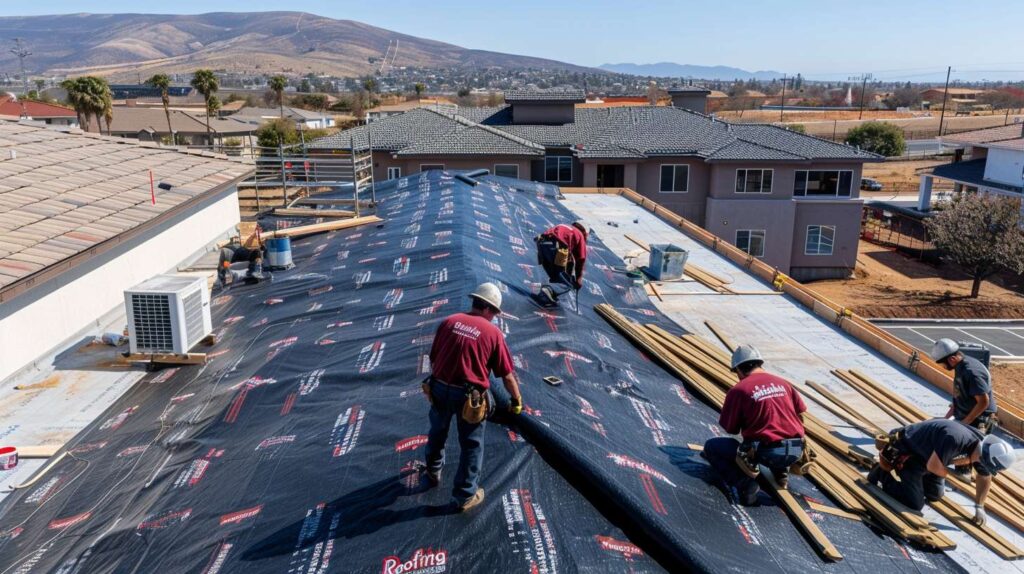
When the Roof Goes, the Ceiling Usually Follows – Here’s How We Handle Both
What the stain is really telling you
A little now or a lot later – that’s usually what this comes down to. That stain you’re standing under right now? It’s not the beginning of the story – it’s the first time the story got loud enough for you to hear it. What the audience sees on the ceiling started behind the curtain above, and by the time it shows up as a ring or a bubble or a soft spot, water has already been moving through layers you can’t see from the floor.
$900 is a repair; $9,000 is a lesson Brooklyn teaches fast. Water doesn’t fall straight down through a building – it travels. It finds a nail hole in flashing, slides along a rafter, gets absorbed by insulation, and drops near a light fixture that’s four feet from where it entered. That’s why the stain and the source are rarely the same address. I’m Joe Santangelo, and I’ve spent 19 years in roofing specializing in exactly this: tracing leaks that show up in ceilings after moving through decking, flashing, and insulation – finding where the curtain actually parted before the audience noticed anything was wrong.
Myth vs. Fact: What Brooklyn Homeowners Get Wrong About Ceiling Stains
| Myth |
What Actually Happens |
| “The stain is right where the leak is.” |
Water travels laterally along rafters and decking before dropping. The stain can land several feet – or rooms – from the actual entry point. Coordinated diagnosis is the only way to find the real source. |
| “I dried it out, so we’re good.” |
Surface drying doesn’t reach soaked insulation or trapped moisture inside a joist bay. Wet materials inside the ceiling cavity keep the damage clock running even when the dripping stops. |
| “It’s a small ring – it can wait.” |
Small stains are often warning shots for slow, ongoing leaks that haven’t fully expressed yet. Early mold growth can start in a joist cavity before the ceiling surface shows anything significant. |
| “I just need a roofer – the ceiling’s my problem.” |
If the roofer seals the exterior entry point but doesn’t account for saturated insulation or ceiling damage, you’ve fixed half the problem. Roof and ceiling repair services handled together prevent the second repair call. |
| “Fresh paint hides it just fine.” |
Paint covers the stain, not the moisture. Painting before moisture readings confirm a dry cavity traps humidity, leads to bubbling and peeling, and delays the proper repair – usually making the eventual ceiling work more expensive. |
Fast Truths About Roof Leaks and Ceiling Damage
Visible Sign
A ceiling stain, bubble, or soft spot is the output of a water path that’s already been active – not the starting point of the leak.
Hidden Risk
Insulation soaks up and holds water long after a drip pauses. That retained moisture silently feeds mold growth and structural softening in the ceiling cavity.
First Visit Goal
Map the full water path from entry point on the roof to drop point on the ceiling – before any patching, painting, or ceiling work begins.
Brooklyn Housing Note
Brick rowhouses, flat roofs, aging chimneys, parapet walls, and rooftop penetrations like HVAC curb units are among the most common contributors to misleading leak paths in Brooklyn homes.
Follow the water path, not the paint damage
Where entry points usually hide in Brooklyn homes
Here’s the part nobody likes when I say it on the ladder. I was on a rowhouse in Dyker Heights at 6:10 in the morning after one of those sideways March rains that come off the water and hit the brick at a full angle. The homeowner kept pointing at a bubble in the dining room ceiling – that bubble was everything to him. But the water had come in higher up at a chimney corner, traveled the full length of the decking, and dropped near a light fixture six feet away. When we opened the ceiling, we found insulation holding water like a wet winter coat. Brooklyn brick rowhouses do this constantly: the chimney corners, old flashing at roof edges, and parapets that haven’t been repointed in twenty years all create travel paths that make the ceiling evidence look guilty when it’s really just downstream.
If I asked you where the water actually entered, would you point to the stain or the roofline? Most people point at the stain – and that’s a reasonable guess from the floor, just not the right one. Water that enters at a flashing gap hits the roof deck, follows the pitch or a rafter, gets absorbed by insulation, and eventually drops wherever gravity and saturation point it – which is often near a fixture, a junction box, or a ceiling seam. The stain tells you where the water gave up. The roof inspection tells you where it got in. Both of those answers are needed before anyone touches a ladder or a piece of drywall. The decision tree below helps you figure out which path you’re looking at.
Do You Need Roof Repair, Ceiling Repair, or Both?
START HERE
Do you see bubbling, sagging, or active dripping indoors?
YES →
Is there a roof defect, recent storm, drain issue, flashing failure, or rooftop unit nearby?
YES → Schedule coordinated roof and ceiling repair services immediately.
NO → Check plumbing and HVAC lines above – and still inspect the ceiling cavity for moisture before assuming the source.
NO →
Is there a ceiling stain with no indoor soft spot or dripping?
YES → Roof inspection first. Map the path, confirm moisture levels, then monitor the interior before any ceiling work.
NO → Likely cosmetic only – but verify with a moisture meter before patching or painting. Don’t assume dry just because it looks dry.
Common Hidden Starting Points – Where Leaks Begin Before They Hit Your Ceiling
🔺 Chimney Flashing
Flashing at chimney bases and corners is among the most common Brooklyn leak sources. When the step flashing or counter-flashing separates – especially after freeze-thaw cycles – water enters high on the roofline and travels down the decking before dropping into a ceiling area that looks completely unrelated to the chimney.
🔺 Roof Drain Patch Failure
Flat roofs in Brooklyn often have older drain patches that were applied over existing material and eventually crack like dried paint. When the patch fails, water bypasses the drain collar, saturates the insulation layer, and shows up as a ceiling stain in a room below that has no obvious connection to the drain location above.
🔺 Curb Seams Around Rooftop Units
HVAC units, exhaust fans, and other rooftop equipment sit on raised curbs sealed at the base with mastic or flashing tape. As these age and the membrane below shifts, the seam opens. Water enters slowly – often undetected for months – and appears in the ceiling directly below or laterally, depending on how the roof deck is sloped.
🔺 Parapet Wall Transitions
Where the roof membrane meets the parapet wall, movement in the brick and settling in the building can open the cap flashing or coping joint. Water enters at the wall-to-roof transition and follows the base of the parapet before finding a path into the ceiling below – often appearing as a streak along the interior wall near the ceiling line rather than a typical circular stain.
🔺 Nail Holes and Open Seams in Aging Membrane or Shingles
On older roofs – pitched shingle or flat membrane – fasteners back out over time, and seams at overlaps can lift in heat and contract in cold. These small openings let in a steady trickle, not a flood, which means the ceiling damage grows slowly and the stain appears minor right up until the point where the insulation is fully saturated and the damage scope jumps dramatically.
Separate crews create one bigger mess
Blunt truth: ceilings are tattletales. I had a landlord in Bed-Stuy one August afternoon who was absolutely certain his tenant “must’ve left a window open” because a stain showed up overnight in the back bedroom. I got up on that roof in full sun and found an old patch around a drain that had cracked clean through – dry as paper on the surface, completely failed underneath. By 3 p.m. we were running a coordinated job: roof repair crew upstairs sealing the drain, ceiling crew downstairs cutting out sagging plaster before it came down on the kid’s bunk bed. And honestly, that’s my opinion and I’ll stand on it: handling the roof and the ceiling as two separate unrelated chores is how people end up paying twice, waiting twice, and still missing wet insulation sitting behind a fresh coat of paint. It’s not just inconvenient – it’s a way of pretending the second half of the problem doesn’t exist.
Coordinated Plan vs. Split-Up Approach
| Factor |
✔ Coordinated Roof + Ceiling Repair |
✗ Separate Appointments, No Shared Diagnosis |
| Speed |
One visit to diagnose, one scope, one repair sequence |
Multiple scheduling windows; ceiling crew often waits on roofer’s sign-off |
| Source Confirmation |
Entry point confirmed before any interior work begins |
Ceiling may be patched before root cause is fully traced |
| Interior Protection |
Room is prepped and protected as part of a single plan |
Coordination gaps can leave interior exposed between appointments |
| Hidden Moisture Risk |
Moisture mapping covers both roof cavity and ceiling joist bay |
Wet insulation easily missed when crews aren’t communicating |
| Repeat Damage Chance |
Low – roof sealed before ceiling closed |
High – ceiling repairs fail if roof path wasn’t fully sealed first |
| Total Disruption |
One round of disruption, properly sequenced |
Two or more rounds of noise, dust, and room access |
⚠ Warning: Don’t Patch the Ceiling Before You Find the Roof Entry Point
- Painting over a stain traps moisture behind new paint – it will bubble, peel, and return within weeks if the roof source isn’t sealed.
- Ignoring a sagging area because it feels firm is risky; wet plaster and drywall can hold until they don’t, and a ceiling failure is a safety issue, not just a repair issue.
- Delaying the cut-open inspection when insulation is suspected to be wet allows mold to establish in the joist cavity – often invisible from the surface until it’s a much larger remediation job.
- Assuming the leak stopped because the drip paused is one of the most common mistakes. Slow leaks stall between rain events and resume when conditions return – the path stays open either way.
Count the damage by scope, not by stain size
Typical repair scenarios and what changes the bill
Last winter on a brick two-family off 13th Avenue, I saw this exact movie. Owner calls about a damp ceiling in the top-floor unit – stain wasn’t huge, no dripping. We get up there and find that the flat roof membrane had lifted at two seams near the parapet, and water had been traveling under the membrane before dropping near a bedroom wall. The ceiling wasn’t catastrophic, but the insulation in two joist bays was fully saturated, and there was the beginning of a mold situation that nobody downstairs knew about yet. The stain size told you nothing. The scope told you everything. Cost depends on where water entered, how long it traveled before you found it, and what interior materials absorbed the most of it.
The main price drivers break down like this: membrane, shingle, or flashing repair at the entry point; drain collar or curb work if a rooftop penetration is involved; ceiling cut-out, drywall or plaster replacement, insulation removal, drying time, and repainting. Emergency stabilization – tarping, temporary barriers – adds another layer if the job comes in after a storm or during active weather. And here’s the insider tip worth writing down: ask for one written scope that names both the exterior fix and the interior restoration sequence before any ceiling work begins. If those two things aren’t in the same document, there’s a real chance the ceiling gets patched before the roof path is fully sealed – and then you’re back to square one inside six months.
Typical Brooklyn Roof & Ceiling Repair Scenarios
All ranges are estimates only. Actual costs depend on site conditions, materials, and access.
| Scenario |
What’s Included |
Estimated Range |
| Minor flashing repair + stain sealing |
Locate and seal isolated flashing gap; seal ceiling stain with primer; no ceiling cut-out needed |
$600 – $1,400 |
| Drain or patch repair + small ceiling opening |
Re-collar or repatch roof drain; open small ceiling section for moisture check; patch and paint |
$1,200 – $2,800 |
| Chimney corner leak + wet insulation removal |
Step flashing and counter-flashing repair; open ceiling section; remove and replace saturated insulation; patch and refinish |
$2,500 – $5,500 |
| Rooftop unit curb seam + mold-start cleanup |
Reseal curb seams; open ceiling at affected joist bay; treat early mold; dry out; close and finish |
$3,000 – $7,000 |
| Widespread leak with multiple roof corrections + larger ceiling replacement |
Multiple roof repairs (flashing, membrane, seams); significant ceiling demo; full insulation replacement; drywall reset; prime and paint |
$6,500 – $15,000+ |
What Changes the Price Fastest – Ranked by Impact
| Cost Driver |
Why It Matters |
Typical Impact on Scope |
| Cosmetic stain only (after confirmed dry-out) |
Roof sealed, no moisture present – stain is surface only |
Minimal – stain block + repaint |
| One localized roof repair |
Single failure point found and corrected; no interior damage |
Low – roof materials and labor only |
| Wet insulation discovery |
Retained moisture must be removed and replaced – can’t simply dry in place |
Moderate – ceiling opening required, removal and reinstall |
| Plaster or drywall demo and reset |
Structural ceiling material compromised; has to come out |
Moderate-high – adds labor, materials, finishing time |
| Mold treatment in limited cavity |
Requires treatment protocol, containment, and possible testing |
High – specialized work with added time and cleanup steps |
| Emergency after-hours stabilization |
Active water intrusion during or after a storm requires immediate tarping and containment |
Highest – emergency rates, additional material, urgent scheduling |
Know when the ceiling can wait and when it cannot
A house is a stage set more than people think – what shows in front usually started backstage. I finished a small repair in Bay Ridge right before dusk when the owner mentioned almost as an afterthought a “tiny coffee-colored ring” over the hallway. We traced it to a slow leak at a curb seam around an old rooftop unit, and when we opened the ceiling, mold was just starting around the joist bay. Small marks can be warning shots.
Now back up a step – because not every stain is an emergency, and knowing the difference saves you from either panicking unnecessarily or waiting too long. A proper service call works in sequence: inspect the roof first, map the moisture path with a meter before anyone touches drywall, protect the room, open only what needs opening based on what the moisture readings show, and then repair in the right order – exterior sealed before interior closed. That’s the sequence that keeps you from paying twice. When you’re ready to get the source traced and the ceiling handled correctly, call Dennis Roofing – that’s exactly what we’re set up to do.
Urgent vs. Schedulable: How to Read Your Situation
📞 Call Now
- Active dripping from the ceiling – any volume
- Visible sagging or bulging in ceiling surface
- Stain appearing near a light fixture or junction box
- Child’s bedroom directly beneath wet or soft plaster
- Stain has grown back after a prior patch or repair
- Stain appeared suddenly after a storm or heavy rain
📅 Can Be Scheduled Soon
- Old, dry stain with confirmed prior repair on record
- Cosmetic discoloration with a zero moisture meter reading
- Planned repaint after a fully verified dry-out period
Note: “Can be scheduled” doesn’t mean can be ignored. Moisture readings should be confirmed before any cosmetic work begins.
Questions We Hear Often About Roof and Ceiling Repair Services
Do you always have to open the ceiling?
Not always – but the ceiling should always be checked with a moisture meter before anyone assumes it’s fine. If readings are elevated or the insulation is suspected to be wet, opening a targeted section is the right call. Skipping that step and patching visually is how you end up with mold in a closed cavity six months later.
Can a roof leak show up far from the actual hole?
Yes – and this is one of the most consistent sources of confusion we deal with. Water enters at a flashing gap, nail hole, or seam, then follows the roof deck pitch and rafter lines before dropping. In a Brooklyn rowhouse, the entry point and the ceiling stain can easily be separated by eight to twelve feet horizontally. Never assume they’re in the same place.
Will insurance cover roof and ceiling work?
It depends on the cause. Storm damage – wind, hail, a falling branch – is typically covered under a standard homeowner’s policy. Gradual wear, deferred maintenance, or slow leaks that developed over time are often excluded. Get a detailed written scope that clearly describes the cause and the damage before submitting any claim. Documentation of the entry point and the interior damage path matters to adjusters.
How fast should I act if the stain is small but growing?
A growing stain means the water path is active – not paused, not fixed, not drying on its own. Don’t wait for the next rain to see how bad it gets. Schedule an inspection immediately, because the difference between a small ceiling opening and a large one is usually measured in how many weeks you waited. A growing stain is the ceiling telling you the roof still has an open door.
A roof that fails and a ceiling that shows it aren’t two different problems – they’re two ends of the same one. Dennis Roofing is the team to call when you need the roof source traced and the ceiling damage handled in the right order, the first time. – Joe Santangelo, Dennis Roofing, Brooklyn, NY