
An Asbestos Roof Has to Go – Here’s What a Safe, Legal Replacement Looks Like
Find the spot where two materials meet – that’s where asbestos roof replacement services actually begin, and it’s almost never where the new shingles go down. The most important part of this whole project isn’t the new roof; it’s the controlled handoff between abatement, disposal, clearance, and rebuild, and Brooklyn owners deserve to understand that sequence before anyone shows up with a dumpster.
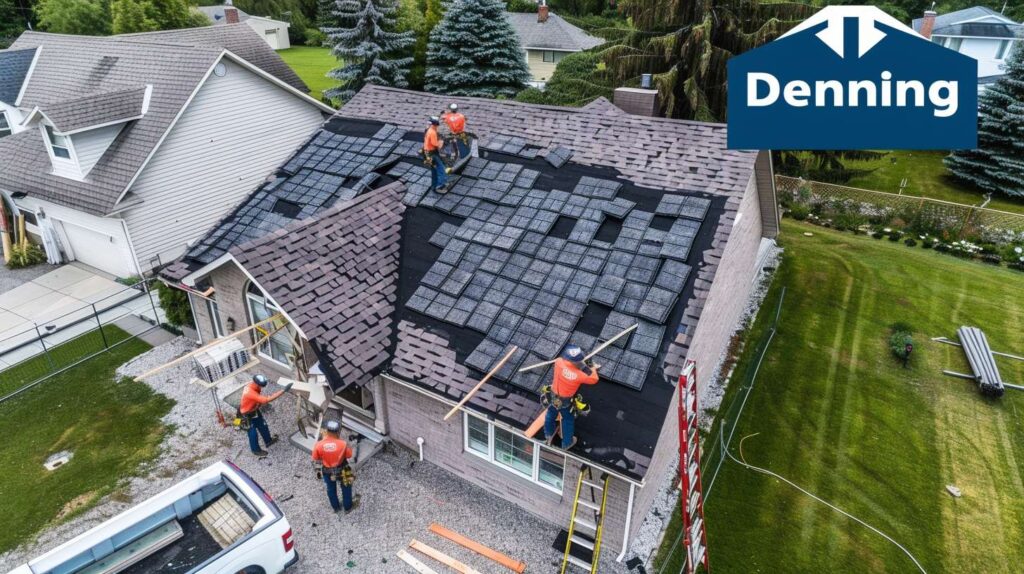
Where the Replacement Really Begins
The ugliest part of these jobs is usually the most important part, and I’d rather tell you that up front than let you find out halfway through a stopped project. Asbestos roof replacement services are coordination work first and roofing work second – what you’re really managing is a series of handoffs between licensed parties, each one carrying its own paperwork, its own liability, and its own sign-off requirement before the next crew is allowed to touch anything.
On a Brooklyn row house, the trouble usually starts at the edge details. Shared walls, parapet flashings, rubber membrane that bleeds under the adjoining garage – the borders are where asbestos fiber migrates if the abatement isn’t contained properly. That’s why I talk about the handoff: the exact moment one crew, material, permit phase, or responsibility ends and the next one begins. Get that moment right, every time, and the job stays legal and on schedule. Fumble it once, and the whole sequence locks up.
The Legal Sequence for Asbestos Roof Replacement
-
1
Material Identification and Scope Confirmation
A certified inspector confirms what’s there and how much – the inspector owns this handoff.
-
2
Abatement Plan and Site Controls
Containment zones, negative air, access restrictions, and neighbor notification are mapped out – the abatement contractor owns this handoff.
-
3
Licensed Removal
Asbestos-containing material is removed wet, intact where possible, and placed in sealed, labeled containers – the licensed abatement crew owns this handoff.
-
4
Sealed Transport and Disposal Documentation
A manifest tracks the waste from the site to a licensed disposal facility – the licensed transporter owns this handoff.
-
5
Clearance / Ready-for-Rebuild Confirmation
Air testing or visual clearance confirms the deck is clean and safe before any roofing crew enters – the clearance inspector owns this handoff.
-
6
Installation of the New Roof System
Only after clearance is confirmed does the roofing installer take over – the roofing contractor owns this handoff.
⚠ Why “Tear It Off Fast” Is the Wrong Plan
Speed without containment, sequencing, and paperwork doesn’t save time – it creates contamination events, stop-work orders, and regulatory fines that push the actual rebuild further away than a slow, legal job would have. I’ve watched “fast” jobs take three times as long as the careful version, with legal bills attached.
And here’s the piece people don’t consider: the moment that old asbestos roof becomes debris, the liability doesn’t disappear – it changes hands. Whoever generated it, transported it, or left it unsecured is now holding that exposure.
How a Brooklyn Owner Should Vet the Handoff Chain
Who Removes It
If I’m standing in your driveway, the first question I’m asking is: who exactly is removing what? There’s a real division of responsibility between the abatement crew, the transporter, the disposal facility, and the roofing installer – and those four parties are not interchangeable. I’ve worked with enough Brooklyn property owners to know that a single contractor promising to handle “all of it” without being licensed for each phase is usually describing the fastest way to a compliance problem, and that matters to me because Brett Callahan, after 17 years around demolition permits, roofing crews, and hazardous-material sequencing, has seen most failures happen right at that boundary.
Who Documents It
I remember standing in Sheepshead Bay at 7:10 in the morning, coffee going cold in my hand, while a two-family homeowner on Nostrand Avenue told me three different contractors had said they could “just tear it off fast” before the neighbors noticed. The roof was old asbestos cement, the wind was already coming off the water hard, and I had to tell him straight: the fastest job on paper was also the one most likely to get him fined and contaminate his own driveway. He didn’t love hearing it. By noon he was thanking me. Narrow driveways, attached brownstones in Bushwick, shared alley access in Crown Heights, waterfront exposure in Sheepshead Bay and Red Hook – Brooklyn’s physical conditions mean containment planning isn’t a box you check; it’s something that changes job to job based on what’s next door, what’s downwind, and whether your neighbors share a roof deck with you.
Bluntly, if a contractor can’t walk you through every handoff in order – who removes it, who seals it, who signs the manifest, who confirms clearance, who starts the new roof – slow down and ask more questions. A company that gets vague at any one of those steps is showing you exactly where their process breaks down.
Before You Call: What to Verify When Hiring Asbestos Roof Replacement Services
-
✔
Licensed asbestos handling role – Confirm the removing party holds a current NY State asbestos contractor license, not just a general contractor’s license. -
✔
Written scope separating abatement from reroofing – The proposal should show two distinct phases, not one lump sum labeled “roof replacement.” -
✔
Who pulls required permits – Ask specifically which permits are needed and which party is responsible for pulling each one before work starts. -
✔
Containment plan for driveway, sidewalk, and shared access – Get a written description of how the work zone is isolated, especially if neighboring properties are attached or immediately adjacent. -
✔
Transport manifest and disposal record process – Confirm you’ll receive a copy of the waste manifest and a disposal facility receipt, not just a verbal confirmation that “it was handled.” -
✔
Clearance or readiness confirmation before roofing starts – There must be a documented sign-off, whether air testing or inspector sign-off, before any roofing crew sets foot on the deck. -
✔
Weather-delay communication plan – Ask how wind, rain, or temperature changes affect the abatement schedule and who notifies you when a delay shifts the roofing start date.
| Phase | Primary Party | What the Owner Should Get | What Goes Wrong If It’s Missing |
|---|---|---|---|
| Material Testing | Certified inspector | Written lab report confirming ACM presence and scope | Scope gets guessed; wrong materials included or excluded from abatement plan |
| Abatement | Licensed abatement contractor | Permit copy, work plan, and sign-in log for all on-site personnel | No legal record of who did what; owner holds full exposure if a complaint is filed |
| Transport | Licensed waste transporter | Signed waste manifest with transporter license number | Illegal disposal liability can trace back to the property owner |
| Disposal | Licensed disposal facility | Facility receipt or confirmation of accepted load | No proof waste reached a legal site; regulatory audit becomes a serious problem |
| Clearance | Third-party clearance inspector | Written clearance letter or air-test results confirming safe fiber levels | Roofing crew enters a potentially contaminated deck; liability expands significantly |
| Roof Installation | Licensed roofing contractor | Standard roofing contract, warranty, and final inspection sign-off | Work starts on an uncertified deck; warranty may be void and code compliance questioned |
What Usually Derails the Schedule After Everyone Says “We’re Ready”
I learned this the hard way watching a job get delayed over one missing sign-off: hazardous roofing projects don’t fail at the installation – they fail at the paperwork gaps between phases. The clearance letter that wasn’t ordered, the manifest that was “going to be emailed later,” the permit that only covered part of the scope – that’s the stuff that stops a crew on a Tuesday morning and pushes your new roof back by two weeks.
Which Shortcuts Turn a Roof Job Into a Cleanup Problem
Bad Assumptions Owners Hear All the Time
Here’s the part people don’t want to hear: pressure washing brittle asbestos panels, breaking material to fit a container, mixing asbestos debris with regular tear-off waste, or scheduling other trades before clearance – each one of those turns a manageable project into a much larger problem. I had a job near Bushwick where the surprise wasn’t the asbestos itself; it was that the building owner had booked solar installers for the very next morning, assuming roof replacement was a one-step event. It was drizzling, the tenants were watching from the lobby, and I ended up drawing the abatement-to-clearance-to-roofing sequence on the back of a permit printout with a shipping marker just to make the order visible. That was the day I stopped assuming anyone already knew that asbestos replacement is not a shingle upgrade with extra steps.
One Saturday evening in Bay Ridge, I got a call from a landlord who had let a handyman pressure-wash a brittle asbestos garage roof because it “looked dusty.” By the time I arrived, fragments had washed into the gutter line along 69th Street, the pavement was wet, and four people were standing around trying to figure out whose problem it was. I spent more time that night explaining site boundary expansion, reporting obligations, and cleanup sequencing than I spent talking about roofing at all. A bad handyman call on a Saturday afternoon turned a straightforward replacement into a multi-step remediation with reporting requirements attached – and the property owner was at the center of all of it.
| Myth | Real Answer |
|---|---|
| “If it’s only a garage roof, the rules are lighter.” | Asbestos regulations apply based on material type and quantity, not building use. A garage roof with asbestos cement shingles triggers the same abatement requirements as a residential structure. |
| “You can wash it first to make removal easier.” | Water pressure on brittle asbestos panels breaks fibers loose and spreads contamination across your property – including into drains and shared surfaces. It converts a contained removal into a dispersal event. |
| “The roofer can just bag it with the other debris.” | Asbestos-containing waste requires separate, sealed, labeled containment and a licensed transporter with a manifest. Mixing it into general tear-off waste is a regulatory violation, not a shortcut. |
| “Solar can start the next day if the new roof is scheduled.” | No subsequent trade – solar, HVAC, skylights – can start until the roofing phase is complete, and the roofing phase can’t start until clearance is documented. Booking trades before clearance just creates a costly standby situation. |
| “If neighbors don’t complain, the job is fine.” | Compliance isn’t determined by neighbor response – it’s determined by permit records, disposal documentation, and air quality results. A job can be non-compliant even if nobody on the block noticed anything. |
Shortcuts to Refuse Immediately
-
✖
No same-pile debris mixing – asbestos waste stays completely separated from all other tear-off material, from start to disposal. -
✖
No pressure washing – water disperses asbestos fibers; it doesn’t make removal easier, it makes contamination worse. -
✖
No smashing material to fit containers – breaking ACM increases airborne fiber release; intact removal is the standard for a reason. -
✖
No unplanned crew overlap – roofing installers should not be on-site while abatement is active, period. -
✖
No vague disposal language – “we’ll take care of it” is not a manifest; get the transporter name, license number, and receiving facility in writing. -
✖
No promises that paperwork can be handled later – documentation is not an afterthought; it’s the legal record that protects you if questions come up later.
Questions to Ask Before the New Roof Ever Shows Up
It works more like a stage strike than a normal tear-off – wrong sequence, the whole thing stops. So the goal isn’t to find the fastest contractor; it’s to find one who can explain the handoffs without hedging. And honestly, the best question you can ask isn’t “How fast can you replace it?” – it’s “What are the handoffs and what proof do I get at each one?” A contractor who can answer that clearly, in order, without getting vague in the middle, is showing you something important about how their operation actually runs. Ask for each handoff and the proof attached to it, not just the final price or the projected start date.
A safe job feels slower at the front end. There’s more paperwork before day one, more check-ins between phases, more waiting for the clearance letter before the roofing crew loads up. But by the time the new roof actually starts, the site is clean, the liability trail is documented, and there are no open questions about what happened to the old material. That’s a better position to be in than a fast job with loose ends – and Dennis Roofing has been putting Brooklyn owners in that position for years.
Scope Separation
The estimate should clearly list abatement and roofing as distinct line items with separate deliverables – not a single bundled price.
Site Controls
The proposal should state exactly how the work zone will be contained – barriers, negative air, access restrictions, and sidewalk/driveway protection.
Disposal Proof
The estimate should confirm that a signed waste manifest and disposal facility receipt will be provided to the owner after removal – not promised verbally and forgotten.
Rebuild Start Trigger
The proposal should state plainly that roofing installation begins only after written clearance is received – not after abatement is “done” by verbal report.
If you’re dealing with an asbestos roof in Brooklyn and want the handoffs explained clearly before anyone picks up a tool, call Dennis Roofing – we’ll walk you through the legal sequence start to finish, so you know exactly what’s happening at every step before the new roof ever goes on.